










Innomet H1 FY27 revenue rose 137% to Rs 55.67 crore YoY
Key highlights
- Innomet reported H1 FY27 revenue of Rs 55.67 crore, up 137% year on year and above FY26 revenue of Rs 53.86 crore.
- THA revenue rose six-fold to Rs 17.6 crore in H1 FY27, raising its sales-mix share to 32% from 14%.
- Exports reached Rs 25.9 crore, or 46.4% of H1 FY27 revenue, versus Rs 3.6 crore and 15.1% a year earlier.
- H1 FY27 profit after tax increased 136% to Rs 4.75 crore, while EBITDA margin was 14.8%.
powered by IRIS
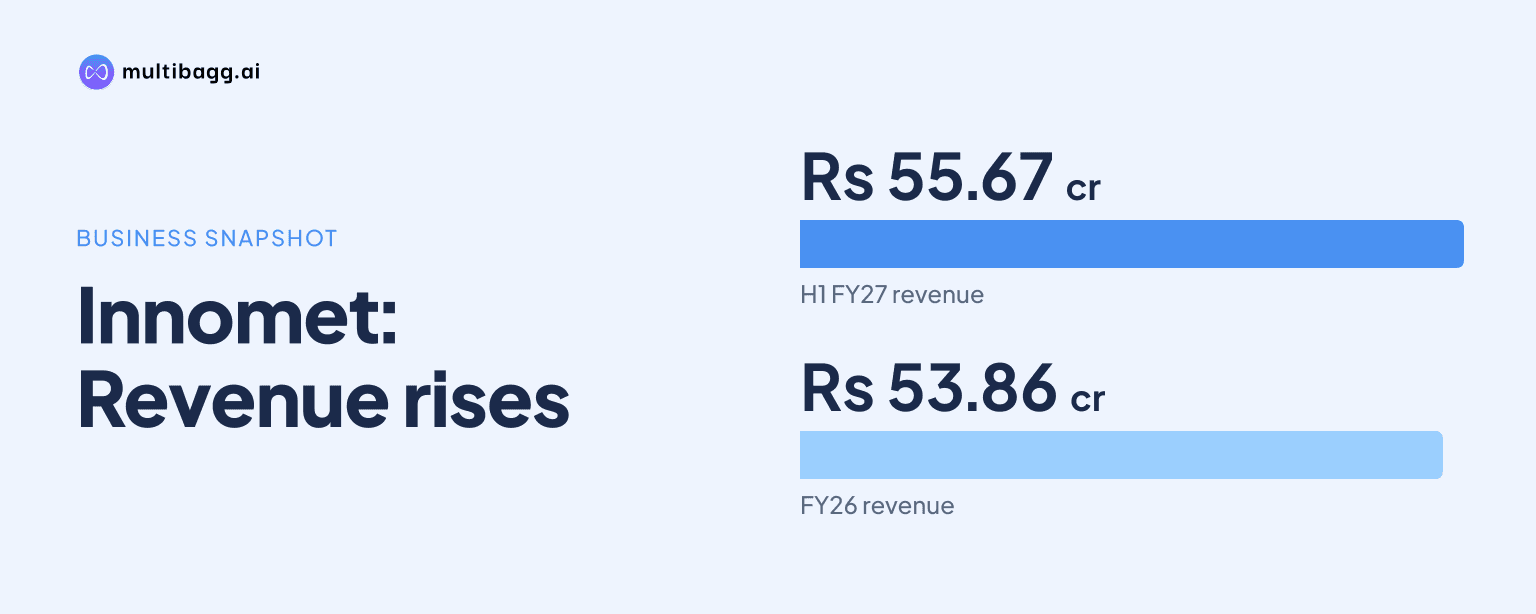
Innomet Advanced Materials Limited reported H1 FY27 revenue from operations of Rs 55.67 crore, up 137% from Rs 23.53 crore in H1 FY26 and above its full-year FY26 revenue of Rs 53.86 crore. The increase was led by tungsten heavy alloy (THA) sales, which rose six-fold to Rs 17.6 crore, while exports reached 46.4% of revenue.
Know Innomet Advanced Materials inside out
Results, valuation, peers and who's buying, in one view.
What drove Innomet’s H1 FY27 revenue growth?
Innomet’s H1 FY27 revenue growth was driven by expansion in both metal powders and THA, with revenue from operations reaching Rs 55.67 crore versus Rs 23.53 crore a year earlier. The H1 FY27 result also exceeded Rs 30.33 crore in H2 FY26 and the Rs 53.86 crore reported across FY26.
Metal powders remained the larger segment at Rs 38.1 crore in H1 FY27, up 116% from Rs 17.7 crore in H1 FY26. Management attributed the increase to a 39% rise in powder volume to 256 tonnes from 184 tonnes, a 55% increase in realisation to Rs 1,487 per kg from Rs 959 per kg, and 18 new powder customers during the half year.
The H1 FY27 numbers are consolidated and include Swastik Tungsten, while the earlier periods are standalone. Management said Swastik was consolidated from September 2026 and added only a few days to the H1 period, following the acquisition’s completion and pollution and power clearances.
How did Innomet’s profit and margins change?
Innomet’s profit after tax rose 136% to Rs 4.75 crore in H1 FY27 from Rs 2.02 crore in H1 FY26, while basic earnings per share increased to Rs 3.64 from Rs 1.56. The H1 FY27 profit was also above the Rs 1.57 crore reported for FY26, after a loss of Rs 44 lakh in H2 FY26.
Earnings before interest, tax, depreciation and amortisation (EBITDA) increased 93% to Rs 8.24 crore from Rs 4.26 crore. EBITDA margin declined to 14.8% from 18.1% in H1 FY26, but recovered from 4.4% in H2 FY26; management cited higher tungsten costs and higher marketing and exhibition expenditure for the year-on-year margin change.
Gross margin was 30.1% in H1 FY27, below 34.5% in H1 FY26 but above 25.6% in H2 FY26. Finance cost rose to Rs 55 lakh from Rs 36 lakh and depreciation increased to Rs 1.49 crore from Rs 1.28 crore, while EBITDA excludes other income.
How did Innomet’s sales mix change in H1 FY27?
Innomet’s sales mix shifted toward THA, whose revenue increased six-fold to Rs 17.6 crore from Rs 2.9 crore and whose share of sales rose to 32% from 14%. Metal powders still represented 68% of the H1 FY27 mix, although that was down from 86% in H1 FY26 because THA grew faster.
The presentation identifies THA cubes and balls as pre-fragments used in munitions and says Innomet is developing penetrators, targets and allied products. Management said defence has historically accounted for 30% to 40% of THA revenue and is expected to nearly double this year, while the same powder-metallurgy base supports the product families.
Inventory was Rs 33.5 crore at the end of H1 FY27, comprising raw material and semi-finished goods for THA and powder orders. The balance included about Rs 2 crore from Swastik, which management linked to order execution rather than describing as finished-goods inventory.
Got a follow-up? Ask IRIS
Why did Innomet’s export share rise to 46.4%?
Innomet’s export revenue rose more than seven-fold to Rs 25.9 crore in H1 FY27 from Rs 3.6 crore in H1 FY26, lifting exports to 46.4% of revenue from 15.1%. The export share had previously increased from 9.7% in FY25 to 18.3% in FY26.
THA accounted for Rs 15.3 crore of H1 FY27 exports, or 87% of THA revenue, compared with Rs 1.3 crore of THA exports in FY26. Metal-powder exports were Rs 10.6 crore, or 28% of powder revenue, and exceeded the Rs 8.5 crore recorded in all of FY26.
Management cited global defence restocking, an exclusive representative in the United States and demand for alternatives to Chinese supply as export factors. Innomet listed the United States, Israel, Australia, the Netherlands, Switzerland, New Zealand and Japan as markets, and stated that its exports are ex-works, meaning tariffs fall on the buyer.
What does Swastik Tungsten add to Innomet’s plan?
Swastik Tungsten adds an in-house source of tungsten powder to Innomet’s THA supply chain after Innomet acquired a 57.5% stake for Rs 1.5 crore through the National Company Law Tribunal process. The operation restarted at 2 to 3 tonnes a month and management plans to scale it to 10 tonnes a month, or 120 tonnes per annum, by the end of FY27.
Swastik processes tungsten carbide scrap into ammonium paratungstate and then tungsten metal powder with stated purity of at least 99.95%. Management said captive powder can support THA order execution as China, which it says mines about 79% of global tungsten, has restricted exports since February 2025 and tungsten prices have risen 4.7 times.
The presentation also identifies carbide powder, ready-to-press powder and carbide components as a new vertical described as more than five times the THA market. Innomet said it is acquiring a production-scale spark plasma sintering furnace from Germany and developing tungsten hexafluoride and 5N pure tungsten, without providing revenue or completion estimates.
Conclusion
Innomet’s H1 FY27 result combined growth in both product lines with a faster rise in THA and exports. Revenue of Rs 55.67 crore exceeded FY26 revenue within six months, while profit after tax reached Rs 4.75 crore despite year-on-year declines in gross and EBITDA margins linked by management to tungsten costs and commercial spending.
The next disclosed measures are the Rs 36.7 crore order book reported on 1 October 2026, Swastik’s planned scale-up to 10 tonnes a month by the end of FY27, and management’s view that Rs 100 crore revenue is within reach in FY27. Execution of the order book, the THA and export mix, and tungsten-cost movements are the stated factors to watch.