










Kay Cee defers Plant III commercial launch to FY28 on costs
Key highlights
- Kay Cee expects Plant III commercial-production readiness in FY 2027-28, replacing an earlier Fiscal 2027 expectation.
- H1 FY27 total income rose 59.92% year on year to Rs 134.36 crore.
- H1 FY27 PAT rose 83.76% year on year to Rs 16.87 crore.
- Kay Cee’s unexecuted order book was Rs 377.63 crore as of 30 September 2026.
powered by IRIS
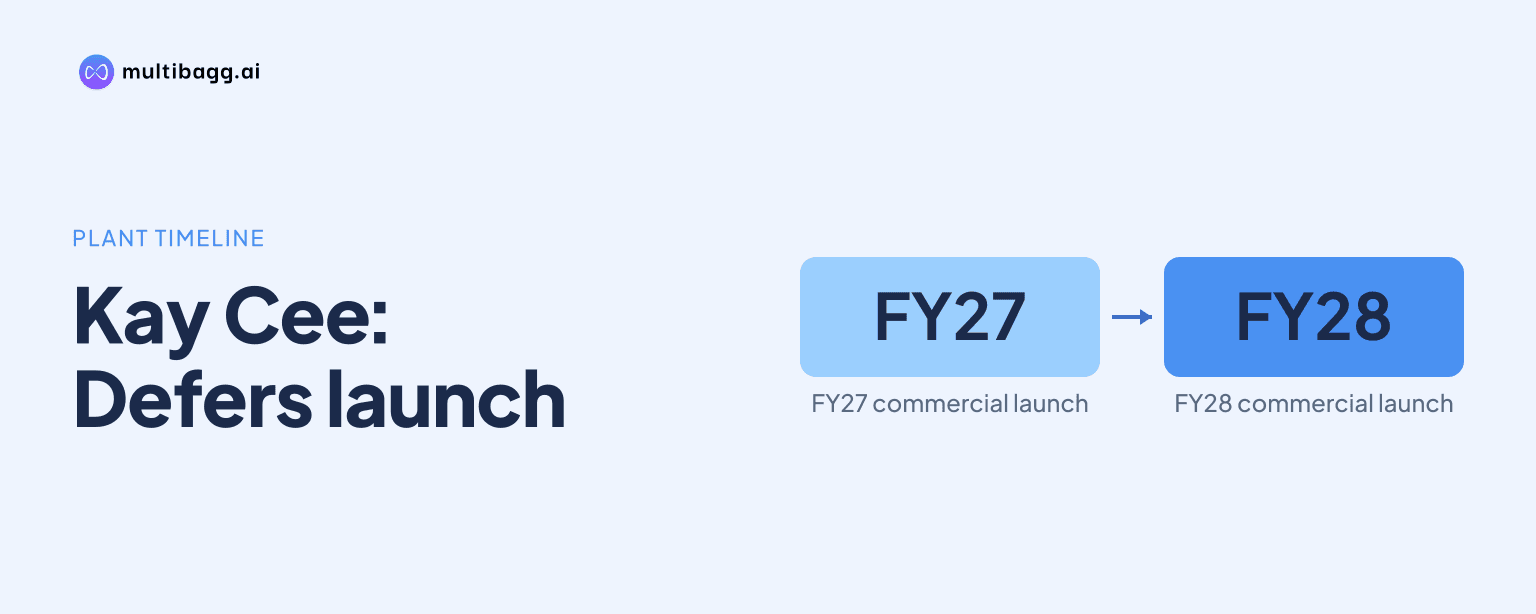
Kay Cee Energy & Infra Limited has deferred Plant III’s commercial-production readiness to FY 2027-28 from an earlier Fiscal 2027 expectation, citing rising raw-material costs amid the ongoing war and market conditions. The change comes as H1 FY27 total income increased 59.92% year on year to Rs 134.36 crore.
Know Kay Cee Energy & Infra inside out
Results, valuation, peers and who's buying, in one view.
Why did Kay Cee defer Plant III?
Kay Cee deferred Plant III because management said an unprecedented surge in raw-material prices following the ongoing war required it to reassess its manufacturing plans. The B-16, IPIA, Kota-5, Rajasthan facility is now expected to be ready for commercial production in FY 2027-28, rather than the Fiscal 2027 timetable previously stated for the proposed manufacturing unit.
The presentation does not quantify the capital expenditure, revised construction cost or increase in any raw-material category behind the decision. Management instead linked the revision to prevailing cost dynamics and market conditions. Plant III was purchased in 2021 and remains under construction, while Plant II at G-249, Kota-5 was purchased in 2018 and has operational office premises.
The timing change defers, rather than cancels, the stated backward-integration plan. Kay Cee said Plant III is intended to manufacture hardware, connectors up to 765 kilovolt (kV), bird diverters, substation structures and electrical panels for its engineering, procurement and construction (EPC) projects and potential third-party sales.
What was Plant III expected to add to Kay Cee’s business?
Plant III is intended to make Kay Cee a more integrated supplier of materials used in its EPC work, with output now planned for FY 2027-28. The proposed Kota-5 product range includes hardware, connectors up to 765 kV, bird diverters, substation structures and electrical panels.
Kay Cee said in-house production is intended to reduce the time and cost associated with material procurement. It also identified sales of manufactured items to third-party contractors and public-sector units as a potential new revenue stream. These remain management’s stated objectives rather than reported manufacturing revenue because Plant III was under construction in the H1 FY27 presentation.
The company placed the capacity plan alongside railway-related service diversification, including substation automation, long-distance underground and monopole transmission, and the installation of overhead lines or underground cables across railway tracks. Kay Cee’s present EPC offering covers overhead and underground transmission lines, extra-high-voltage substations and emergency restoration systems, including substation services up to 400 kV and line work up to 765 kV.
Got a follow-up? Ask IRIS
How did Kay Cee perform before the manufacturing delay?
Kay Cee reported higher income and profit in H1 FY27 even as it deferred Plant III. Total income increased 59.92% to Rs 134.36 crore from Rs 84.02 crore in H1 FY26, while profit after tax (PAT) increased 83.76% to Rs 16.87 crore from Rs 9.18 crore.
Raw-material expenditure rose to Rs 71.07 crore in H1 FY27 from Rs 41.45 crore a year earlier, alongside the revenue increase to Rs 133.89 crore. EBITDA rose 68.77% to Rs 27.17 crore, and the EBITDA margin increased to 20.22% from 19.16%.
PAT margin increased by 1.62 percentage points to 12.55% in H1 FY27 from 10.93% in H1 FY26. Finance costs increased to Rs 4.43 crore from Rs 3.66 crore, while profit before tax rose 83.59% to Rs 22.63 crore. Management attributed the margin movement to pricing power and optimisation of employee and finance costs, while separately citing raw-material costs for the manufacturing deferral.
What supports Kay Cee’s revenue pipeline after the delay?
Kay Cee reported an unexecuted order book of Rs 377.63 crore as of 30 September 2026, which is the disclosed base for EPC execution while Plant III remains under construction. Rajasthan Rajya Vidyut Prasaran Nigam Limited accounted for Rs 329.05 crore, the largest balance among the listed customers.
Other disclosed order-book balances included Rs 12.89 crore from Power Grid Corporation of India Limited, Rs 8.75 crore from Railway-Palakkad Division and Rs 6.29 crore from the National Highways Authority of India. These orders relate to transmission, utility and railway work rather than manufacturing sales planned from Plant III.
Kay Cee also listed recently announced orders totalling Rs 77.31 crore, including goods and services tax (GST). The two largest were a Rs 21.84 crore maintenance order across Bhilwara, Chittorgarh and Udaipur circles and a Rs 17.15 crore order for 220 kV and 132 kV substations and transmission lines in Jaipur Rural Circle.
Management said it is pursuing FY27 growth targets while seeking to maintain EBITDA and PAT levels, and is expanding into Maharashtra, Uttar Pradesh, West Bengal and Bihar. The presentation does not give a revenue target, order-book conversion timetable or specific commissioning date within FY 2027-28 for Plant III, leaving the precise start of production unresolved.
Conclusion
The Plant III deferral changes the timing of Kay Cee’s planned backward integration, not the stated scope of the facility. The company continues to identify EPC material supply and third-party sales as intended uses for the unit, while H1 FY27 EBITDA reached Rs 27.17 crore and the unexecuted order book stood at Rs 377.63 crore on 30 September 2026.
The next disclosed milestone is Plant III’s expected commercial-production readiness in FY 2027-28. Investors can watch for a more specific commissioning date, updated manufacturing economics and any reported revenue from hardware, connectors, bird diverters, structures or electrical panels, alongside management’s FY27 aim of maintaining EBITDA and PAT levels.