










Madhusudan Masala Limited targets 35% CAGR through distribution expansion
Key highlights
- Madhusudan Masala expects approximately 35% CAGR over the next 3 to 5 years.
- Madhusudan Masala reports about 35% market share in Saurashtra versus about 5% across Gujarat.
- Madhusudan Masala has more than 6,800 wholesalers and 50,000 retailers.
- Sanosara Phase 1 is designed to add 6,000 MT of annual capacity, subject to government approvals.
powered by IRIS
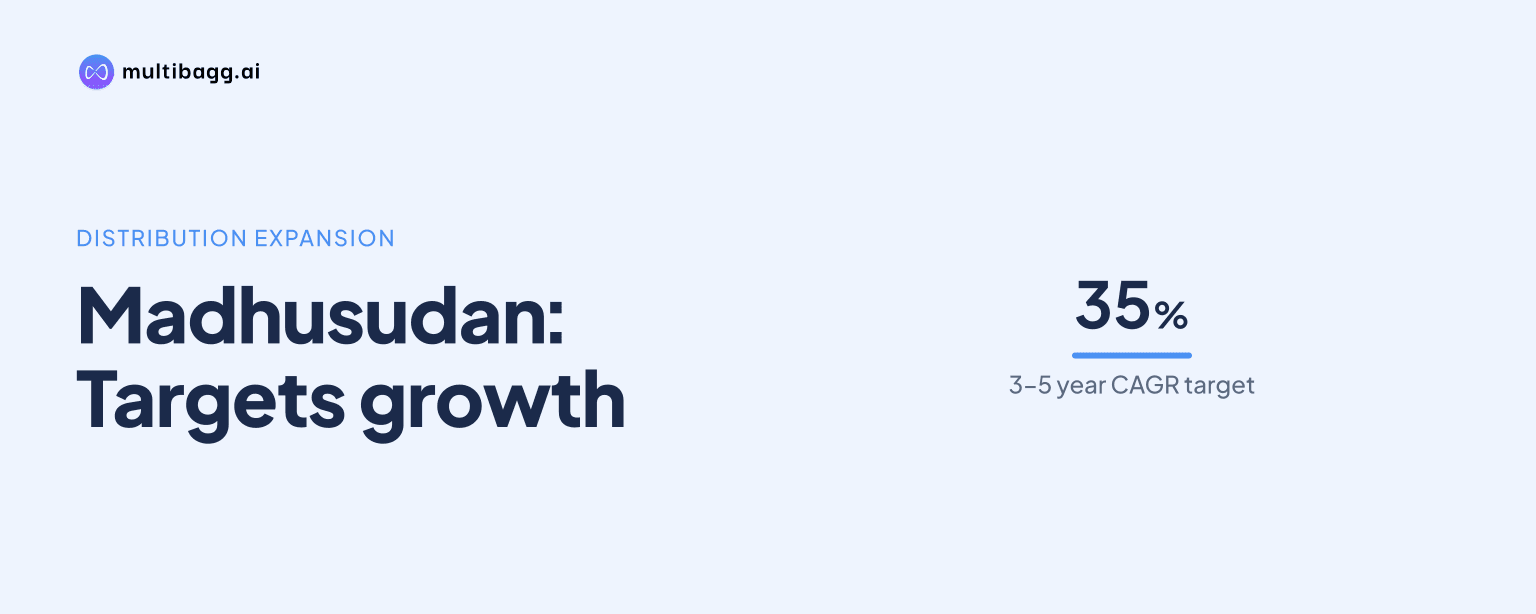
Madhusudan Masala targets an approximately 35% compound annual growth rate (CAGR) over the next three to five years by extending distribution beyond Gujarat, where it reports about 35% market share in Saurashtra but about 5% statewide. The plan includes Maharashtra, Goa, Telangana and northern markets, supported by more than 6,800 wholesalers and 50,000 retailers.
Know Madhusudan Masala inside out
Results, valuation, peers and who's buying, in one view.
What growth target has Madhusudan Masala set?
Madhusudan Masala expects approximately 35% CAGR over the next three to five years. Its presentation links the target to reinforcing Saurashtra and other Gujarat markets, expanding in Maharashtra, Goa and Telangana, developing northern states further, and building a pan-India distribution network.
The 35% figure is an expected CAGR, not reported growth or a target tied in the presentation to a disclosed revenue base. Madhusudan Masala places itself between stage 2, distribution expansion, and stage 3, brand premiumisation, in a four-stage path that begins with regional dominance and ends with a pan-India network.
The company also intends to raise the share of branded spices and food products in revenue. Its stated route includes continuous research and development, new and region-specific products, and a universal C-T-C blend intended to appeal across Indian regions; the presentation does not quantify revenue expected from these initiatives.
Where is Madhusudan Masala expanding beyond Gujarat?
Madhusudan Masala is prioritising Maharashtra, Goa and Telangana outside Gujarat, while planning further expansion in Chandigarh, Haryana, Uttar Pradesh, Bihar, Jammu and Kashmir, and Jharkhand. It lists operating regions across 14 states and territories, including Gujarat, Maharashtra, Telangana, Delhi, Punjab and Rajasthan.
Its reported market shares show a substantial difference between its core territory and the wider state. Madhusudan Masala has about 35% share in Saurashtra, described as western Gujarat, compared with about 5% in Gujarat overall, making further Gujarat coverage part of the stated expansion opportunity.
Maharashtra is identified as a significant opportunity, particularly beyond Mumbai suburban areas, because the company describes it as large and diverse. In northern India, Madhusudan Masala has appointed an exclusive super stockist in Chandigarh to manage the region using the distributor’s expertise and relationships.
How will Madhusudan Masala build its pan-India network?
Madhusudan Masala plans to build its pan-India network through its 6,800-plus wholesalers and 50,000-plus retailers, new sales channels in Telangana and Goa, and deeper northern coverage. The company says it already has sales presence in Chandigarh, Punjab, Haryana, Rajasthan, Uttar Pradesh, Bihar, Jharkhand, Delhi and Jammu and Kashmir.
The distribution plan is paired with product expansion. Madhusudan Masala offers ground spices, blended spices and essential grocery products, and it plans region-specific offerings alongside the proposed universal C-T-C blend to address consumer preferences in new markets.
The acquisition of Vitagreen Products and the 77 GREEN brand is presented as another category-expansion mechanism, adding organic and blended-spice presence. Management’s stated strategy is to expand stock-keeping units, widen wallet share, scale distribution for volume and build brands to support margins, without disclosing the expected contribution of each lever.
Brands named in the presentation include DOUBLE HAATHI, MAHARAJA and MANTAVYA. Madhusudan Masala says it aims to increase branded spices and food products as a larger revenue share while strengthening brand visibility, an objective that depends on outlet reach and consumer acceptance in each new region.
Got a follow-up? Ask IRIS
Does Madhusudan Masala have capacity for wider distribution?
Madhusudan Masala has 7,200 metric tonnes (MT) of manufacturing capacity at Unit 1 in Jamnagar, which reported 99% capacity utilisation in Q2FY27, and its Sanosara Phase 1 project is designed to add 6,000 MT annually. The additional capacity is relevant to the company’s plan to serve distribution outside its established Gujarat base.
Unit 1 has 4,029 MT of on-site cold storage and added 1,200 MT of in-house whole-spice cleaning and packing capability. Madhusudan Masala says bringing this work in-house, after it was previously outsourced, supports process control, product availability and faster supply response.
The 200,000-square-foot Sanosara facility had civil and pre-engineered building work, machine installation, electrification, outer roads and staff quarters each reported as 100% complete. However, it was awaiting government approvals to start operations, making those approvals a disclosed dependency for the 6,000 MT Phase 1 addition.
What will determine whether Madhusudan Masala reaches 35% CAGR?
Madhusudan Masala’s approximately 35% CAGR expectation depends on deepening its 14-region footprint, increasing branded-product sales and commencing operations at the 6,000 MT Sanosara Phase 1 facility. The presentation identifies the ability to scale distribution and strengthen brand recall as a key monitorable for its positioning.
The company’s reported 35% Saurashtra share versus 5% Gujarat-wide share illustrates the difference between regional depth and broader state coverage. Its plan is to extend coverage within Gujarat while establishing distribution in Maharashtra, Goa and Telangana, where channel development and region-specific products are planned.
Management says margin expansion could be supported by a richer blended-masala mix, operational scale-up and branded-sales growth. These are stated strategic drivers rather than reported outcomes, and the presentation gives no state-level market-share targets, segment revenue figures or timetable for each market beyond the three-to-five-year CAGR period.
Conclusion
Madhusudan Masala’s plan combines an approximately 35% CAGR expectation with a defined distribution base of more than 6,800 wholesalers and 50,000 retailers. Its expansion strategy addresses the gap between its approximately 35% Saurashtra share and approximately 5% Gujarat-wide share, while seeking new coverage in western, southern and northern markets.
The next disclosed operating milestone is government approval for Sanosara Phase 1, which is designed to add 6,000 MT of annual capacity after construction and installation were reported complete. Management’s plan also makes progress in Maharashtra beyond Mumbai suburban areas, Goa, Telangana and the Chandigarh super-stockist model relevant indicators of distribution execution.