










Madhusudan Masala capacity can rise 69% after government approval
Key highlights
- Madhusudan Masala reported 7,800 MT of consolidated manufacturing capacity in Q2 FY27.
- Madhusudan Masala’s 7,200-MT Jamnagar Unit 1 operated at 99% utilisation in Q2 FY27.
- The completed Sanosara Phase 1 project can add 6,000 MT and lift consolidated capacity to 13,200 MT.
- Madhusudan Masala increased its main facility’s capacity from 6,000 MT to 7,200 MT in Q1 FY27.
powered by IRIS
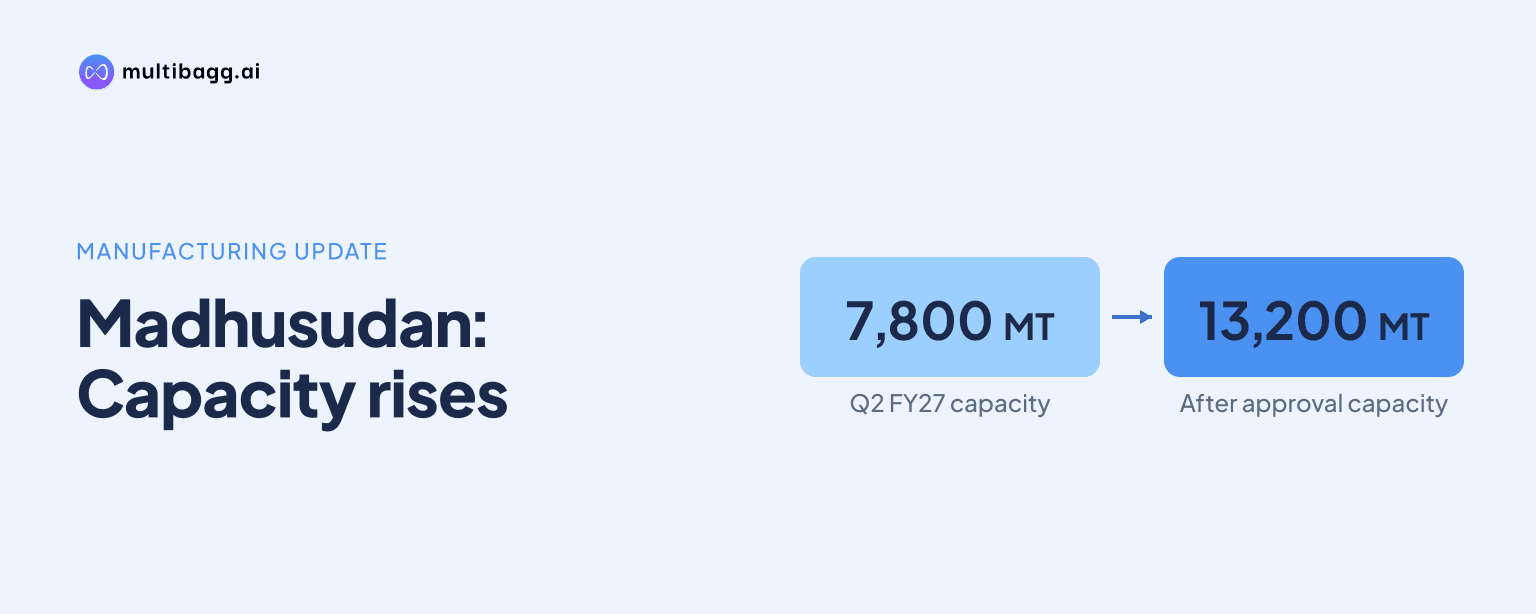
Madhusudan Masala Limited reported 7,800 MT of consolidated manufacturing capacity in Q2 FY27, and this can rise about 69% to 13,200 MT once government approvals allow its completed 6,000-MT Sanosara plant to begin operations. Madhusudan Masala’s 7,200-MT Jamnagar Unit 1 operated at 99% capacity utilisation in the quarter.
Know Madhusudan Masala inside out
Results, valuation, peers and who's buying, in one view.
What is Madhusudan Masala’s manufacturing capacity today?
Madhusudan Masala reported current consolidated manufacturing capacity of 7,800 MT in Q2 FY27. The presentation splits this total between 7,200 MT at Madhusudan Masala and 600 MT at Double Seven Green, while showing the 6,000-MT Sanosara Phase 1 addition separately because it awaits approval to operate.
Madhusudan Masala increased its principal facility’s capacity by 20% in Q1 FY27, taking it from 6,000 MT to 7,200 MT. The 1,200-MT addition brought whole-spice cleaning and packing in-house, replacing outsourced activity; the presentation says this supports process control, product availability and faster supply response, but it does not disclose output or sales from the addition.
Why is Madhusudan Masala adding capacity at Sanosara?
The presentation does not specify one stated reason for the Sanosara project, but Madhusudan Masala’s 7,200-MT Unit 1 in Jamnagar recorded 99% utilisation in Q2 FY27. That reported utilisation level leaves limited unused capacity at the company’s main existing unit while the Phase 1 project would add 6,000 MT of annual manufacturing capacity.
Madhusudan Masala’s Jamnagar facility occupies 1 lakh square feet and has 4,029 MT of on-site cold-storage capacity. The company says this storage eliminates dependence on rented facilities, while the plant’s location near the Agricultural Produce Market Committee, or APMC, in Jamnagar provides access to raw materials.
Madhusudan Masala processes ground spices, blended spices, whole spices and grocery products. Its ground-spice packaging ranges from 10 grams to 20 kilograms, while blended spices are available from Rs 5 and Rs 10 packs to 1-kilogram jars, indicating that the manufacturing base serves multiple product types and pack sizes.
What is the status of Madhusudan Masala’s Sanosara plant?
Madhusudan Masala’s Sanosara greenfield project has completed construction and is awaiting government approvals before operations can start. Phase 1 is designed to add 6,000 MT of annual capacity, and the presentation shows civil and pre-engineered building work, machine installation, electrification, outer roads and staff quarters as 100% complete.
The facility is located at Sanosara on the Rajkot-Jamnagar Highway in Gujarat and covers 2 lakh square feet. Madhusudan Masala describes a two-phase expansion plan, although it discloses capacity only for the 6,000-MT Phase 1 addition and provides neither an approval timetable nor a capacity figure for the second phase.
The project is designed with cleaning, cold-air processing and cryogenic grinding technology, according to the presentation. Madhusudan Masala says an experienced technical partner is supporting turnkey implementation, and the facility is designed to meet food-safety norms for spices and related products.
Got a follow-up? Ask IRIS
What changed at Madhusudan Masala’s Rajkot unit in Q2 FY27?
Madhusudan Masala shifted its 600-MT Unit 2 from Rajkot to the new Sanosara plant during Q2 FY27, and the unit was not operational at the quarter-end. The company processed two months of semi-finished goods, or SFG, ahead of the move as planned, while Unit 1 handled the remaining work during the transition.
The Rajkot unit occupied 50,000 square feet, including administration-office and plant-building space. Madhusudan Masala lists grinding and pulverising machines, flour-mixing machines, automatic and semi-automatic packing equipment, an in-house research and development function, and a modern laboratory at the facility.
The presentation continues to include the 600-MT Unit 2 capacity in its 7,800-MT Q2 FY27 consolidated capacity figure. However, it does not state whether the unit resumed operations at Sanosara after the quarter-end, so its operating status beyond Q2 FY27 is not disclosed.
How large is Madhusudan Masala’s planned capacity increase?
Madhusudan Masala’s 6,000-MT Phase 1 addition would increase stated consolidated capacity from 7,800 MT to 13,200 MT, or about 69%. The post-expansion figure combines the existing 7,200-MT Madhusudan Masala capacity, 600 MT at Double Seven Green and the planned Sanosara capacity.
The increase is a measure of installed capacity rather than reported production, sales or revenue growth. Madhusudan Masala has not disclosed a production ramp-up schedule, utilisation target, capital cost, or expected revenue contribution for the 6,000-MT project.
Madhusudan Masala’s existing process includes drying, cleaning, grinding, blending, sieving and packing. Its presentation describes cleaning with air jets, vibratory sieves or manual sorting, followed by machine grinding and automated filling into bottles, bags or cans, whereas Sanosara adds cold-air processing and cryogenic grinding to the planned production base.
Conclusion
Madhusudan Masala expanded its main facility from 6,000 MT to 7,200 MT in Q1 FY27 and reported 99% utilisation there in Q2 FY27. Together with the 600-MT Double Seven Green capacity, this produced a stated 7,800-MT consolidated base, while the completed 6,000-MT Sanosara Phase 1 project would lift the total to 13,200 MT once it can operate.
The next disclosed milestone is government approval to start Sanosara operations. Readers can watch for confirmation that the 600-MT Unit 2 transition has been completed, operating and utilisation details for the new plant, and further disclosure on the second phase, for which Madhusudan Masala has not provided a capacity figure or timeline.