










MMP powders are 65% of revenue as exports hit unprecedented Q2 scale
Key highlights
- MMP aluminium powders contributed approximately 65% of total revenue in H1FY27.
- MMP powders revenue was Rs 315 crore in H1FY27, following Rs 504 crore in FY26.
- MMP had 29,100 metric tonnes of aluminium powder capacity in September 2026.
- AAC blocks and explosives represented 36% and 31%, respectively, of FY26 powders revenue.
powered by IRIS
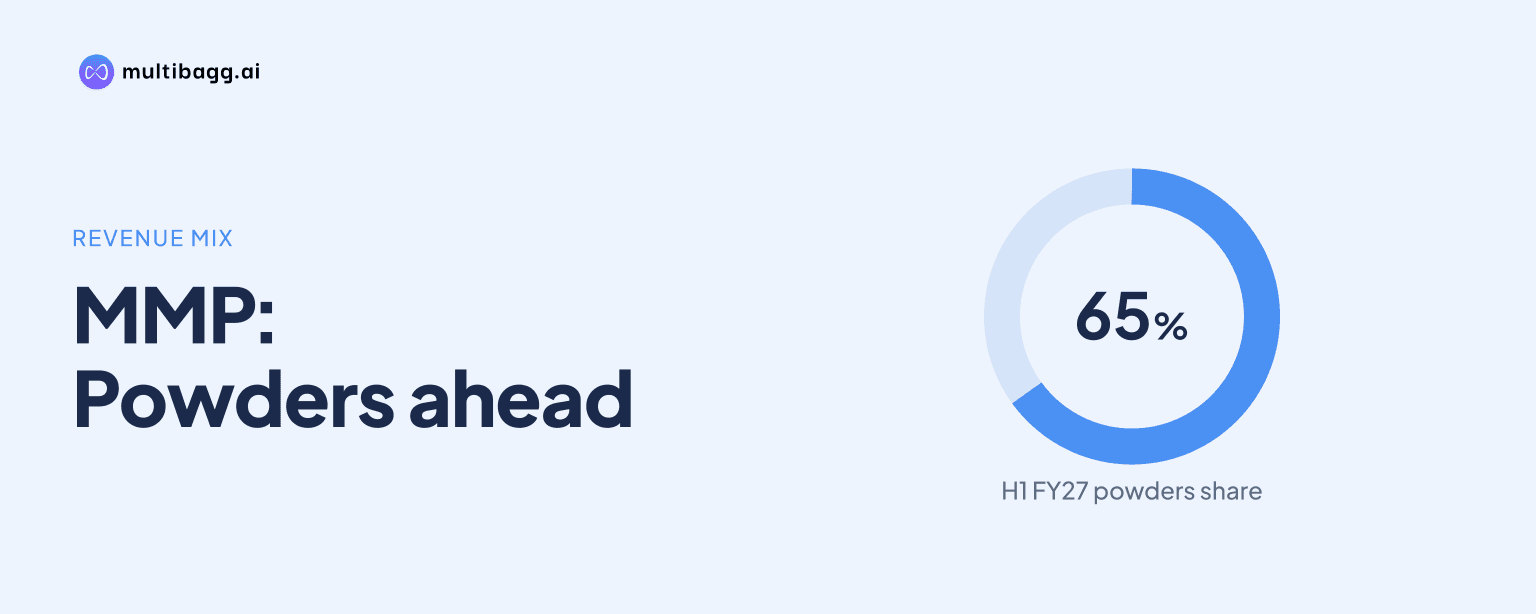
MMP’s aluminium powders business contributed about 65% of total revenue in H1FY27, with unprecedented-scale export order execution in Q2FY27 supporting the segment alongside domestic demand, higher plant utilisation and 29,100 metric tonnes of powder capacity as of September 2026. Management expects export momentum to strengthen in H2FY27.
Know MMP Industries inside out
Results, valuation, peers and who's buying, in one view.
Why do MMP aluminium powders account for 65% of revenue?
MMP aluminium powders accounted for approximately 65% of total revenue in H1FY27, making powders the largest disclosed business line by revenue contribution. Aluminium foils contributed about 28% and conductors and cables about 7% in the same period, placing the powders segment ahead of the other two divisions combined by roughly 30 percentage points.
The segment makes atomised, pyro and flake, and leafing aluminium powders from 99.7% purity aluminium ingots through atomisation and milling. Its end uses include autoclaved aerated concrete, or AAC, blocks, explosives, agrochemicals and pyrotechnics, linking the 65% revenue contribution to construction, mining, agricultural-chemical and specialised industrial applications.
MMP reported powders revenue of Rs 315 crore in H1FY27, compared with Rs 504 crore for the full FY26. The H1FY27 figure is a partial-year result, while the FY26 figure covers 12 months.
How did exports support MMP powders in Q2FY27?
MMP executed export orders at an unprecedented scale during Q2FY27, according to management, and said this activity supported powders performance together with healthy domestic demand and improved plant utilisation. The presentation does not disclose export revenue, volumes, countries or customer concentration, so the export contribution cannot be quantified from the supplied material.
Management expects the export momentum seen in Q2FY27 to strengthen further in H2FY27. This is a forward-looking management expectation rather than reported revenue.
The reported segment revenue trend provides context for the export statement. Powders revenue increased from Rs 438 crore in FY25 to Rs 504 crore in FY26, a rise of Rs 66 crore, while H1FY27 revenue reached Rs 315 crore. The presentation attributes current performance to domestic demand, exports and utilisation, rather than assigning a separate amount to any one driver.
Which powder markets generate MMP revenue?
AAC blocks were MMP powders’ largest disclosed application market in FY26, accounting for 36% of segment revenue, followed by explosives at 31%. Together, these two markets represented 67% of FY26 powders revenue, making construction-related AAC blocks and mining-related explosives the largest stated demand outlets.
AAC-block customers use tailored powders to generate hydrogen gas bubbles in block production, while flake powders act as sensitizers in explosives across varying pH environments. The remaining 33% of FY26 powders revenue was spread among pesticides, atomised powder, pyrotechnics and leafing powder, with no one of these applications exceeding 13%.
Pesticides accounted for 13% of FY26 powders revenue, where coarse flake powder is used in aluminium phosphide for grain-storage fumigation. Atomised powder represented 12%, and MMP describes it as high-purity material ranging from granular to superfine forms customised for varied uses; pyro and leafing powder each contributed 4%.
Got a follow-up? Ask IRIS
How much has MMP expanded powder capacity since FY18?
MMP increased total disclosed powder capacity from 15,000 metric tonnes in March 2018 to 29,100 metric tonnes in September 2026, an increase of 14,100 metric tonnes. The expansion was led by pyro and flake capacity, which grew from 7,800 metric tonnes to 16,800 metric tonnes, while atomised capacity rose from 7,200 metric tonnes to 12,000 metric tonnes.
Pyro and flake capacity increased in several stages, from 9,600 metric tonnes in March 2020 to 11,000 metric tonnes in March 2023, 12,500 metric tonnes in March 2024, 16,100 metric tonnes in March 2025 and 16,800 metric tonnes in March 2026. Atomised capacity reached 12,000 metric tonnes in March 2020 and remained at that level through September 2026.
MMP also added 300 metric tonnes of leafing powder and paste capacity by March 2022, which remained unchanged through September 2026. The September 2026 capacity base comprised 12,000 metric tonnes of atomised powder, 16,800 metric tonnes of pyro and flakes, and 300 metric tonnes of leafing capacity, with no further powder expansion listed in the Q2FY27 capacity table.
What is MMP doing to improve powder realisations and margins?
MMP is focusing on higher-value-added products, an optimised product mix and economies of scale to support improved realisations and margins in aluminium powders. This is management’s stated operating approach; the presentation does not provide a powders margin percentage, average selling price or product-level profitability figure for H1FY27.
The FY26 powders business generated Rs 504 crore, Rs 327 crore above the Rs 177 crore reported in FY18. Capacity rose over that broad period from 15,000 metric tonnes in March 2018 to 29,100 metric tonnes in September 2026, while management cited plant utilisation as one support for H1FY27 performance.
MMP operates four manufacturing units on 110 acres around Nagpur, Maharashtra, from a 150-acre land bank. Unit I at Maregaon and Unit II at Hingna manufacture aluminium powders, while Unit III at Umred produces aluminium powders and foils, giving the powders segment production capacity across three disclosed facilities.
Conclusion
MMP powders are the company’s principal disclosed revenue engine, contributing about 65% of H1FY27 total revenue and generating Rs 315 crore in the first half. The segment combines a 29,100-metric-tonne September 2026 capacity base with exposure to AAC blocks, explosives, pesticides and other applications, while FY26 revenue reached Rs 504 crore.
The next disclosed marker is whether management’s expectation of stronger export momentum in H2FY27 follows the unprecedented Q2FY27 export execution. Readers can also watch whether the stated emphasis on higher-value-added products, mix optimisation and economies of scale is reflected in future disclosures on powders realisations, margins or revenue.