










Madhusudan Masala Limited H1 revenue gains 66% as brands held 70%
Key highlights
- Madhusudan Masala's consolidated H1 FY27 revenue rose 65.8% to Rs 195.95 crore.
- Madhusudan Masala's H1 FY27 reported net profit increased 68.7% to Rs 12.92 crore.
- Branded products contributed 70% of Madhusudan Masala's H1 FY27 revenue, versus 47% in FY23.
- Madhusudan Masala reported H1 FY27 sales volume of 15,902 MT, including 9,348 MT of branded products.
powered by IRIS
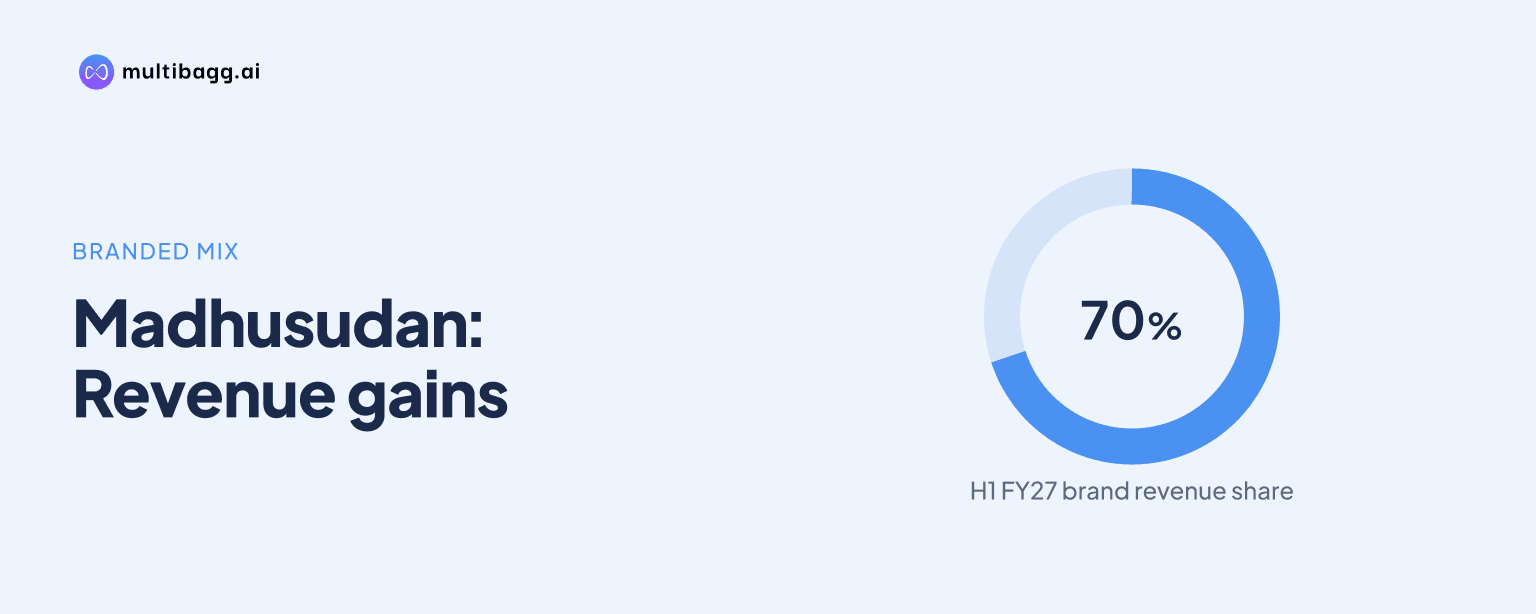
Madhusudan Masala increased consolidated H1 FY27 revenue by 65.8% year on year to Rs 195.95 crore and reported net profit growth of 68.7% to Rs 12.92 crore, while branded products accounted for 70% of turnover. The branded share was unchanged from FY26 but 23 percentage points above the 47% reported in FY23.
Know Madhusudan Masala inside out
Results, valuation, peers and who's buying, in one view.
What drove Madhusudan Masala's H1 FY27 revenue growth?
Madhusudan Masala's consolidated revenue from operations rose to Rs 195.95 crore in H1 FY27 from Rs 118.22 crore in H1 FY26, representing 65.8% year-on-year growth. Q2 FY27 revenue was Rs 97.67 crore, up 116.4% from Rs 45.13 crore in Q2 FY26, but marginally below Rs 98.28 crore in Q1 FY27.
The H1 FY27 revenue figure was about 67% of FY26 revenue of Rs 291.70 crore, according to the presentation. Revenue came from 11 state and union territory markets: Gujarat provided 48%, Maharashtra 12%, and North and East markets together 40%, meaning markets outside Gujarat accounted for 52% of revenue.
Madhusudan Masala reported 15,902 metric tonnes, or MT, of total sales volume in H1 FY27. Branded products accounted for 9,348 MT and non-branded products for 6,554 MT, while packet sales during the half year were about 15.60 crore. The presentation states branded products generated about 70% of revenue despite representing about 59% of volume.
How did Madhusudan Masala's H1 FY27 profit and margins change?
Madhusudan Masala's reported net profit increased 68.7% to Rs 12.92 crore in H1 FY27 from Rs 7.66 crore in H1 FY26, and net profit margin rose to 6.6% from 6.5%. Profit before tax increased 68.6% to Rs 17.28 crore from Rs 10.25 crore, while reported earnings per share rose 54.8% to Rs 8.19 from Rs 5.29.
Earnings before interest, tax, depreciation and amortisation, or EBITDA, rose 55.7% to Rs 21.89 crore in H1 FY27 from Rs 14.06 crore a year earlier. EBITDA margin, however, was 11.2%, compared with 11.9% in H1 FY26. This means EBITDA grew more slowly than revenue during the half year, even as absolute operating profit increased.
In Q2 FY27, EBITDA was Rs 10.82 crore, up 65.3% from Rs 6.54 crore in Q2 FY26, but the margin declined to 11.1% from 14.5%. Total expenditure grew 125.1% year on year to Rs 86.85 crore, faster than the 116.4% increase in quarterly revenue. The presentation provides the expenditure movement but does not give a detailed explanation for the cost increase.
How important are branded products to Madhusudan Masala's sales mix?
Branded products contributed 70% of Madhusudan Masala's total revenue in H1 FY27, unchanged from FY26 and up from 47% in FY23. The non-branded share correspondingly fell to 30% from 53% over that period, representing a 23-percentage-point change in the reported revenue mix.
The shift was progressive through the periods disclosed: branded sales were 56% of total revenue in FY24 and 62% in FY25 before reaching 70% in FY26 and holding at that level in H1 FY27. The sales breakdown for FY25, FY26 and H1 FY27 is consolidated following the acquisition of Vitagreen Products Pvt. Ltd. on July 26, 2024.
Within branded revenue, ground spices represented 50% in H1 FY27, up from 44% in FY26. Whole spices declined to 25% from 33%, while grocery products rose to 18% from 16%; blended spices were 5% versus 6%, and tea remained 1%. The mix therefore moved toward ground spices and grocery products in the first half.
Got a follow-up? Ask IRIS
Which products and brands contributed to branded volume?
Grocery products were Madhusudan Masala's largest branded-volume category in H1 FY27 at 4,078 MT, followed by ground spices at 2,739 MT and whole spices at 2,252 MT. Blended spices contributed 223 MT and tea 56 MT, together reconciling to the reported branded volume of 9,348 MT.
Double Hathi was the largest brand by reported H1 FY27 volume, at 5,746 MT. 77 Green contributed 1,728 MT, Maharaja 1,311 MT and Mantavya 563 MT. The presentation connects 77 Green and blended-spice expertise with the Vitagreen acquisition in July 2024, which also added manufacturing infrastructure and an established distribution network in Northern India.
Madhusudan Masala describes its portfolio as 32 types of spices across more than 500 stock-keeping units, or SKUs, under four brands. The company also sells grocery products, instant mixes and other food products. Its stated product range spans ground, whole and blended spices, as well as tea and grocery categories reflected in the H1 FY27 revenue and volume disclosures.
What distribution and capacity changes support Madhusudan Masala's next phase?
Madhusudan Masala had more than 50,000 retailers, more than 6,800 wholesalers, more than 400 distributors and 18 super stockists as of September 2026. Before its initial public offering, or IPO, it had more than 3,700 retailers, more than 2,100 wholesalers, more than 65 distributors and no super stockists.
The presentation says the company discontinued more than 2,000 distributors and more than 50 super stockists with smaller territories in Q2 FY27. Their territories were consolidated with neighbouring partners that, according to the company, demonstrated faster payments and greater brand focus. The reported network remained present across 11 states as of September 30, 2026.
Manufacturing capacity is stated at 13,200 MT after commissioning of the new Sanosara plant, compared with an initial capacity of 6,600 MT. Madhusudan Masala added 1,200 MT at Plant 1 in Q1 FY27, while the Vitagreen acquisition added a second manufacturing facility. The presentation says Unit 1 was operating effectively at full capacity and was supplemented by outsourcing.
Conclusion
Madhusudan Masala's H1 FY27 figures show revenue growth of 65.8% and net profit growth of 68.7%, alongside a branded-revenue share that held at 70%. Ground spices increased their share of branded revenue to 50% from 44% in FY26, while grocery products were the largest branded-volume category at 4,078 MT. EBITDA margin nonetheless declined to 11.2% from 11.9% in H1 FY26.
The next disclosed operating matter is the start of a completed third facility with 6,000 MT capacity across 2 lakh square feet, which remains subject to government approval. The presentation also identifies the 13,200 MT installed capacity, the distribution network of more than 50,000 retailers and the consolidation of smaller distribution territories as factors to monitor in subsequent periods.