










Kay Cee Energy & Infra reports 84% H1 FY27 profit growth
Key highlights
- Kay Cee Energy & Infra Limited's H1 FY27 net profit rose 83.76% year on year to ₹16.87 crore.
- Total income increased 59.92% to ₹134.36 crore, while EBITDA rose 68.77% to ₹27.17 crore.
- EBITDA margin improved by 106 basis points to 20.22%, and PAT margin rose by 163 basis points to 12.55%.
- KCEIL reported a ₹377.63 crore unexecuted order book and secured ₹77.31 crore of new orders in H1 FY27.
powered by IRIS
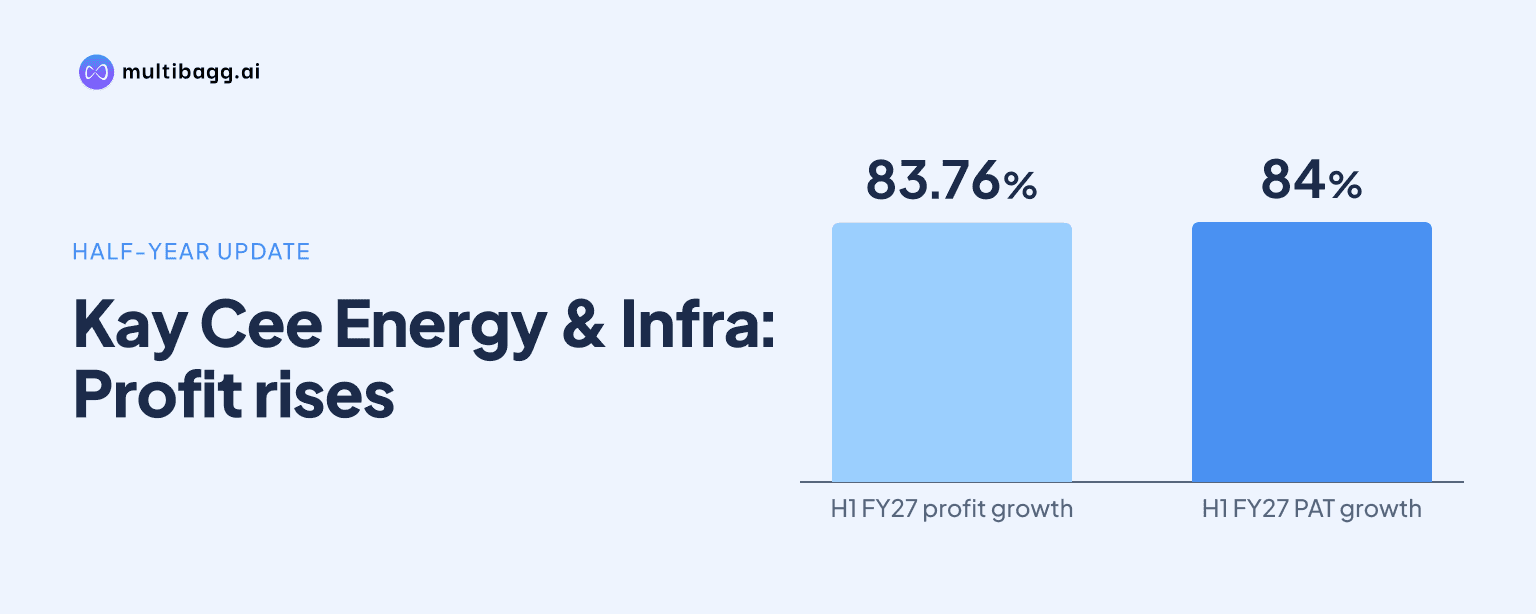
Kay Cee Energy & Infra Limited reported an 83.76% year-on-year increase in H1 FY27 net profit to ₹16.87 crore for the half year ended September 30, 2026, while total income rose 59.92% to ₹134.36 crore. The performance matters because the power transmission and distribution EPC company also widened operating and profit margins while retaining a ₹377.63 crore unexecuted order book.
Know Kay Cee Energy & Infra inside out
Results, valuation, peers and who's buying, in one view.
What did Kay Cee Energy & Infra report for H1 FY27?
Kay Cee Energy & Infra Limited, which trades as KCEIL on the NSE, announced unaudited consolidated financial results for the six months ended September 30, 2026. Net profit rose to ₹16.87 crore from ₹9.18 crore in H1 FY26, while earnings per share increased to ₹13.80 from ₹7.61.
Total income reached ₹134.36 crore, compared with ₹84.02 crore a year earlier. The company separately reported revenue from operations of ₹133.9 crore, up 60.7% year on year. The close alignment between revenue from operations and total income indicates that operations remained the principal contributor to reported income during the period.
KCEIL provides engineering, procurement and construction solutions for power transmission and distribution infrastructure. Its reported half-year figures place the focus on execution, costs and project pipeline in a segment where contract conversion and timely delivery influence financial performance.
How did KCEIL's margins change during the half year?
KCEIL's EBITDA increased 68.77% year on year to ₹27.17 crore, and its EBITDA margin improved by 106 basis points to 20.22%. In H1 FY26, EBITDA was ₹16.10 crore and the corresponding margin was 19.16%.
Profit after tax margin rose to 12.55% from 10.93%, an expansion of 163 basis points. The company attributed the margin improvement to pricing power and optimisation of employee and finance costs. These statements explain the reported margin movement, while the results do not provide a line-by-line breakup of individual cost changes.
The faster growth in EBITDA and net profit than total income resulted in higher margins. For investors, the combination of revenue growth and margin expansion is more informative than revenue growth alone, because it indicates that a greater share of income was retained at the operating and net-profit levels.
What is KCEIL's order book and tender pipeline?
KCEIL had an unexecuted order book of ₹377.63 crore, including GST, as of September 30, 2026. The company said this order book provides revenue visibility, although the reported release does not specify the expected timing of execution or revenue recognition from these projects.
The company secured new orders worth ₹77.31 crore, including GST, during H1 FY27. It also participated in tenders aggregating about ₹200 crore, including GST, across various states. Management indicated an expected conversion rate of about 40% to 50% for those tenders, which is an expectation rather than confirmed business.
The order book is substantially larger than H1 FY27 total income, underlining the importance of project execution for the company's near-term operations. However, the company has not disclosed project-wise schedules, contract margins or the timing at which tendered opportunities may convert into orders.
Got a follow-up? Ask IRIS
What expansion plans and constraints has KCEIL disclosed?
KCEIL said it plans to expand into Maharashtra, Uttar Pradesh, West Bengal and Bihar, seeking a broader national presence beyond its existing operating footprint. Managing Director Lokendra Jain linked the half-year performance to cost optimisation and strategic growth, while citing the reported improvement in income and profitability.
The company has deferred its Plant II expansion because of a surge in raw-material prices. It said it has adequate working capital and no immediate plans for equity dilution. The deferral shows that KCEIL is balancing capacity plans against input-cost conditions rather than proceeding with the expansion on the earlier timetable.
For shareholders, the absence of immediate equity dilution is relevant because it means the company has not indicated a near-term need to raise fresh equity capital. At the same time, the results announcement does not provide an updated date, investment amount or capacity detail for Plant II, leaving the eventual pace of that expansion unresolved.
Why do KCEIL's H1 FY27 results matter to investors?
KCEIL's H1 FY27 results matter because income growth of 59.92%, net-profit growth of 83.76% and margin expansion occurred alongside a ₹377.63 crore order book. Together, these figures indicate a stronger reported financial position for the half year and provide a disclosed base of work for the EPC business.
The results also highlight the operating factors investors may track: conversion of the tender pipeline, execution of confirmed orders, preservation of EBITDA and PAT margins, raw-material prices, and progress on expansion into new states. The company has disclosed no forecast for full-year revenue or profit, so the reported H1 performance should be assessed on the basis of actual future execution rather than an implied annual projection.
Conclusion
KCEIL delivered higher H1 FY27 income, EBITDA and net profit, with net profit reaching ₹16.87 crore and EBITDA margin crossing 20%. Its order book and new orders support the company's stated revenue visibility, while improved profitability was attributed to pricing and cost optimisation.
The next areas to watch are execution of the ₹377.63 crore unexecuted order book, the conversion of tenders worth about ₹200 crore, and developments in the planned expansion into Maharashtra, Uttar Pradesh, West Bengal and Bihar. Investors will also look for an updated decision on Plant II after its deferral due to raw-material price increases.