










The Phoenix Mills Limited Reports 25% Retail Consumption Growth
Key highlights
- Phoenix Mills reported Q2 FY27 retail consumption of ₹4,685 crore, up 25% year-on-year.
- Retail EBITDA rose 18% year-on-year to ₹639 crore in Q2 FY27.
- Revenue across retail, offices, hospitality and asset management increased 16% to ₹1,055 crore.
- Consolidated operating EBITDA was ₹710 crore in Q2 FY27, with a 62% EBITDA margin.
powered by IRIS
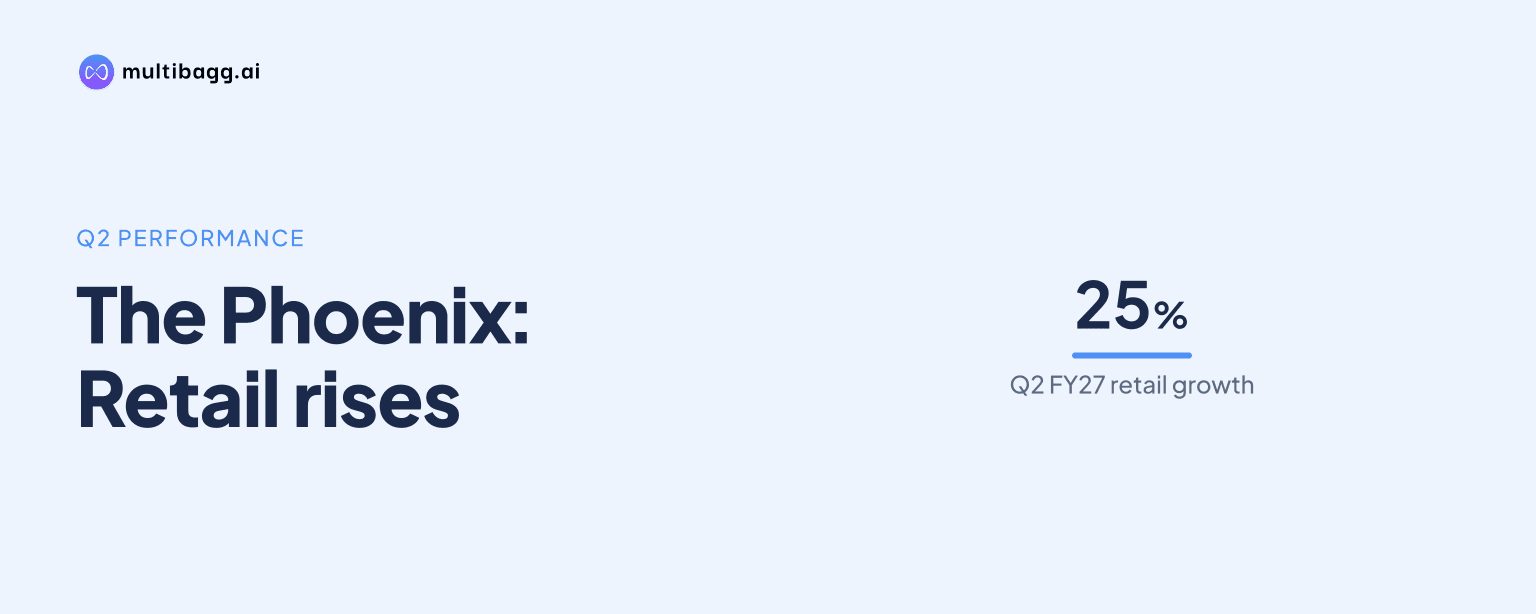
The Phoenix Mills Limited reported retail consumption of ₹4,685 crore in Q2 FY27, up 25% year-on-year, while retail EBITDA increased 18% to ₹639 crore, reflecting broad-based growth across its operating mall portfolio without additional operational retail area.
Know Phoenix Mills inside out
Results, valuation, peers and who's buying, in one view.
What did Phoenix Mills report for Q2 FY27?
Phoenix Mills reported continued operating growth across retail, offices, hospitality and asset management in the quarter ended September 30, 2026. Revenue from these businesses increased 16% year-on-year to ₹1,055 crore, while EBITDA rose 21% to ₹669 crore, according to management's Q2 and H1 FY27 earnings call.
On a consolidated basis, the company reported Q2 operating revenue of ₹1,152.8065 crore, compared with ₹1,115.4272 crore a year earlier. Consolidated operating EBITDA stood at ₹710 crore, up 7% year-on-year, and the EBITDA margin improved to 62%. Consolidated profit after tax and share of associates was ₹426.9988 crore, against ₹384.09 crore in the prior-year quarter. Management separately stated that profit after tax after minority interest was ₹326 crore for the quarter.
How did retail operations drive the quarter's performance?
Retail operations drove the quarter as consumption rose 25% year-on-year to ₹4,685 crore, with management citing double-digit growth across all malls and broad-based category performance. The company said this growth was achieved without an addition to its operational retail area, indicating higher activity from the existing portfolio.
Rental income grew 15% to ₹605 crore in Q2 FY27. Retail EBITDA rose 18% to ₹639 crore, supported by rental growth, operating leverage and cost discipline. For H1 FY27, rental income increased 16% to ₹1,200 crore, while retail EBITDA was stated at ₹1,264 crore, up 17%.
One retail business also recorded faster growth during the quarter, with consumption increasing 68% year-on-year and rental income rising 44%. Its trading occupancy reached 96%, compared with 84% a year earlier. The transcript does not identify the specific asset in the provided material, but the figures point to stronger utilisation within the operating portfolio.
What do the H1 FY27 results show?
The H1 FY27 figures show that Phoenix Mills maintained growth over the first six months of the financial year. Consolidated revenue rose 8% year-on-year to ₹2,227.7505 crore from ₹2,068.4125 crore, while operating EBITDA increased 10% to ₹1,352 crore.
Net profit after tax and associate results for H1 FY27 was ₹843.2464 crore. The reported half-year figures include the company's consolidated operations and associate contribution, while the earnings call also provided business-level figures for retail, office, hospitality and asset management. These reporting scopes explain why the separately disclosed revenue and EBITDA values are not identical.
Phoenix Mills operates retail-led mixed-use destinations, including malls, Grade-A offices, hotels and premium residential projects in India. That portfolio structure means its financial performance is influenced by consumer spending and tenant activity in malls, alongside contributions from other annuity-oriented operations.
Got a follow-up? Ask IRIS
Why do occupancy and rental growth matter to investors?
Occupancy and rental income matter because they indicate how effectively Phoenix Mills is using its existing retail assets. The reported 96% trading occupancy at one growing operation, compared with 84% a year earlier, was accompanied by 68% consumption growth and 44% rental-income growth. These data points support management's statement that operating momentum was broad-based.
The 25% increase in retail consumption was faster than the 15% rise in quarterly rental income. Retail EBITDA nevertheless rose 18%, and management attributed the outcome to rental growth, operating leverage and cost discipline. For investors, the figures show that the company generated higher retail activity without adding operational retail area during the quarter.
The company made the audio recording of its earnings call available following the October 31, 2026 results event. It also disclosed participation in a virtual investor meeting organised by BofA Securities India on November 6, 2026, under its SEBI disclosure requirements. These events provide investors with additional management communication around the reported results.
How does the Q2 performance compare across reported measures?
The Q2 performance shows growth in consumption, rental income, business-level earnings and consolidated profitability, although each metric covers a different financial scope. Retail consumption was ₹4,685 crore, while revenue across retail, offices, hospitality and asset management was ₹1,055 crore and consolidated operating revenue was ₹1,152.8065 crore.
The difference between business-level and consolidated figures is important when assessing the results. The company reported ₹669 crore of EBITDA for retail, offices, hospitality and asset management, compared with consolidated operating EBITDA of ₹710 crore. Similarly, its disclosed profit measures distinguish consolidated profit after tax and share of associates from profit after tax after minority interest.
Conclusion
Phoenix Mills delivered a Q2 FY27 performance led by higher activity at its existing malls. Retail consumption rose 25% to ₹4,685 crore, rental income increased 15% to ₹605 crore, and retail EBITDA grew 18% to ₹639 crore. Consolidated operating revenue and EBITDA also increased, though at a slower pace than the retail business measures.
Investors will next assess management commentary at the November 6, 2026 virtual investor meeting organised by BofA Securities India, along with subsequent disclosures on consumption, occupancy, rentals and the contribution of the company’s other annuity businesses.