










Phoenix Mills projects fivefold density, doubled Bangalore rent
Key highlights
- Phoenix MarketCity Bangalore’s projected trading density rises to Rs 2,932 pspm from Rs 568 pspm after stabilisation.
- Projected monthly rent at Phoenix MarketCity Bangalore increases to Rs 1.23 crore from Rs 65 lakh.
- The revised layout increases relevant GLA to 0.87 lakh square feet from 0.82 lakh square feet and replaces a hypermarket with one electronic anchor and two fashion anchors.
- PML has 8.21 million square feet, or 72% of operational retail GLA, due to expire between FY26 and FY30, with the largest expiry pool of 2.74 million square feet in FY28.
powered by IRIS
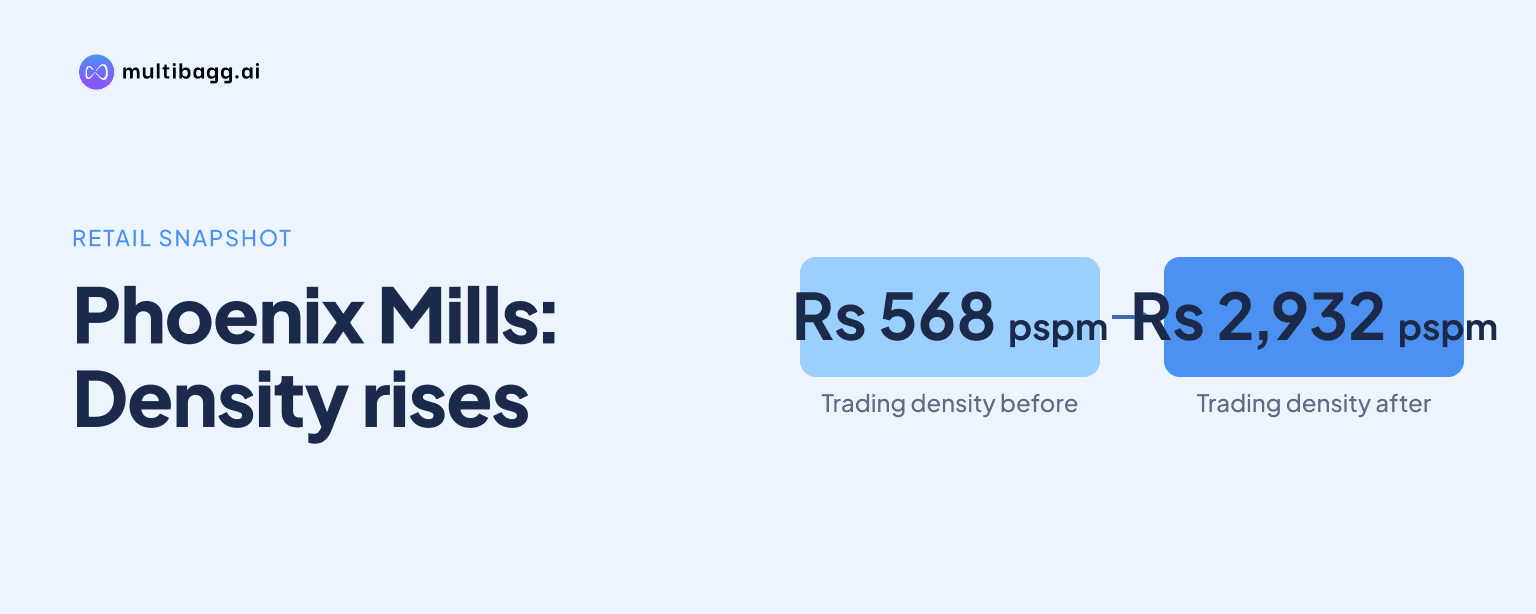
Phoenix Mills projects that re-leasing and re-layout at Phoenix MarketCity Bangalore will lift trading density to Rs 2,932 pspm from Rs 568 pspm and monthly rent to Rs 1.23 crore from Rs 65 lakh after stabilisation. The plan changes a hypermarket-led layout into one electronic anchor and two fashion anchors across 0.87 lakh square feet of gross leasable area.
Know Phoenix Mills inside out
Results, valuation, peers and who's buying, in one view.
How is PML raising density at Phoenix MarketCity Bangalore?
PML is raising density by replacing a hypermarket and one fashion anchor with one electronic anchor and two fashion anchors at Phoenix MarketCity Bangalore. The presentation identifies this as a re-leasing and re-layout case study, where trading density is projected to rise from Rs 568 pspm to Rs 2,932 pspm after stabilisation. The source labels the measure as pspm and describes the change as a fivefold increase in trading density.
The company projects monthly rent of Rs 1.23 crore after the revised space stabilises, compared with Rs 65 lakh before the change. PML characterises that movement as a twofold increase. Both the higher trading-density figure and the higher rent are projections, rather than reported results from a completed re-leasing exercise.
PML’s stated mechanism is to identify stores with large areas, low density and low rent, then optimise their size for anchors or relocate them. This is intended to release prime space for flagship in-line stores and mini anchors at higher rent, while generating higher trading density. The presentation does not disclose individual tenant rents, opening dates or a date by which the revised layout is expected to stabilise.
What changes in the Bangalore space and tenant mix?
PML is increasing the relevant GLA by 0.05 lakh square feet, to 0.87 lakh square feet from 0.82 lakh square feet, while changing the tenant mix more substantially. The earlier configuration comprised a hypermarket and one fashion anchor; the proposed configuration comprises an electronic anchor and two fashion anchors. The projected rent outcome is Rs 1.23 crore a month, versus Rs 65 lakh before the re-layout.
The modest increase in area means the presentation principally attributes the projected economic change to re-leasing, space allocation and the revised tenant mix. The company does not quantify the contribution to the projected Rs 2,932 pspm trading density from the electronic anchor, either fashion anchor, or any flagship in-line and mini-anchor space released through resizing and relocation.
PML presents the case as an example of rental uplift on rechurned space. Across its wider portfolio, it also says trading occupancy is ramping towards about 95% as stores open. The Bangalore slide does not disclose the trading occupancy of the 0.87 lakh-square-foot area, so that portfolio observation cannot be used to infer occupancy at this particular re-laid space.
How much retail GLA has PML earmarked for lease expiries?
PML says leases covering 72% of operational retail GLA, or about 8.21 million square feet, are due to expire between financial year 2026, or FY26, and FY30. The company describes these contractual expiries as opportunities to refresh the brand and category mix, seek higher re-leasing spreads and drive growth without new capital expenditure.
FY28 has the largest disclosed expiry pool, at about 2.74 million square feet or 24% of operational retail GLA. This exceeds the 1.52 million square feet, or 13%, scheduled for expiry in FY26; the 1.43 million square feet, or 12%, in FY27; the 1.61 million square feet, or 14%, in FY29; and the 0.90 million square feet, or 8%, in FY30.
The expiry programme is much broader than the 0.87 lakh-square-foot Phoenix MarketCity Bangalore case study. PML’s portfolio approach is to use contractual expiries to reprice space and alter brand and category mix. The presentation does not provide a portfolio-wide target for re-leasing spreads, rent uplift or trading density from the 8.21 million square feet due for expiry.
Got a follow-up? Ask IRIS
How does re-leasing fit PML’s growth plan?
PML places strategic repositioning alongside lease expiries, luxury and premium brand additions, office portfolio ramp-up, campus densification and portfolio expansion as drivers of earnings before interest, tax, depreciation and amortisation, or EBITDA. Its stated retail levers are rental uplift on rechurned space and trading occupancy moving towards about 95% as stores open.
The company shows retail GLA of about 11 million square feet in 2025, planned to exceed 14 million square feet by 2027-2028 and 18 million square feet by 2030. PML says those GLA estimates are based on current plans and market or company norms, and may change with development plans and tenant negotiations. Re-leasing is therefore presented as an embedded growth lever alongside physical portfolio expansion.
PML also identifies lease expiries as a route to repricing spreads without new capital expenditure. In contrast, its expansion plans involve further development: the company says it is adding 1.6 million square feet of offices and 0.45 million square feet of retail at the Phoenix Palladium campus in Lower Parel. The presentation treats these as separate paths to future EBITDA expansion.
What further development is planned at Phoenix MarketCity Bangalore?
PML plans to expand Phoenix MarketCity Bangalore from about 1 million square feet to more than 4 million square feet as an integrated mixed-use campus. This campus densification plan is separate from the 0.82 lakh-square-foot re-layout case. The company states that the areas cited remain subject to planning and regulatory approvals and payment of applicable premiums and charges.
Phase 2 includes about 0.17 million square feet of retail, about 0.40 million square feet of Art Exchange offices and a Grand Hyatt hotel with about 400 keys, each with a target completion in 2027. PML says Phase 2 is under construction. These disclosed targets provide a defined timetable that the re-leasing case itself does not provide.
Phase 3 comprises about 1.20 million square feet of offices, about 0.6 million square feet of retail and a hotel with about 300 keys. PML says civil contracts for Phase 3 have been awarded. The presentation also cites potential floor space index, or FSI, capacity of about 1.1 million square feet for Phase 2 and about 2.2 million square feet for Phase 3.
Conclusion
PML’s Phoenix MarketCity Bangalore case suggests that a change in tenant mix, rather than a major increase in retail area, is central to its projected uplift. GLA rises only from 0.82 lakh square feet to 0.87 lakh square feet, while projected trading density rises from Rs 568 pspm to Rs 2,932 pspm and monthly rent moves from Rs 65 lakh to Rs 1.23 crore after stabilisation. The wider expiry schedule gives PML further scope to pursue similar re-leasing actions across 8.21 million square feet through FY30.
What to watch next is the disclosed FY26 to FY30 expiry cycle, which peaks at 2.74 million square feet in FY28, and the 2027 Phase 2 completion targets at Phoenix MarketCity Bangalore. PML has not disclosed a stabilisation date for the re-laid retail area or a portfolio-wide re-leasing spread target, leaving the realised rent and density outcome unresolved.