










INNOMET maps 210 TPA tungsten capacity by FY29–FY31
Key highlights
- INNOMET’s tungsten-capacity roadmap rises from 18 TPA in FY26 to about 210 TPA in FY29–FY31.
- Swastik is planned to reach 120 TPA, or 10 tonnes monthly, by the end of FY27.
- INNOMET reported THA revenue of Rs 17.60 crore in H1 FY27, up from Rs 2.90 crore in H1 FY26.
- INNOMET reported a Rs 36.70 crore pending order book on 1 October 2026 and Rs 33.51 crore of inventory on 30 September 2026.
powered by IRIS
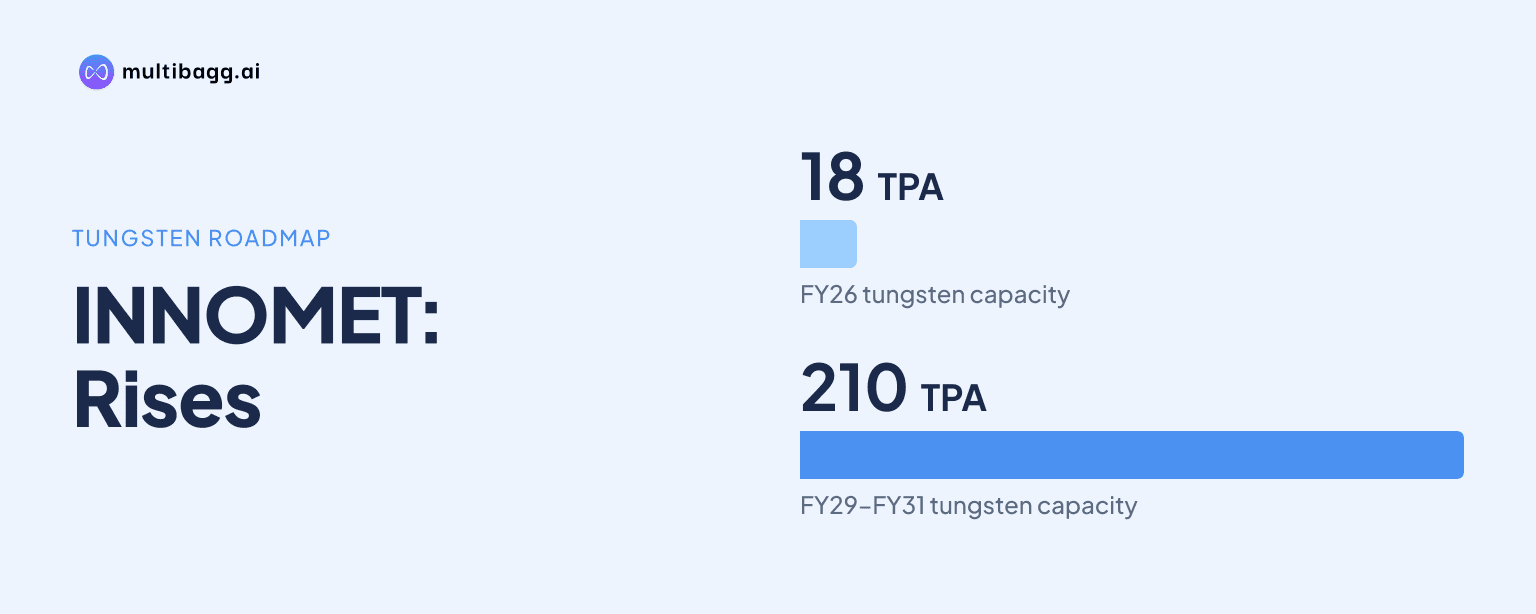
INNOMET’s tentative roadmap lifts aggregate tungsten capacity from 18 tonnes per annum (TPA) in FY26 to about 210 TPA in FY29–FY31, combining 120 TPA of Swastik tungsten powder with about 90 TPA of in-house tungsten heavy alloy (THA) components. The near-term milestone is Swastik reaching 10 tonnes monthly by the end of FY27.
Know Innomet Advanced Materials inside out
Results, valuation, peers and who's buying, in one view.
What is INNOMET’s tungsten capacity roadmap?
INNOMET plans total tungsten capacity of 180 TPA in FY27 and FY28, followed by about 210 TPA in FY29–FY31. The roadmap separates in-house THA component capacity from Swastik powder capacity, although Swastik powder is an input for THA rather than an independent end-product line.
INNOMET expects a new furnace to take THA capacity from 18 TPA in FY26 to 60 TPA in FY27. A further furnace step, targeted in about two years, is intended to raise THA capacity to about 90 TPA, creating the additional 30 TPA in the FY29–FY31 roadmap.
INNOMET describes these figures as tentative installed capacity rather than output forecasts and says practical peak utilisation is about 75%. Its wider capacity plan raises total metal-powder capacity from 620 TPA in FY26 to 1,600 TPA in FY29–FY31, including water atomisation, gas atomisation and a proposed Indian Institute of Technology Hyderabad and Defence Research and Development Organisation (DRDO) line.
How will Swastik support INNOMET’s THA expansion?
Swastik gives INNOMET a captive tungsten-powder operation designed to support THA order execution as global supply tightens. INNOMET acquired a 57.5% stake in Swastik for Rs 1.5 crore through the National Company Law Tribunal process and consolidated the business from 26 September 2026.
Swastik’s process begins with tungsten-carbide scrap from more than 60 sources, compared with 2 to 3 vendors previously cited by INNOMET. Hydrometallurgical extraction produces ammonium paratungstate, or APT, and hydrogen reduction then produces tungsten metal powder with stated purity of at least 99.95%, which can feed THA sintering and machining.
INNOMET said Swastik had restarted at 2 to 3 tonnes a month and was producing about 2 tonnes monthly in H1 FY27, against the 10-tonne monthly capacity target. The intended year-end FY27 rate equals 120 TPA, which is the powder contribution shown in the FY27, FY28 and FY29–FY31 capacity roadmap.
Management links the integration to China mining about 79% of global tungsten and imposing export restrictions from February 2025. INNOMET also cited a 4.7-times rise in tungsten prices and said internalising powder conversion retains a production step previously purchased from vendors. It identifies carbide powder, ready-to-press powder and carbide components as a new vertical, describing that market as more than five times THA’s market, without providing a revenue target.
How is INNOMET funding the capacity programme?
INNOMET is funding the programme through internal accruals, bank lines, customer advances and preferential issues. The company reported Rs 37.5 crore committed through preferential issues between August and October 2026, with about Rs 14 crore received, including Rs 7.5 crore in H1 FY27, and about Rs 23.5 crore still due.
Consolidated H1 FY27 capital expenditure was Rs 6.98 crore across the disclosed projects. These included the Swastik restart, a larger water atomiser order intended to lift water-atomisation capacity from 600 TPA to 1,200 TPA, and a 50-kilogram gas atomiser that was in trials for about 50 TPA of FY27 capacity.
INNOMET said DRDO separately funds an Rs 8.73 crore gas-atomiser project at the Indian Institute of Technology Hyderabad, scheduled for FY28. That 100-kilogram unit belongs to the metal-powder programme rather than the tungsten total, while a production-scale spark plasma sintering furnace from Germany had received an advance payment.
At 30 September 2026, fixed assets, capital work in progress and goodwill were Rs 27.60 crore, compared with Rs 22.12 crore at 31 March 2026. Net worth including warrant money rose to Rs 54.97 crore from Rs 42.90 crore, while long-term borrowings were Rs 9.82 crore and short-term borrowings were Rs 9.89 crore, producing debt to equity of 0.36 times versus 0.35 times in March 2026.
Got a follow-up? Ask IRIS
What demand and working-capital factors affect INNOMET’s plan?
INNOMET reported THA revenue of Rs 17.60 crore in H1 FY27, six times the Rs 2.90 crore recorded in H1 FY26. Metal-powder revenue rose 116% to Rs 38.10 crore, while THA’s revenue share increased to 32% from 14%, providing the commercial context for the planned increase in THA capacity to 60 TPA.
Exports reached Rs 25.90 crore in H1 FY27 from Rs 3.60 crore a year earlier and represented 46.4% of revenue, compared with 15.1% in H1 FY26. THA exports were Rs 15.30 crore, or 87% of THA revenue, while metal-powder exports were Rs 10.60 crore; INNOMET cited defence restocking, AS 9100D certification and demand for non-Chinese supply alternatives as drivers.
Working capital increased as THA orders move through a stated 3-to-9-month cycle. Inventory rose to Rs 33.51 crore on 30 September 2026 from Rs 13.65 crore on 31 March 2026, including about Rs 2 crore from Swastik, while trade receivables declined to Rs 9.46 crore from Rs 11.00 crore.
Trade payables increased to Rs 7.74 crore from Rs 1.69 crore as purchases rose, and short-term borrowings reached Rs 9.89 crore from Rs 5.69 crore. INNOMET reported a Rs 36.70 crore pending order book on 1 October 2026, which it said supports the inventory build, although short-cycle metal-powder orders mostly do not enter that order book.
What execution risks does INNOMET disclose?
INNOMET identifies raw-material price movements, working-capital needs, lumpy defence orders, long qualification cycles, export disruption and integration risks as material issues. Its working-capital mitigants include customer advances of about 30% on THA export orders, bank lines and fresh equity funding.
The Swastik ramp is a specific operational dependency because the facility had been idle for three years before restarting. INNOMET’s stated mitigants are refurbishment, retention of the original promoters, employee stock-option plans and senior hires, but the 120 TPA target remains dependent on scaling output from about 2 tonnes monthly to 10 tonnes monthly by the end of FY27.
Aerospace and defence qualification can also delay revenue conversion. INNOMET said AS 9100D certification has been in place since September 2025, while new entrants can require 6 to 12 months for certification followed by a 3-to-4-year customer qualification cycle.
Conclusion
INNOMET’s capacity plan combines a larger THA component line with captive powder production to change its tungsten platform from 18 TPA in FY26 to about 210 TPA in FY29–FY31. The 120 TPA Swastik line is central because it is both the largest capacity addition and the intended input source for a planned 90 TPA THA operation.
The next disclosed milestones are Swastik reaching 10 tonnes monthly by the end of FY27, THA capacity reaching 60 TPA after the new furnace, and receipt of about Rs 23.5 crore still due from the preferential issues. The subsequent measure will be whether Rs 33.51 crore of inventory converts into shipments across the stated 3-to-9-month THA cycle while the later expansion to about 90 TPA of THA capacity proceeds.