










Innomet says ₹100 crore FY27 revenue target is within reach
Key highlights
- Innomet reported ₹55.7 crore of H1 FY27 revenue against management’s ₹100 crore FY27 target.
- Pending orders were ₹36.7 crore at 1 October 2026, taking revenue plus orders to ₹92.4 crore.
- Consolidated inventory rose to ₹33.51 crore at 30 September 2026 from ₹13.65 crore at 31 March 2026.
- Swastik Tungsten was producing about 2 tonnes monthly against 10 tonnes monthly capacity targeted by end-FY27.
powered by IRIS
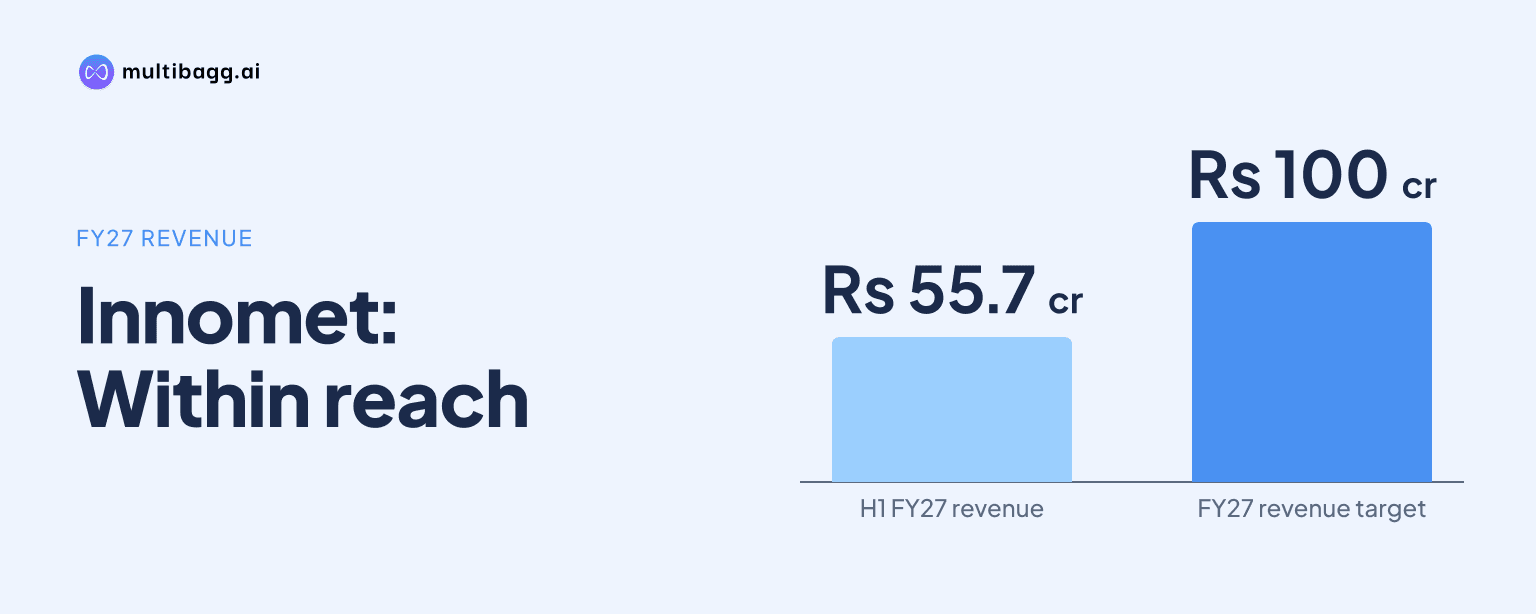
INNOMET says its ₹100 crore FY27 revenue target is within reach after reporting ₹55.7 crore of H1 FY27 revenue and ₹36.7 crore of pending orders at 1 October 2026. Together, these figures total ₹92.4 crore, or 92.4% of the target, before new orders and short-cycle metal-powder sales.
Know Innomet Advanced Materials inside out
Results, valuation, peers and who's buying, in one view.
What supports Innomet’s ₹100 crore FY27 revenue target?
Innomet’s disclosed revenue path comprises ₹55.7 crore of H1 FY27 sales and ₹36.7 crore of pending orders, taking the total to ₹92.4 crore against the ₹100 crore FY27 target. Management describes the target as within reach, not achieved, because the pending orders must still be executed and the remaining revenue depends on new business.
Metal and alloy powders generated 68% of H1 FY27 revenue, compared with 32% from tungsten heavy alloys, or THA. Innomet says powder orders are short-cycle and mostly outside the ₹36.7 crore disclosed order book, so that order-book figure does not represent all potential FY27 powder sales.
THA shipments have a three-to-nine-month cycle, linking the conversion of the pending orders to production and dispatch timing. Innomet also identifies long approvals and stage-wise inspections in defence orders as reasons quarterly revenue can be uneven, while powder orders generally have shorter sales cycles.
How is Innomet expanding capacity for FY27 and beyond?
Innomet estimates total metal-powder installed capacity will rise from 620 tonnes per annum, or TPA, in FY26 to 800 TPA in FY27 and 1,350 TPA in FY28. Its tungsten capacity estimate rises from 18 TPA in FY26 to 180 TPA in FY27, although the company labels the roadmap tentative and says practical peak utilisation is about 75%.
The main metal-powder project is a larger water atomiser, for which the order is under progress and which is intended to lift water-atomisation capacity from 600 TPA to 1,200 TPA. A 50 kg gas atomiser is installed and in trials; the capacity roadmap assigns 50 TPA to gas atomisation in FY27, while the strategy slide refers to 20 TPA for additive manufacturing and coatings. The presentation does not reconcile these two FY27 figures.
THA capacity reached 60 TPA after a new furnace, with Innomet indicating a next step of about 90 TPA in roughly two years. Swastik Tungsten, consolidated from 26 September 2026, was producing about 2 tonnes of tungsten powder per month against a 10-tonne monthly capacity, or 120 TPA, targeted by end-FY27; that powder is intended to feed THA production.
How is Innomet financing order execution and expansion?
Innomet lists internal accruals, bank lines, customer advances and a preferential issue as funding sources. The company says ₹37.5 crore was committed through the preferential issue during August to October 2026, of which about ₹14 crore had been received, including ₹7.5 crore in H1 FY27, leaving about ₹23.5 crore still to come.
H1 FY27 capital expenditure was ₹6.98 crore across the stated projects, while the Defence Research and Development Organisation, or DRDO, separately funds the ₹8.73 crore gas-atomiser project. Innomet says preferential-issue funds support working capital, which is material because THA orders require inventory through their three-to-nine-month cycle.
Consolidated inventory rose to ₹33.51 crore at 30 September 2026 from ₹13.65 crore at 31 March 2026. Innomet attributes the ₹19.9 crore increase to raw material and semi-finished goods for THA and powder orders, including about ₹2 crore from Swastik; it says these stocks convert to sales as THA orders are shipped.
Receivables fell to ₹9.46 crore from ₹11 crore despite revenue more than doubling, while trade payables increased to ₹7.74 crore from ₹1.69 crore with higher purchases. Short-term borrowings rose to ₹9.89 crore from ₹5.69 crore to fund order-book raw materials, and debt-to-equity was 0.36 times at 30 September 2026 versus 0.35 times at 31 March 2026.
Got a follow-up? Ask IRIS
What risks could affect Innomet’s FY27 plan?
Innomet identifies raw-material prices, working capital, lumpy defence orders, qualification cycles, export conditions and Swastik integration as principal risks. Tungsten, copper and other metal-price movements can affect margins and working-capital needs; the company’s stated mitigations are back-to-back buying, short quote validity and backward integration through Swastik.
The company says 30% customer advances on THA export orders, bank lines and fresh equity are intended to address the working-capital demands of the three-to-nine-month THA cycle. The increase in inventory to ₹33.51 crore shows the capital committed to orders in progress, while ₹36.7 crore of pending orders at 1 October 2026 provides the stated basis for that build.
Defence approvals and stage-wise inspections can delay deliveries between quarters. Innomet says it is diversifying across powders, THA, industrial customers and export markets, while noting currency movements, tariffs and trade rules as export risks; exports accounted for 46% of revenue in the presentation.
Aerospace and defence qualification is another timing risk. Innomet has held AS 9100D certification since September 2025, but says certification can take six to 12 months and subsequent customer qualification can take three to four years. Swastik had been idle for three years before its restart, and Innomet cites refurbishment, retained original promoters, senior hires and an employee stock-option plan as its scaling measures.
Which businesses shape Innomet’s longer-term growth strategy?
Innomet’s strategy combines THA, captive tungsten powder and specialty metal powders, followed by advanced materials from FY28 onward. Management’s stated long-term earnings before interest, tax, depreciation and amortisation, or EBITDA, margin objective is 16% to 20%, based on THA mix, exports, operating leverage and, over time, advanced materials.
THA is the company’s current defence and aerospace platform, with 60 TPA capacity and 87% of H1 FY27 THA revenue exported. Innomet is developing penetrators, targets and allied products, while its disclosed THA uses include aerospace balance weights, defence pre-fragments, radiation shielding and engineering balance weights.
For FY27 and FY28, Innomet says Swastik’s tungsten powder can secure THA feedstock and that carbide powder, ready-to-press powder and components are a market more than five times THA. H1 FY27 metal-powder exports were ₹10.6 crore, already above all of FY26, while management’s ₹1,000 crore vision has no disclosed date.
Conclusion
Innomet’s ₹100 crore FY27 target is supported by a quantified base of ₹55.7 crore in H1 revenue and ₹36.7 crore of pending orders. The same presentation shows the execution requirement behind that path: inventory increased to ₹33.51 crore, short-term borrowings rose to ₹9.89 crore, and a material portion of orders must move through the THA production cycle.
The next disclosures to watch are conversion of the ₹36.7 crore pending order book, Swastik’s progress from about 2 tonnes monthly production toward 10 tonnes monthly capacity by end-FY27, and completion of the water and gas atomisation projects. Innomet also plans a DRDO-funded 100 kg atomiser in FY28 and indicates THA capacity could reach about 90 TPA in roughly two years.