










Gayatri Rubbers Says Smart-Meter Orders Average Rs 12 Crore
Key highlights
- GRCL says its average annual smart-meter component order book is Rs 12 crore.
- GRCL names Genus Power and HPL Power as its two single-source smart-meter customers.
- GRCL cites projected smart-meter installations rising from 50 million at end-2025 to 250 million by 2030.
- Industrial applications represent 20% of GRCL's revenue-sector mix and have listed EBITDA margins of 21-23%.
powered by IRIS
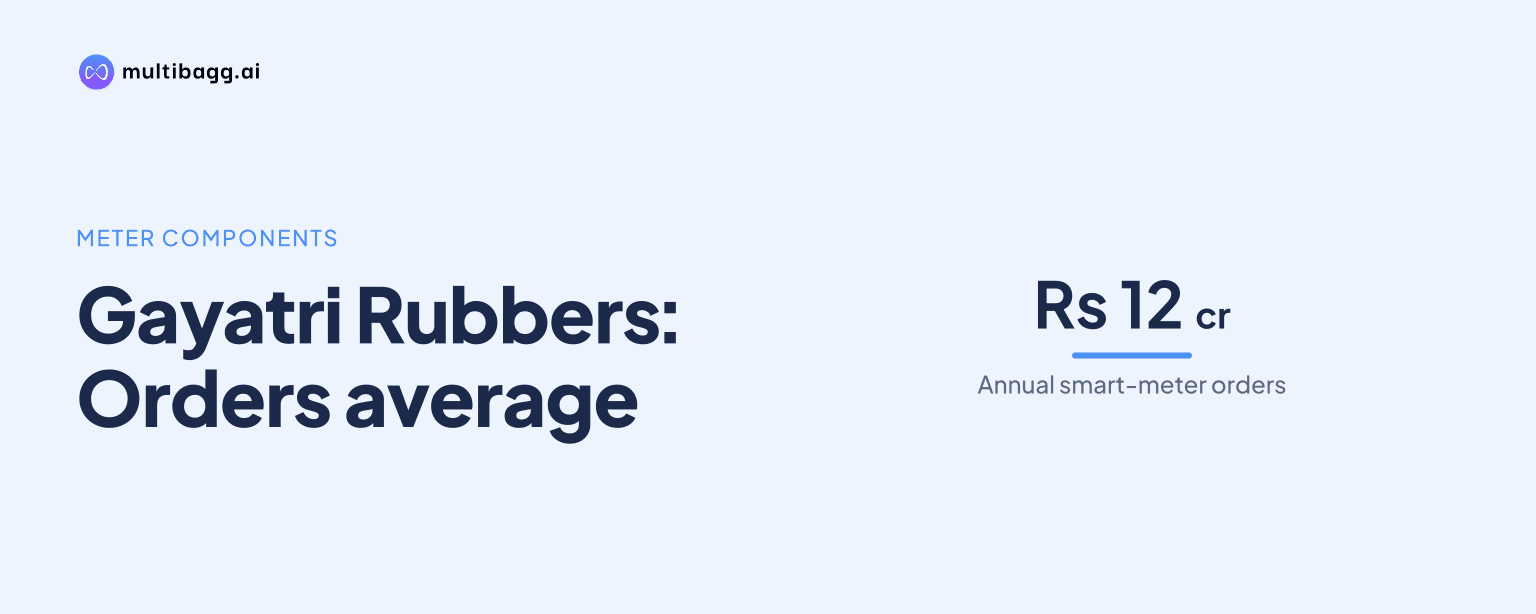
Gayatri Rubbers says its average annual smart-meter component order book is Rs 12 crore, supported by its stated position as a single-source vendor to Genus Power and HPL Power. The company links the opportunity to projected smart-meter installations rising from 50 million units by the end of 2025 to 250 million units by 2030.
Know Gayatri Rubbers and Chemicals inside out
Results, valuation, peers and who's buying, in one view.
What does GRCL supply to smart-meter makers?
GRCL supplies Neopreme rubber components for smart meters and SMC boxes, according to the presentation. Smart meters are listed within the industrial application segment, alongside engineering products, while the industrial portfolio specifically includes smart-meter rubber gaskets, SMC-box rubber gaskets, electric-switchgear rubber components, grommets, EPDM square gaskets and EPDM strip gaskets.
The presentation describes this work as labour-intensive and critical, which management says results in few skilled players and protected margins. It does not disclose the production volume, price per component, revenue or margin attributable specifically to smart-meter products. The disclosed industrial figures therefore provide segment context rather than a separate financial result for meter-related rubber components.
Is GRCL the sole supplier to Genus Power and HPL Power?
GRCL says it is a single-source vendor to two listed industry leaders, Genus Power and HPL Power, for smart-meter and SMC-box rubber components. The slide headline describes the business as a “monopoly supplier” niche, while the detailed text makes the more specific claim that GRCL is the single-source vendor to those two named customers.
This statement concerns the two customers named in the accompanying text and does not disclose GRCL's share of all Indian smart-meter manufacturing. The slide also displays a Sintex logo, but the presentation identifies only Genus Power and HPL Power as the two listed industry leaders linked to the single-source-vendor claim. It provides no customer-wise split of the Rs 12 crore average annual order book.
How large is GRCL's disclosed smart-meter order book?
GRCL reports an average annual order-book value of Rs 12 crore for the smart-meter business. The presentation does not state the years used to calculate that average, nor does it disclose recognised revenue, profit, component volumes or the timing of order execution for this product line.
Smart meters sit within GRCL's industrial segment, which accounts for 20% of the revenue-sector mix presented, compared with 55% for railways and 25% for other architectural and automotive applications. That makes industrial the second-largest disclosed segment by mix, while railways remains 35 percentage points larger than industrial in the company's stated revenue-sector allocation.
GRCL lists industrial earnings before interest, tax, depreciation and amortisation, or EBITDA, margins at 21-23% and profit-after-tax, or PAT, margins at 16-18%. Those ranges are the same as the railway segment's disclosed ranges, whereas the other architectural and automotive category is listed at 13-15% EBITDA margin and 8-10% PAT margin. The presentation does not assign the industrial segment margin ranges specifically to smart-meter components.
Got a follow-up? Ask IRIS
How fast does GRCL expect the smart-meter market to expand?
GRCL cites projected smart-meter installations of 50 million units by the end of 2025 and 250 million units by 2030. The company describes this increase as a compound annual growth rate, or CAGR, of approximately 38%, and attributes the potential to government initiatives for smart-meter deployment.
The 2030 projection is five times the end-2025 installation base. However, the presentation does not disclose how many rubber components are required per meter, what share of deployments may be supplied by Genus Power or HPL Power, or GRCL's expected share of future installations. The deployment figures are therefore a market projection cited by management, not an order or revenue forecast for GRCL.
What other meter opportunities has GRCL identified?
GRCL says a prototype for gas and water meters has been accepted by Genus. This is the only disclosed development relating to a possible extension from smart-meter and SMC-box components into another meter category, and the presentation does not provide a commercial order value, production schedule, contract term or expected margin for the prototype.
The company also lists pipes, bridge pads and railway pads as expansion verticals. Management says pipe supply is to start in the first half of 2027, railway pads are expected in 2028 from the upcoming Plant 3, and entry into bridge pads is planned within six to eight months. These plans sit alongside the meter opportunity but do not alter the disclosed Rs 12 crore average annual smart-meter order-book value.
Conclusion
GRCL's smart-meter position is based on its stated single-source-vendor status with Genus Power and HPL Power, a Rs 12 crore average annual order book and a product range within the industrial segment. The presentation places that segment at 20% of its revenue-sector mix, with disclosed EBITDA margins of 21-23% and PAT margins of 16-18%, though it does not separate smart-meter financials from the wider industrial business.
The next disclosed meter-related milestone is the accepted Genus gas-and-water-meter prototype, for which management has not given a commercial supply date or order value. Investors can also monitor the company's cited installation projection of 250 million smart meters by 2030 and whether GRCL subsequently discloses its order growth, customer concentration or revenue from that deployment cycle.