










Generic Engineering operating cash flow turns negative in H1
Key highlights
- Generic Engineering reported an Rs 21.93 crore operating cash outflow in the six months ended September 30, 2026, versus an Rs 18.33 crore inflow a year earlier.
- Generic Engineering's current trade receivables rose to Rs 219.74 crore at September 30, 2026 from Rs 197.85 crore at March 31, 2026.
- Generic Engineering's total borrowings increased to Rs 83.78 crore at September 30, 2026 from Rs 57.40 crore at March 31, 2026.
- Generic Engineering reported Rs 4.23 crore of profit after tax for the September 2026 half year, compared with Rs 4.16 crore a year earlier.
powered by IRIS
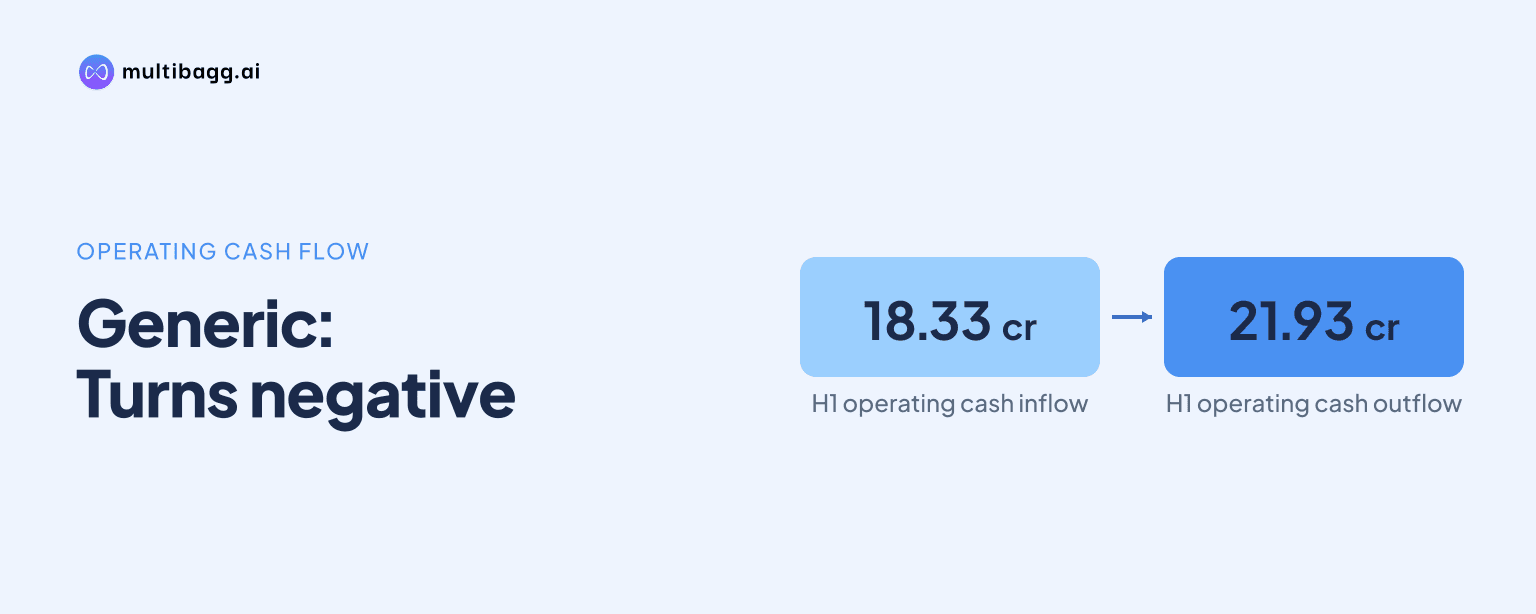
Generic Engineering Construction and Projects Limited reported Rs 21.93 crore of net cash used in operating activities for the six months ended September 30, 2026, compared with an Rs 18.33 crore inflow a year earlier. A Rs 20.13 crore receivables outflow and Rs 16.48 crore payables outflow reversed cash generation before working-capital movements.
Know Generic Engineering Construction & Projects inside out
Results, valuation, peers and who's buying, in one view.
Why did Generic Engineering's operating cash flow turn negative?
Generic Engineering's operating cash flow turned negative because working-capital movements exceeded Rs 15.59 crore of cash generated before those changes in the September 2026 half year. Trade and other receivables used Rs 20.13 crore of cash, while trade and other payables used a further Rs 16.48 crore, leaving cash generated from operations at negative Rs 21.02 crore before tax payments.
Net income-tax payments of Rs 90.74 lakh took operating cash outflow to Rs 21.93 crore. In the six months ended September 30, 2025, Generic Engineering generated Rs 18.69 crore before working-capital changes; receivables used Rs 15.80 crore, but payables provided Rs 16.43 crore. That combination produced Rs 19.32 crore of cash from operations and an Rs 18.33 crore operating inflow after Rs 99.54 lakh of taxes.
How did Generic Engineering's receivables and payables change?
Generic Engineering's current trade receivables rose to Rs 219.74 crore at September 30, 2026 from Rs 197.85 crore at March 31, 2026, an increase of Rs 21.89 crore. Non-current trade receivables declined to Rs 6.79 crore from Rs 8.95 crore. The cash-flow statement records the combined movement in trade and other receivables as an Rs 20.13 crore use of cash.
Trade payables fell to Rs 92.18 crore at September 30 from Rs 114.09 crore at March 31. Amounts due to micro and small enterprises were Rs 20.59 crore, compared with Rs 20.96 crore, while dues to other creditors declined to Rs 71.59 crore from Rs 93.13 crore. Despite the lower closing trade-payables balance, changes in trade and other payables represented an Rs 16.48 crore cash outflow in the half year.
How did Generic Engineering fund its operating cash shortfall?
Generic Engineering reported Rs 20.20 crore of net financing cash inflow in the six months ended September 2026, partly offsetting the operating outflow. It received Rs 9.84 crore from long-term borrowings and reported Rs 17.51 crore of proceeds from short-term borrowings, net of payments. These inflows were reduced by Rs 4.49 crore of finance charges paid, Rs 98.08 lakh of long-term borrowing repayments and Rs 1.69 crore of rent paid on hire charges.
Total borrowings rose to Rs 83.78 crore at September 30, 2026 from Rs 57.40 crore at March 31, 2026. Current borrowings increased to Rs 74.60 crore from Rs 57.08 crore, while non-current borrowings rose to Rs 9.18 crore from Rs 31.93 lakh. Lease liabilities, reported separately from borrowings, were Rs 5.46 crore at September 30, compared with Rs 6.87 crore at the March year-end.
Generic Engineering generated Rs 94.36 lakh from investing activities, compared with an Rs 11.83 crore investing outflow in the prior-year half. Interest received was Rs 34.71 lakh and rental income was Rs 69.30 lakh, while purchases of fixed assets were Rs 9.66 lakh. Cash and cash equivalents nevertheless fell by Rs 78.78 lakh to Rs 4.96 crore at September 30, 2026 from Rs 5.74 crore at the start of the financial year.
Got a follow-up? Ask IRIS
Did Generic Engineering's profit and revenue move with cash flow?
Generic Engineering remained profitable even as operating cash flow reversed, reporting Rs 4.23 crore of profit after tax for the six months ended September 30, 2026, compared with Rs 4.16 crore a year earlier. Revenue from operations rose to Rs 115.05 crore from Rs 113.55 crore, but profit before tax declined to Rs 4.61 crore from Rs 6.10 crore.
The segment labelled Construction to Services reported Rs 82.20 crore of half-year revenue, up from Rs 72.25 crore in the corresponding 2025 period. Its segment result before interest and tax fell to Rs 8.38 crore from Rs 18.67 crore. Trading Material revenue declined to Rs 22.61 crore from Rs 41.30 crore, and its segment result declined to Rs 45.22 lakh from Rs 70.49 lakh.
The cash-flow statement starts with Rs 3.57 crore of net profit before taxation, whereas the standalone profit-and-loss account reports Rs 4.61 crore of profit before tax for the same September 2026 half year. The filing does not explain the difference between those two reported figures. The cash-flow statement then adds Rs 4.49 crore of finance charges and Rs 7.22 crore of depreciation among its operating-cash-flow adjustments.
What does the auditor's qualification mean for Generic Engineering?
Generic Engineering's statutory auditor issued a qualified conclusion on the September 30, 2026 standalone results because it could not obtain sufficient and appropriate evidence over work-in-progress valuation. The auditor said Generic Engineering provided engineering completion certificates supporting the existence of work-in-progress, but did not provide cost records, cost-allocation details or the basis for calculating accumulated costs.
Inventories stood at Rs 77.88 crore at September 30, 2026, compared with Rs 78.29 crore at March 31, 2026. The auditor said it could not determine whether a write-down to net realisable value or an obsolescence provision was required, and described the qualification as repeated. Management estimated a nil impact, citing certificates and valuations, and said it expected to realise the work-in-progress into revenue within one year; the auditor maintained that valuation could not be verified without the relevant cost evidence.
Conclusion
Generic Engineering's September 2026 half-year results show a divergence between reported profit and operating cash generation. Profit after tax increased by Rs 7.97 lakh to Rs 4.23 crore, but working-capital movements shifted operating cash flow from an Rs 18.33 crore inflow to an Rs 21.93 crore outflow, while total borrowings increased by Rs 26.38 crore from March 2026.
Next, readers should watch whether Generic Engineering realises the work-in-progress into revenue within the one-year period cited by management and supplies the cost support identified by the auditor. The company also said it is evaluating the New Labour Codes' impact on areas including its contract workforce after their November 21, 2025 implementation, although management does not expect a material impact.