










GHCL links future payouts to capex and acquisition search
Key highlights
- GHCL distributed 79% to 80% of the previous year’s cash generation to shareholders, according to management.
- GHCL is pursuing about Rs 500 crore of capital allocation for Zara Zumara and other projects.
- GHCL estimates Rs 4,200 crore for a 0.5 million-tonne soda ash greenfield phase.
- Vacuum salt and bromine are expected to generate about Rs 168 crore to Rs 170 crore of revenue together at scale.
powered by IRIS
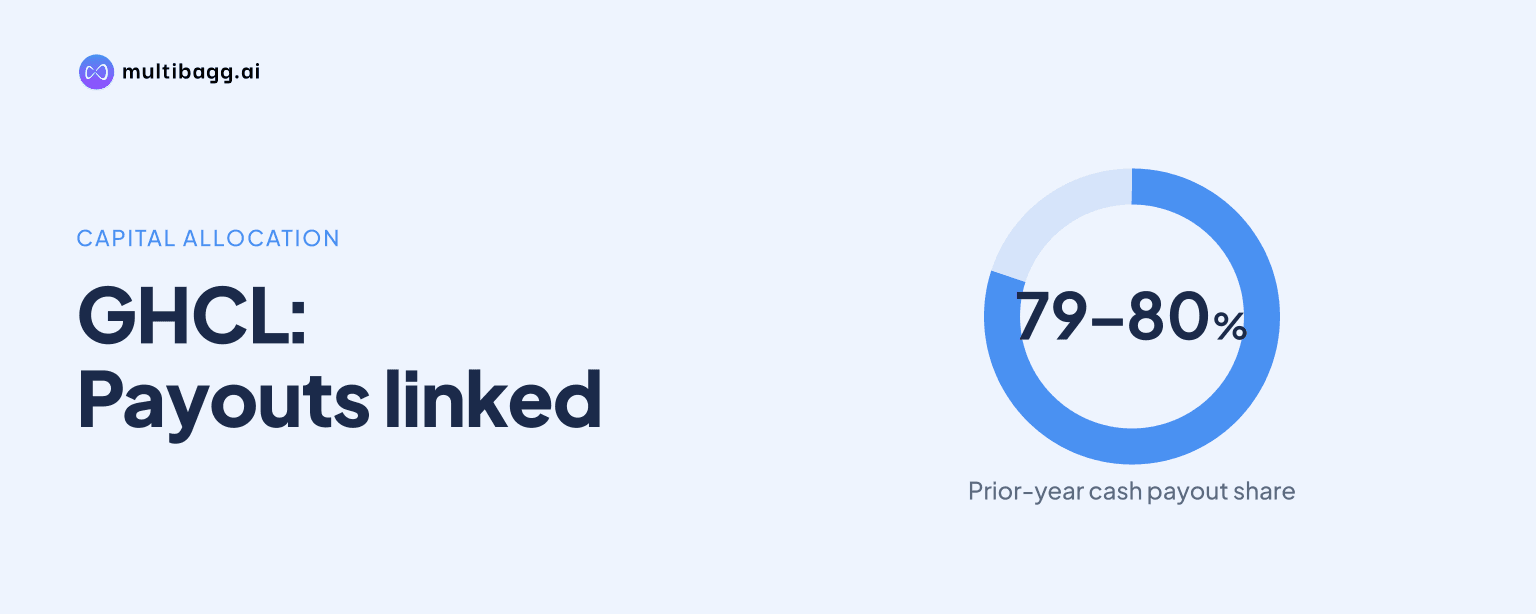
GHCL Limited said on November 2, 2026 that its next shareholder payout will depend on greenfield-project progress, capital needs and acquisition opportunities, after distributing 79% to 80% of the previous year’s cash generation and pursuing about Rs 500 crore of allocation for Zara Zumara and other projects.
Know GHCL inside out
Results, valuation, peers and who's buying, in one view.
What will determine GHCL’s next shareholder payout?
GHCL said its next payout decision will be based on greenfield-project progress, capital-expenditure requirements and any inorganic-growth opportunity that emerges over the next six to nine months. Management did not announce a dividend increase, buyback amount or payout timetable, saying it would make a judicious allocation decision between growth and shareholders after assessing those factors.
GHCL said it does not want to retain idle cash, but it also needs capital available when opportunities arise. Management said 79% to 80% of the previous year’s cash generation was distributed to shareholders and cited three buybacks over the past seven to eight years. An analyst said the dividend distribution had risen from 15% to 25%, although management did not independently quantify that change in this exchange.
An analyst referred to a net cash surplus close to Rs 1,100 crore and a Rs 350 crore to Rs 400 crore capex programme. GHCL did not confirm those specific balance-sheet figures in its response, instead distinguishing between accumulated cash and annual cash generation. Management said the relevant approach is to retain enough capital for growth opportunities without accumulating cash beyond that need.
How much is GHCL planning to allocate to projects?
GHCL is pursuing about Rs 500 crore of capital allocation for Zara Zumara and other projects, while its soda ash greenfield proposal has a substantially larger long-term funding requirement. Management put the first 0.5 million-tonne greenfield phase at about Rs 4,200 crore and the eventual 1.1 million-tonne project at Rs 6,800 crore to Rs 7,000 crore.
GHCL said the greenfield project would require about 3 to 3.5 years from its zero date before production, followed by a stabilisation period. Management said most spending would occur in the final two years, while the first 1.5 years would primarily cover civil work, capital advances and related work. The Rs 500 crore allocation should therefore not be read as the full funding requirement for the soda ash project.
GHCL said it had reviewed the Phase 1 cost about a year earlier and had not subsequently revised it. Management said Gujarat government investment-promotion benefits could offset any inflationary cost pressure, and it would revisit the estimate before or at the project’s zero date. That date has not been disclosed, leaving the project’s final cost and implementation start unresolved.
Got a follow-up? Ask IRIS
What can GHCL’s new vacuum salt and bromine projects contribute?
GHCL expects vacuum salt and bromine to generate about Rs 168 crore to Rs 170 crore of revenue together at indicated scale, with an earnings before interest, tax, depreciation and amortisation margin of more than 40%. Management also indicated return on capital employed of more than 20%, arguing that this measure is more relevant than asset turnover for the two operations.
Vacuum salt had started in the second quarter at about 5% capacity utilisation, with management expecting 50% to 60% in the following quarter and about 80% in the fourth quarter. Bromine began in the third quarter, with expected utilisation of 40% to 50% in that quarter and 70% to 75% in the next. Management said both projects should reach full optimum utilisation in the following year.
GHCL said the two projects involve about Rs 315 crore to Rs 320 crore of investment and should add roughly Rs 15 crore to Rs 17 crore of annual depreciation. Management said vacuum salt converts solar salt into vacuum salt using waste energy, but the relatively high salt cost means revenue is lower relative to asset cost than in some industries. It has not announced a second-stage investment plan because it first wants both operations to stabilise.
Why is GHCL retaining flexibility on acquisitions?
GHCL is retaining flexibility because it has explored several inorganic opportunities without reaching a definitive action point. Management said geopolitical conditions had made it cautious, and that an acquisition would require either suitable operating expertise or a long-term commitment to the acquired business. The company said it continues to examine opportunities rather than ruling them out.
This search affects the payout decision because management explicitly identified a potential new opportunity as a claim on capital alongside greenfield spending. GHCL’s record of three buybacks in seven to eight years and its 79% to 80% prior-year cash-generation distribution show its previous approach, but management did not present them as a commitment to a repeat distribution.
Near-term soda ash conditions also shape the available cash for allocation. Management said its 10-year average earnings before interest, tax, depreciation and amortisation margin was about 29% to 30%, compared with 25% at the time of the call. It attributed the difference partly to global pricing conditions, while saying cost initiatives had helped preserve margins despite some Chinese and Solvay-process producers operating below cost.
GHCL said it took a 1.5% to 2% soda ash price increase in the third quarter over the second quarter. It nevertheless expected third-quarter results to be below the second quarter because of an annual shutdown and lower raw-material inventory-cost benefits, while remaining above the same quarter a year earlier. Management estimated the shutdown’s quarterly production effect at roughly 3% to 4%.
Conclusion
GHCL’s message is that shareholder distributions remain part of its capital-allocation approach, but not a pre-set use of cash. The 79% to 80% distribution of the previous year’s cash generation and three past buybacks sit alongside about Rs 500 crore of planned allocation, the ramp-up of new vacuum salt and bromine operations, and an unresolved acquisition search.
Investors should watch management’s stated six-to-nine-month assessment of greenfield progress, capex needs and inorganic opportunities. A greenfield-project zero date would be a key next event: GHCL has said the project would take about 3 to 3.5 years to implement, with most expenditure concentrated in the final two years.