










GHCL sees soda ash demand returning to 9%-10% in India next year
Key highlights
- GHCL said Indian soda ash demand grew only 1%-plus in the first six months of FY27, versus about 9% in the prior year.
- GHCL expects solar-glass capacity to rise from about 15 gigawatts at September 2026 to 35 gigawatts within six months.
- Management estimates solar glass could add 4%-5% to overall soda ash demand growth next year.
- GHCL reported Q2 FY27 revenue of Rs 821 crore and earnings before interest, tax, depreciation and amortisation of Rs 202 crore.
powered by IRIS
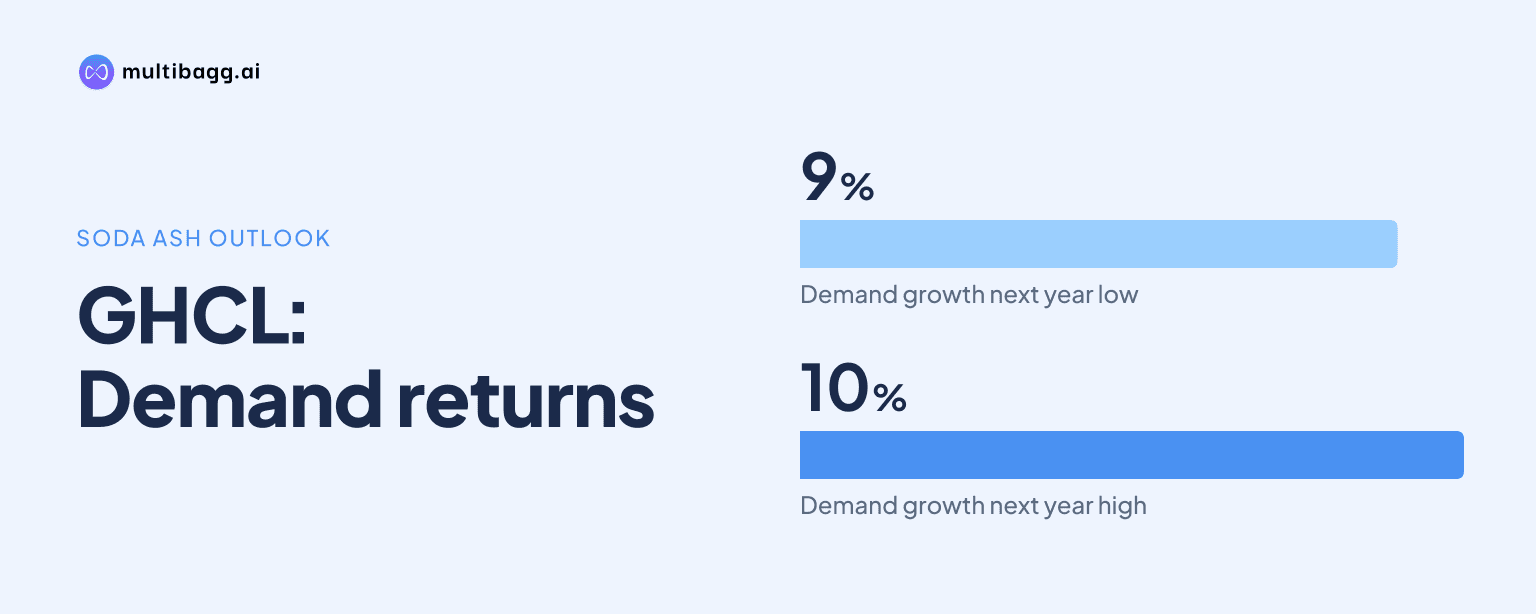
GHCL said India’s soda ash demand growth could return to 9%-10% next year, after rising only 1%-plus in the first six months of FY27, because solar-glass capacity is expected to increase from about 15 gigawatts at September 2026 to 35 gigawatts within six months.
Know GHCL inside out
Results, valuation, peers and who's buying, in one view.
Why does GHCL expect soda ash demand growth to return to 9%-10%?
GHCL expects demand growth near 9%-10% next year because management combines India’s longer-term 4%-5% soda ash growth rate with an estimated additional 4%-5% contribution from solar glass. Managing Director R.S. Jalan said this assessment depends on solar-glass investments playing out fully in 2027-28, following slower-than-expected implementation in the first half of FY27.
The estimate is an outlook rather than company guidance on sales volumes or earnings. An analyst asked whether growth could return to the approximately 9% recorded last year, and Jalan responded that the calculation appeared to support that outcome. The central mechanism is higher solar-glass production, which consumes soda ash, rather than a stated recovery in every end-market.
GHCL’s demand view comes while the wider soda ash market remains oversupplied, according to management. The company said new capacity in China has contributed to the surplus, while global demand was broadly flat through the first eight months to August 2026. The projected Indian recovery therefore rests on a domestic consumption catalyst rather than on an assumed global market tightening.
What caused India’s soda ash demand growth to slow in the first half?
India’s soda ash demand growth slowed to only 1%-plus in the first six months of FY27, compared with about 9% in the prior year, because geopolitical disruption prevented parts of industry from operating at full capacity and delayed solar-glass projects. GHCL described the shortfall as below its earlier expectation for the period.
The slowdown was uneven across consuming sectors in the quarter ended September 2026. GHCL said detergent demand was weak, while glass demand remained stable. This distinction matters because the anticipated recovery is tied largely to new solar-glass capacity, not to a management forecast that detergent demand will immediately rebound from its Q2 FY27 level.
Pricing conditions also remained difficult despite the demand outlook. GHCL said imports continued to keep domestic soda ash realisations soft, while global oversupply and elevated freight and energy costs limited producers’ ability to pass through costs. In Q2 FY27, GHCL’s earnings before interest, tax, depreciation and amortisation margin was 24.7%, down from 29% in Q1 FY27, as higher energy and raw-material costs replaced temporary low-cost inventory benefits.
How could solar-glass capacity increase soda ash consumption?
Solar-glass capacity is expected by GHCL to rise from around 15 gigawatts at September 2026 to 35 gigawatts over the following six months, more than doubling the capacity that the company identifies as a soda ash consumer. Management expects the new consumer plants to reach full utilisation within that six-month period as the plants are established.
GHCL estimates that the move from 15 gigawatts to 35 gigawatts will add around 4%-5% to overall soda ash demand growth next year. Jalan said the capacity’s full production would translate into a significant portion of soda ash demand in 2027-28. That is the quantified basis for adding the solar-led increment to the sector’s historical 4%-5% growth range.
The company also pointed to a policy development for the conventional glass market. The Government of India imposed a minimum import price on clear float glass for one year, which management said should support soda ash demand from domestic glass producers in coming quarters. GHCL did not quantify the potential demand benefit from that measure, so it is separate from the 4%-5% solar-glass estimate.
Got a follow-up? Ask IRIS
What could limit GHCL’s demand recovery outlook?
Imports remain a material uncertainty for GHCL’s domestic-market outlook, although management expects the sourcing pattern to change. India imported more than 9 lakh tonnes of soda ash last year; imports were about 5 lakh tonnes in the first half of that year, about 4 lakh tonnes in its second half, and broadly 4 lakh tonnes again in the first six months of FY27.
GHCL said supply from Iran, Russia and some other countries had tapered and was unlikely to return to India in the same way, potentially concentrating imports among the US, Turkey and China next year. Management said a less fragmented import market could help stabilise prices, but it did not give a target price or say that a price improvement was assured.
Safeguard-related quantitative restrictions were still under consideration by the government during the Q2 FY27 call. Jalan said the matter remained with the Directorate General of Trade Remedies, or DGTR, and that developments could occur in the current quarter, while cautioning that it was difficult to predict the outcome. This leaves trade policy, alongside the timing and utilisation of solar-glass facilities, as an unresolved factor in the demand thesis.
How is GHCL positioned while waiting for demand to improve?
GHCL reported Q2 FY27 revenue of Rs 821 crore, up 11% year on year from Rs 739 crore, while earnings before interest, tax, depreciation and amortisation were Rs 202 crore, up 16% from Rs 175 crore. The sequential comparison was less favourable: earnings before interest, tax, depreciation and amortisation fell from Rs 233 crore in Q1 FY27 and the margin declined by 4.3 percentage points, reflecting higher energy and raw-material costs.
Management said Q3 FY27 would be below Q2 FY27 because of an annual shutdown and a further reduction in low-cost inventory benefits, although it expected the quarter to be better than Q3 of the preceding year. Its full-year view was for FY27 performance to be similar to, or slightly better than, FY26, with incremental earnings before interest, tax, depreciation and amortisation from newly commissioned vacuum salt and bromine operations.
Those projects provide additional operating activity while the soda ash market develops. Vacuum salt began commercial production in Q2 FY27 at about 5% utilisation, with management expecting 50%-60% in Q3 and around 80% in Q4. Bromine production began in Q3 FY27, with expected utilisation of 40%-50% in that quarter and 70%-75% in the following quarter; management said both projects should reach intended utilisation next financial year.
Conclusion
GHCL’s projected return to 9%-10% Indian soda ash demand growth is based on two components: the sector’s stated 4%-5% longer-term growth pattern and a further 4%-5% contribution from solar-glass expansion. The contrast with the 1%-plus increase in the first six months of FY27 shows that the forecast depends on a specific capacity ramp rather than on current demand conditions.
The next indicators are whether solar-glass capacity reaches 35 gigawatts within six months and whether those plants move to full utilisation as management expects. Investors can also watch for a DGTR-related development during the current quarter, import volumes after the roughly 4 lakh tonnes recorded in the first half of FY27, and GHCL’s stated Q3 FY27 impact from its annual shutdown.