










GHCL says Q3 profit will fall despite soda ash price rise
Key highlights
- GHCL said Q3 will be below Q2 because of an annual shutdown and fading low-cost inventory benefits.
- GHCL expects Q3 EBITDA to be at least higher than the corresponding quarter a year earlier.
- GHCL reported a 25% EBITDA margin versus its cited 10-year average of about 29%-30%.
- Vacuum-salt utilisation was about 5% in Q2, while bromine is expected to operate at 40%-50% in Q3.
powered by IRIS
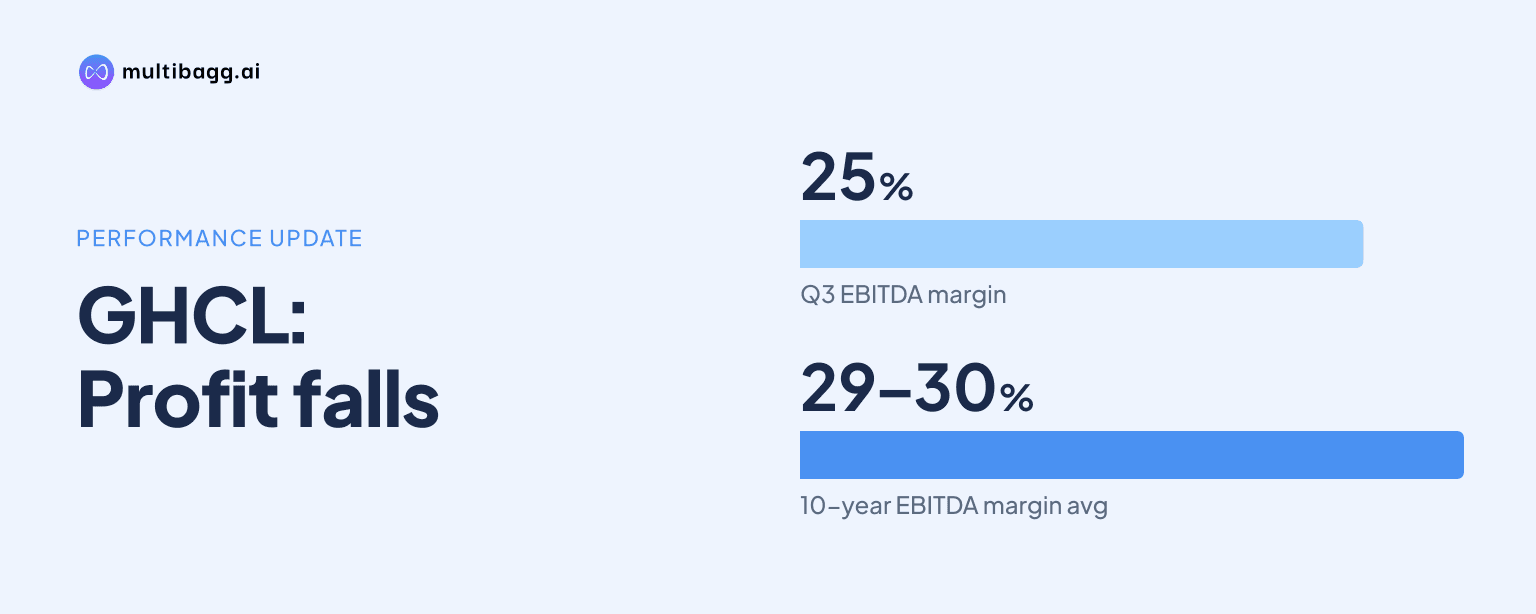
GHCL said its third-quarter profit will fall below the second quarter because an annual shutdown will reduce production and low-cost raw-material inventory benefits will fade, despite a small soda ash price increase. Management nevertheless said third-quarter earnings before interest, tax, depreciation and amortisation (EBITDA) would be at least above the year-earlier quarter, while its EBITDA margin was 25%.
Know GHCL inside out
Results, valuation, peers and who's buying, in one view.
Why will GHCL's Q3 result be lower than Q2?
GHCL expects its Q3 result to be lower than Q2 because an annual shutdown will reduce production and lower-cost raw-material inventory benefits will taper further. Management said the inventory-cost advantage was significant in Q1, had already reduced to some extent in Q2, and would fade further in Q3. The expected sequential decline therefore reflects both production lost during the shutdown and a less favourable cost base.
GHCL nevertheless said Q3 would be at least better than the corresponding quarter a year earlier. In a follow-up, an analyst asked whether Q3 EBITDA would be higher year on year despite margin pressure, and management agreed. Management also said the full-year result was likely to be similar to the prior year or slightly better, with incremental EBITDA from vacuum salt and bromine expected to contribute.
What did GHCL say about soda ash price changes?
GHCL described its latest soda ash price increase as small and did not quantify it during the call. Management said the increase had been taken only the previous day, while cautioning that soda ash pricing was not within the company’s control in the current geopolitical environment. The transcript therefore does not establish a percentage increase for the latest price action.
Management provided two longer-period comparisons. It said soda ash prices had risen about 7% in the reported quarter from the same quarter a year earlier and about 7% to 8% from February-March to the current period. It added that raw-material costs and supply-chain disruption had adjusted away some or much of that benefit. That contrasts with the latest increase, which management characterised only as small.
GHCL said its 25% EBITDA margin was supported by cost-optimisation initiatives despite global supply conditions. Management said many China-based Solvay-process plants were operating below cost and it could not predict when market economics would rebalance. Its view was that a rebalancing could narrow the 4-5-percentage-point gap to its cited 10-year average EBITDA margin of about 29%-30%, but it gave no timetable.
Got a follow-up? Ask IRIS
Can vacuum salt and bromine offset GHCL's Q3 pressure?
Vacuum salt and bromine are unlikely to offset the Q3 pressure fully because both projects are still ramping up. Vacuum salt had about 5% capacity utilisation in Q2 after starting operations, and management expected utilisation of around 50%-60% in the next quarter and about 80% in Q4. Management said the vacuum-salt project was capitalised in September.
Bromine began in Q3, with expected utilisation of around 40%-50% in the current quarter and 70%-75% in the next quarter. Management said both businesses would reach optimum utilisation next year and estimated a bromine margin of more than 40%. It also said bromine would be capitalised during the year after production had already begun.
These additions underpin management’s view that incremental EBITDA from vacuum salt and bromine would support the full-year result. GHCL said a further capacity expansion would come through the Zara Zumara field rather than the existing location, with that development expected to take two to three years to optimise. Separately, phased salt-field work was intended to add about 3 lakh tonnes of salt production over the next two years.
What could change GHCL's soda ash outlook?
GHCL sees India’s soda ash demand outlook improving next year, but current data remain subdued. Management said Indian demand grew about 9% last year but only 1%-plus in the first six months of the current year, citing geopolitical disruption and delayed solar-glass investment. Globally, it described demand outside India as broadly stable to flat while Chinese capacity additions continued to contribute to oversupply.
Management expects solar-glass capacity to rise from about 15 gigawatts to 35 gigawatts in the next six months. In its assessment, full utilisation of that capacity could add about 4%-5% to overall soda ash demand growth next year, on top of India’s longer-term demand-growth range of 4%-5%. Management said this combination could take demand growth in 2027 and 2028 back towards the 9%-10% range seen last year, but this was an outlook rather than a company forecast.
Imports are another variable. GHCL said soda ash imports were roughly 4 lakh tonnes in the first six months of the current year, broadly matching the second half of the previous year, after 5 lakh tonnes in that previous year’s first half. Management said imports from Iran, Russia and certain other countries had tapered and could leave the United States, Turkey and China as the three principal sources. It also said quantitative restrictions were under consideration by the government and the matter remained with the Directorate General of Trade Remedies, or DGTR.
Conclusion
GHCL’s guidance identifies a near-term mismatch between pricing and operating costs: a small soda ash increase is not expected to counter the Q3 production loss from the annual shutdown or the diminishing inventory-cost benefit. Management still expects the year to be similar to, or slightly better than, the previous year, aided by the new vacuum-salt and bromine businesses.
The next disclosures to watch are the reported Q3 impact of the shutdown and progress toward vacuum-salt utilisation of 50%-60% and bromine utilisation of 40%-50% in Q3. Management’s wider 2027-28 outlook also depends on solar-glass capacity reaching 35 gigawatts in six months, the resulting demand contribution, and any DGTR development on quantitative restrictions.