










GHCL Textiles pushes PM MITRA project commissioning to FY30
Key highlights
- GHCL Textiles has allowed for FY30 commissioning of its roughly Rs 300 crore PM MITRA project.
- Management said revised common-infrastructure specifications caused retendering and redrafting of DPRs.
- GHCL Textiles aims to be ready with ready-to-cut fabric by FY29-FY30.
- GHCL Textiles expects to commission 11 megawatts of solar capacity by the end of Q3.
powered by IRIS
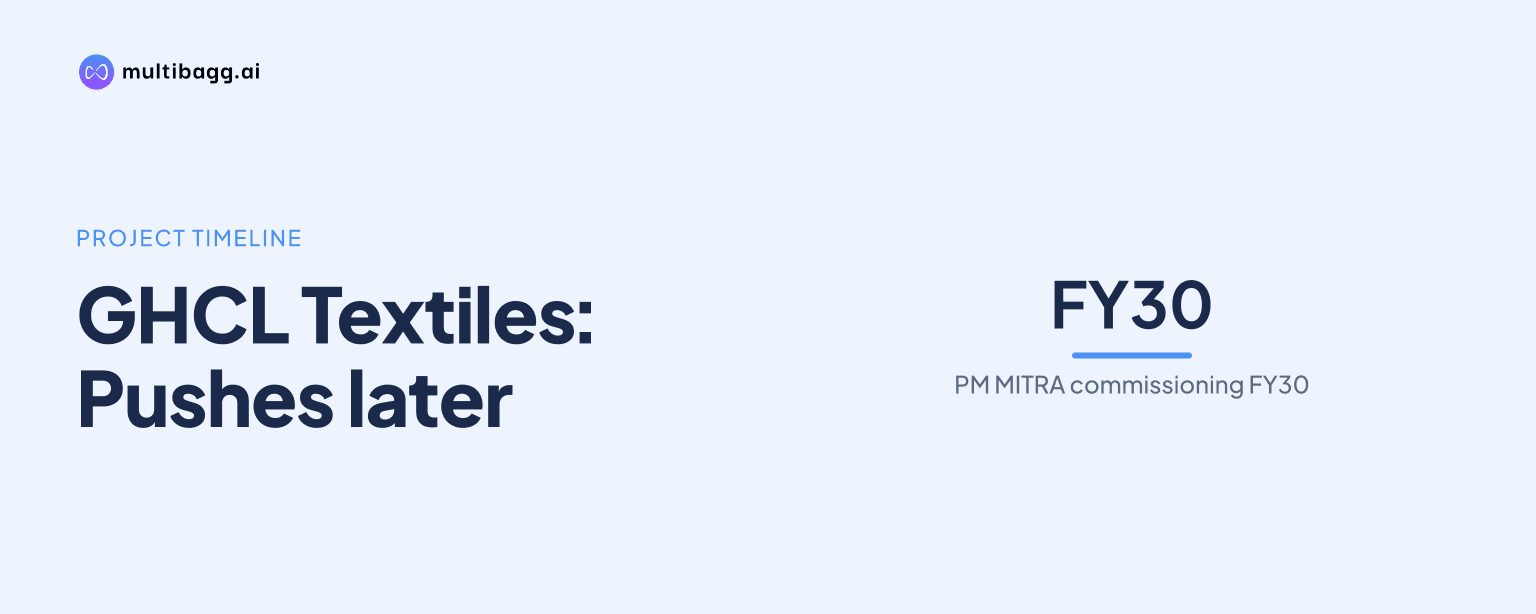
GHCL Textiles Limited has allowed for FY30 commissioning of its roughly Rs 300 crore PM MITRA processing project after requested changes to shared infrastructure specifications led to retendering and redrafting of project reports. Management said the additional time is intended to ensure common park facilities meet allottees’ requirements before GHCL Textiles commits project capital.
Know GHCL Textiles inside out
Results, valuation, peers and who's buying, in one view.
Why has GHCL Textiles delayed the PM MITRA project?
GHCL Textiles said the delay results from a consultative process involving park allottees and SIPCOT, the project’s execution body. Allottees requested changes to specifications for common infrastructure so that the facilities would better suit their requirements. Management said some tenders therefore needed to be reissued and detailed project reports, or DPRs, redrafted.
The company did not describe the FY30 schedule as a withdrawal from the park or a cut in its initial Rs 300 crore investment estimate. Instead, management said SIPCOT remained confident about completing the park on its earlier timeline, while GHCL Textiles had built additional cushion into its own plan. The company wants to assess whether the planned common facilities meet its requirements before scheduling its own capital expenditure.
An analyst referred to commissioning by FY30, compared with an earlier expectation around the end of FY29. Management did not provide a more specific commissioning date on the call. The revised timetable therefore depends partly on common infrastructure outside GHCL Textiles’ direct execution scope, including the revised tenders and DPRs.
How much will GHCL Textiles invest and what incentives are being discussed?
GHCL Textiles said its PM MITRA project would initially cost about Rs 300 crore, although management said the eventual cost could be higher. An analyst referred to a Rs 300 crore to Rs 350 crore range, and management responded that Rs 300 crore was the initial figure. The company said it would pursue a separate memorandum of understanding, or MOU, with the Tamil Nadu government for incentives associated with the PM MITRA investment.
GHCL Textiles said it had spent Rs 675 crore under a Rs 1,035 crore investment commitment with the Tamil Nadu government. Management said it was discussing which expenditure could count toward the remaining roughly Rs 400 crore of the commitment. It had applied for a change to include the Rs 410 crore incremental capital expenditure and said employment and other conditions were being met.
Management qualified its comments on the Rs 145 crore capital subsidy mentioned by the analyst. When asked whether the Rs 410 crore incremental expenditure would support release of that subsidy, management said this was “most likely,” rather than confirmed. It also said the PM MITRA investment would be addressed through a separate MOU that could provide an additional government incentive.
Got a follow-up? Ask IRIS
When will GHCL Textiles complete its vertical-integration plan?
GHCL Textiles said its objective is to be ready with ready-to-cut fabric by FY29-FY30, making the PM MITRA project part of a broader vertical-integration plan. Management said moving beyond a single commodity can help reduce margin fluctuation associated with that exposure. The company linked processing capacity and ready-to-cut fabric capability to that long-term objective.
Management said garmenting is a logical next step because GHCL Textiles is planning to reach ready-to-cut fabric. However, it said there was no garmenting announcement at the time of the call and described its view only as favourable. Management also clarified that any garmenting initiative would be additional to the PM MITRA project, rather than a substitute for it.
The company’s FY29-FY30 ready-to-cut fabric target extends beyond the project’s FY30 commissioning allowance. In closing remarks, management said vertical integration was intended to reduce the effect of fluctuations when operating in one commodity, while its near-term operating plans continue to include knitting capacity and renewable-energy investment.
What other projects and operating factors are on GHCL Textiles’ agenda?
GHCL Textiles expects to commission 11 megawatts of solar capacity by the end of Q3. Management said some spending for the project was recorded as capital advances within non-current assets, rather than solely as construction work in progress. It also cited the solar project and knitting as contributors expected to support Q4 performance.
Management said Q3 margin should be closer to Q1’s 17% than Q2’s 20.6%, while Q4 could be closer to the Q2 level. It attributed the expected sequential Q4 change partly to demand that usually strengthens from the end of December. Management said the full-year margin should be somewhere between the Q1 and Q2 levels.
The company attributed the Q1-to-Q2 margin improvement to a higher contribution from fabric, lower power costs from green-energy installations, product optimisation and strategic customers, alongside market conditions including lower-cost cotton inventory. Management said it believed the Q1 and Q2 margin levels were largely sustainable, while identifying market tailwinds as one contributor rather than a permanent operating change.
GHCL Textiles said it has no buyback plan and intends to reinvest margins and cash flow in growth. Management also said customers with greater exposure to the UK had generated good volumes linked to UK-based brands, although it could not quantify a direct benefit because the company operates upstream in the value chain. It expects effects from buyer nominations and supply-chain shifts to become clearer about a year later.
Conclusion
GHCL Textiles’ FY30 PM MITRA commissioning allowance reflects changes to shared park infrastructure rather than a stated change in the company’s vertical-integration strategy. The company retains an initial project estimate of about Rs 300 crore and continues to target ready-to-cut fabric capability by FY29-FY30, while any garmenting entry remains under consideration without a formal announcement.
Investors should watch whether revised tenders and DPRs allow common-infrastructure work to progress, and whether the Tamil Nadu government accepts the requested changes to the Rs 1,035 crore investment arrangement. Management also expects 11 megawatts of solar capacity by the end of Q3 and plans a separate MOU for PM MITRA-related incentives.