










GHCL Textiles Ltd Adjusted Q2 Profit Rises 249% to ₹56 Crore
Key highlights
- GHCL Textiles reported Q2 FY27 total income of ₹446 crore, up 31% year on year.
- Adjusted Q2 FY27 profit was ₹56 crore, up 249% from ₹16 crore a year earlier.
- EBITDA rose 141% year on year to ₹92 crore, while EBITDA margin expanded to 20.6%.
- The board approved ₹415.25 crore for a 58,368-spindle spinning unit in Tamil Nadu.
powered by IRIS
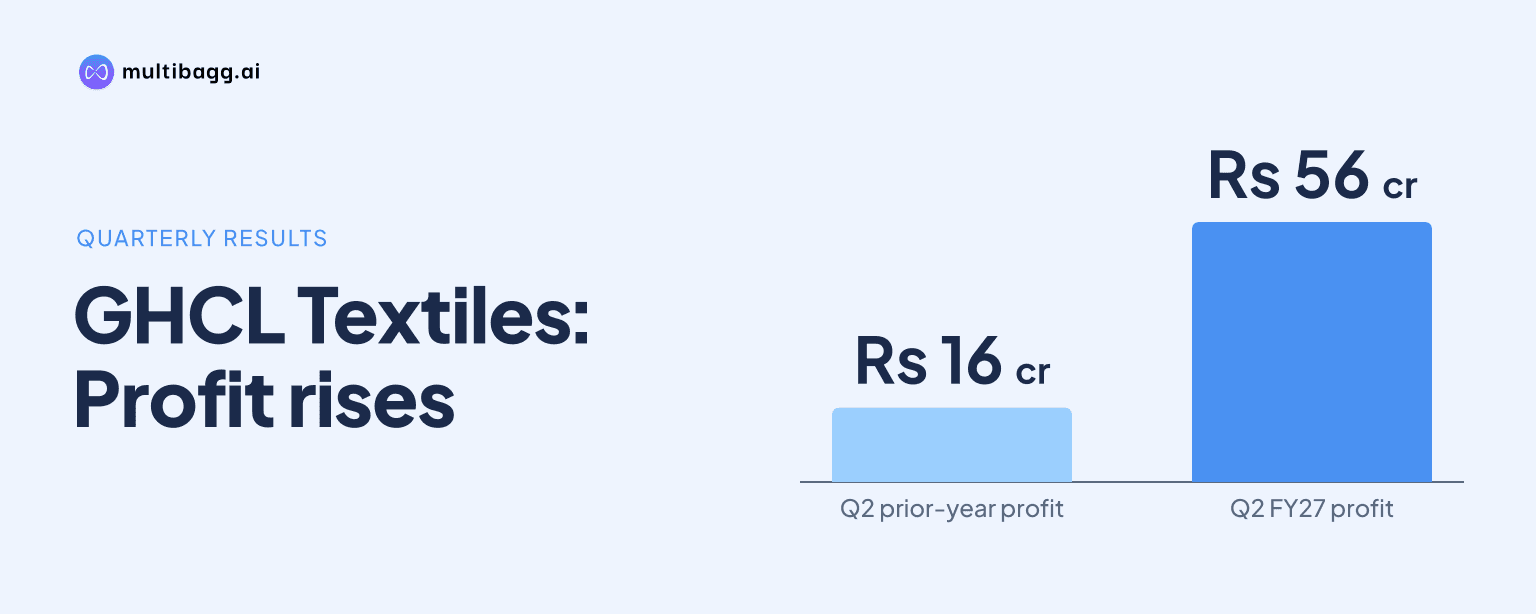
GHCL Textiles Ltd reported adjusted Q2 FY27 profit of ₹56 crore, up 249% year on year. Reported profit after tax was ₹35.84 crore after a ₹26.78 crore exceptional loss related to an August warehouse fire, while total income rose 31% year on year to ₹446 crore.
Know GHCL Textiles inside out
Results, valuation, peers and who's buying, in one view.
What did GHCL Textiles report for Q2 FY27?
GHCL Textiles reported total income of ₹446 crore for the quarter ended September 30, 2026, compared with ₹339 crore in Q2 FY26, a year-on-year rise of 31%. Income was also 9% higher than ₹409.60 crore in the preceding quarter. The company reported EBITDA of ₹92 crore, compared with ₹38 crore a year earlier, while EBITDA margin increased to 20.6% from 11.2%.
Adjusted profit after tax stood at ₹56 crore, against ₹16 crore in Q2 FY26. The reported profit after tax was lower at ₹35.84 crore because the quarter included an exceptional loss of ₹26.78 crore from a fire at a rented warehouse in August 2026. The company said the post-tax impact of this exceptional item was about ₹20 crore.
What drove GHCL Textiles' revenue and margin improvement?
GHCL Textiles attributed the quarterly performance to strong demand, volume growth and improved operating efficiency. Its operations ran at about 99% capacity utilisation during the quarter, while the Menashe unit operated at full capacity. These operating levels supported higher output and contributed to the improvement in profitability.
The product mix also shifted further towards fabric. Fabric contributed 16% of revenue in Q2 FY27, compared with 11% a year earlier. This higher share of value-added products coincided with a rise in operating margin to 20.6%.
The company reported that spreads improved to ₹173 per kg in Q2 from ₹160 per kg in Q1. However, cotton prices increased from ₹64,000 per candy to ₹69,000 per candy during the quarter. Management indicated that higher raw-material costs could put near-term pressure on margins, with Q3 spreads expected to be between the Q1 and Q2 levels.
What is GHCL Textiles' new capital expenditure plan?
GHCL Textiles' board approved a ₹415.25 crore capital budget for a new spinning unit in Tamil Nadu. The planned unit will have 58,368 spindles and is part of the company's capacity expansion programme. Management has indicated that the project is expected to be completed by FY28.
The company also outlined other projects under development. These include an 11 MW solar project targeted for completion by Q3 and a processing unit at PM Mitra Park targeted by FY30. GHCL Textiles has set a revenue target of ₹2,500 crore by FY30, supported by capacity additions, vertical integration and a higher share of value-added products.
Its balance sheet provides context for the investment plan. Net debt declined to ₹48 crore after the company repaid ₹74 crore during the first half of FY27. The reported net debt-to-equity ratio was 0.03 times, indicating relatively low leverage at the end of the period.
Got a follow-up? Ask IRIS
How did the warehouse fire affect the quarterly result?
The August 2026 fire at a rented warehouse reduced GHCL Textiles' reported quarterly profit through an exceptional loss of ₹26.78 crore. The company stated that the loss was about ₹20 crore after tax, explaining the difference between adjusted profit of ₹56 crore and reported profit after tax of ₹35.84 crore.
The company said its insurance claim recovery remained under investigation and was expected by the end of the year. No recovery has been included as a confirmed outcome in the reported quarterly figures. For investors, this means the reported and adjusted profit measures need to be viewed separately when assessing the quarter's operating performance.
The fire-related charge did not alter the company's stated expansion plans. But the final insurance outcome remains relevant because it would determine the extent to which the exceptional loss is recovered after the reporting period.
What do demand conditions mean for GHCL Textiles?
GHCL Textiles reported a limited export contribution, with exports accounting for 8% of Q2 revenue. Of that export business, 30% to 35% was directed to Bangladesh. Management described the continuation of Bangladesh's least-developed-country status as neutral for the company, with no immediate benefit expected.
The company cited trade agreements with the UK and New Zealand as supportive demand factors and referred to an India-European Union agreement as expected in early 2027. It also noted government measures such as duty-free cotton imports. These factors form part of the external backdrop for textile demand, although the quarterly result also showed the continuing importance of domestic operations and input-cost management.
For the wider textile sector, the quarter highlights the interaction between capacity utilisation, product mix and cotton costs. GHCL Textiles achieved a substantial margin improvement in Q2, but the rise in cotton prices shows why future profitability will depend on the company's ability to manage raw-material inflation alongside demand conditions.
Conclusion
GHCL Textiles delivered higher Q2 FY27 income, EBITDA and adjusted profit, with total income reaching ₹446 crore and adjusted profit rising to ₹56 crore. The difference between adjusted and reported profit reflects the one-time warehouse fire loss, while near-full capacity utilisation and a larger fabric contribution supported the operating result.
Investors will next watch the insurance claim outcome, the effect of higher cotton prices on Q3 spreads, and execution of the ₹415.25 crore Tamil Nadu spinning project. The company has also disclosed FY28 as the expected completion period for the new unit and FY30 as the target year for its ₹2,500 crore revenue goal.