










GIC Housing Finance Ltd: 0.33 P/B Meets Weak Returns Profile
Key highlights
- GIC Housing Finance trades at a reported price-to-book ratio of 0.33 times.
- GIC Housing Finance's five-year sales and EBIT reportedly declined 1.51% and 2.23% annually.
- GIC Housing Finance's trailing ROE is cited between 7.35% and 7.61%.
- GIC Housing Finance stock was reported down 30.38% over one year to 27 October 2026.
powered by IRIS
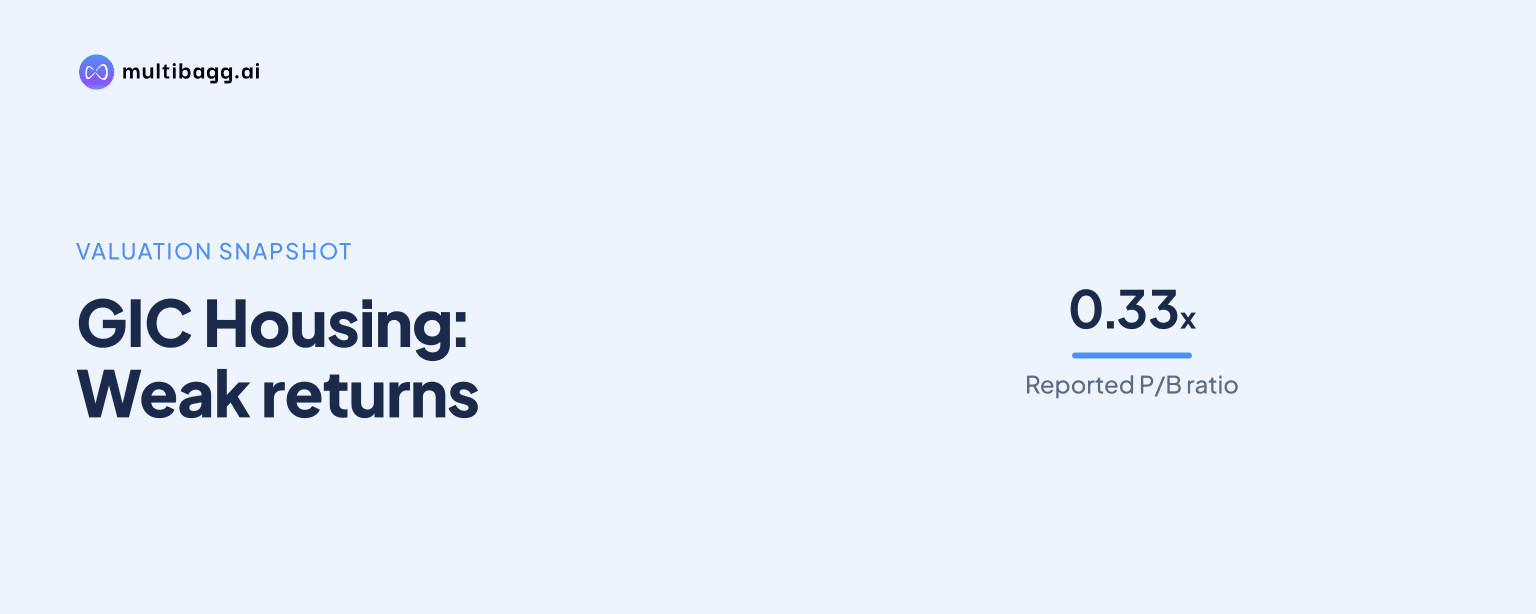
GIC Housing Finance Ltd. trades at a reported price-to-book ratio of 0.33 times, but its five-year sales and EBIT have fallen by 1.51% and 2.23% a year, respectively, making the valuation discount inseparable from concerns over returns, cash flow and leverage.
Why is GIC Housing Finance trading below book value?
GIC Housing Finance is trading below book value because market commentary links its low valuation to weak capital efficiency, shrinking operating metrics and financial-risk concerns rather than treating the discount as an automatic bargain. At a cited share price of ₹133.55 and book value per share of ₹390.94, the implied price-to-book ratio is 0.33 times.
The stock also trades on a reported price-to-earnings multiple of 4.42 to 4.48 times. That is below the same-industry median of 9.36 times cited in one comparison and below a peer average of 11.2 times cited elsewhere. A low multiple can signal value, but it can also reflect investor doubts about the durability of earnings and the returns generated on shareholders' capital.
Different valuation estimates in the discussion also show why a single fair-value figure should not be treated as a conclusion. One estimate puts fair value at ₹149, while another future-cash-flow estimate is ₹70.84 against a cited market price of ₹129.71. These are model-based assessments, not facts about a future share price, and they point to substantial uncertainty around the inputs.
Are GIC Housing Finance's returns and growth weak?
GIC Housing Finance's reported returns and multi-year growth trends are weak relative to the benchmarks cited by social-media commentators. Its trailing ROE has been placed between 7.35% and 7.61%, while long-term average ROE is reported at 9.19% and the three-year average at 8.2%.
Those figures are below the peer ROE range of 14% to 17% cited in the discussion and below an industry median of 11.72% in another comparison. ROCE is also reported between 7.56% and 7.75%, versus a cited industry median of 9.14%. The gap matters because a housing finance company trading below book value needs stronger returns on capital to make that discount look temporary rather than structural.
Growth data adds to the concern. Five-year net sales have reportedly declined at an annualised 1.51%, while EBIT or operating profit has contracted at an annualised 2.23%. Other posts cite earnings declining by 7.5% annually over five years, while one figure puts the five-year earnings decline at 0.2% annually. Despite the differing earnings estimates, the common point in the discussion is that recent long-term growth has not been consistently positive.
Got a follow-up? Ask IRIS
Does GIC Housing Finance face cash flow and leverage risks?
GIC Housing Finance faces reported cash flow and leverage risks, with the discussion identifying debt coverage by operating cash flow as a major concern. The company is described as operating at an operating cash loss in the cited risk assessment, while debt is said not to be well covered by operating cash flow.
The commentary also cites debt-to-equity of 4.3 and interest coverage of 1.2 times. These figures need to be assessed in the context of a housing finance business, but the cited discussion treats them as warning signs because weak cash generation can constrain financial flexibility. A separate observation that leverage has improved provides a counterpoint, although no figure for that improvement was supplied.
Dividend sustainability is another issue raised by commenters. GIC Housing Finance's dividend yield is cited at 3.47%, but the dividend is described as not being covered by free cash flow. For investors considering the stock primarily for income, the key question is not the stated yield alone but whether future cash generation can support distributions alongside debt obligations.
How has GIC Housing Finance stock performed?
GIC Housing Finance stock has delivered negative returns across the one-week, one-month and one-year periods cited in the discussion. As of 27 October 2026, it was reported up 0.28% for one day but down 5.84% over one week, 10.07% over one month and 30.38% over one year.
The posts also say the stock has underperformed the BSE500 benchmark over three years. Institutional ownership reportedly fell by 0.57 percentage points in the latest quarter cited, taking aggregate institutional holdings to 3.37%. That reduction does not establish a cause, but it aligns with the cautious market view described in the commentary.
A recovery case remains possible only if the operational concerns begin to change. The discussion points to recent quarterly earnings growth and improved leverage as offsets to the negative share-price trend. However, it provides no evidence that these developments have yet reversed the longer-term declines in sales, operating profit or return ratios.
Conclusion
GIC Housing Finance's low valuation is clear in the reported 0.33 times price-to-book ratio and roughly 4.4 times price-to-earnings ratio. However, the same discussion identifies declining sales and operating profit, ROE below cited peer benchmarks, weak operating cash flow coverage of debt and an uncovered dividend. Taken together, those factors explain why the discount may reflect fundamental risk rather than a straightforward value opportunity.
Investors should watch whether GIC Housing Finance can demonstrate sustained loan-book growth, more consistent profitability and better cash flow coverage of debt and dividends. The main unresolved issue is whether the reported quarterly improvement and leverage progress can translate into a durable recovery in ROE, ROCE and long-term growth.