










India’s Equity Market Lacks AI Stocks, Offering Diversification
Key highlights
- Foreign investors withdrew a record $29 billion from India in H1 2026 to pursue AI-related assets.
- Hardware and semiconductors drove roughly half of growth in global and emerging-market indices.
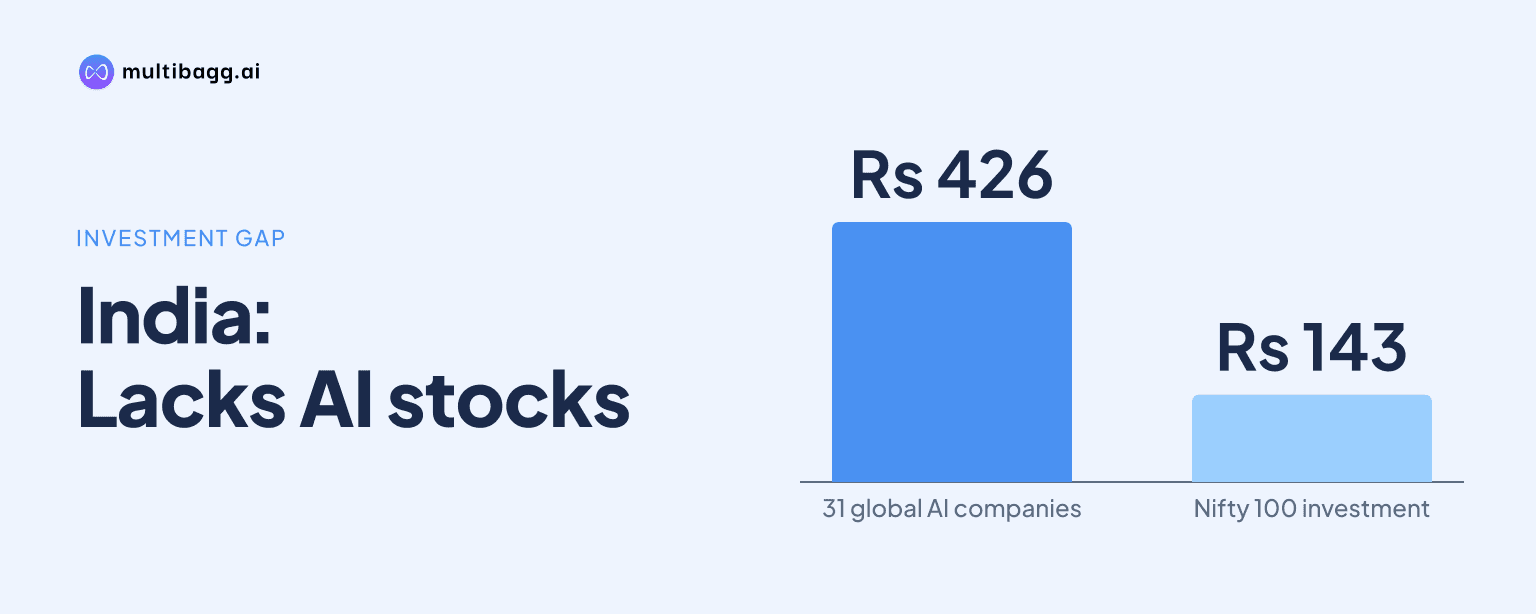
- A hypothetical Rs 100 equal-weighted investment in 31 global AI companies grew to Rs 426, versus Rs 143 for the Nifty 100.
- India’s IT export sector is worth more than $200 billion, according to the discussion.
powered by IRIS
India’s equity market has limited direct exposure to AI hardware, advanced chips and frontier models, a gap that is being viewed as a diversification feature after foreign investors withdrew a record $29 billion in H1 2026 to pursue AI-related assets. The market’s domestic earnings base may cushion it if the global AI trade weakens, though it does not remove valuation or earnings risks.
Why does India lack major AI stocks?
India lacks the listed semiconductor, GPU, hardware and frontier large-language-model companies that have powered AI-led gains in markets such as Taiwan, Korea, China and the United States. Its benchmark indices instead have greater exposure to financial services, consumption, energy, industrials and other service businesses, leaving them less tied to spending on AI infrastructure.
For roughly two years, this composition was seen as a weakness because capital moved towards companies across the AI value chain. Hardware and semiconductors drove roughly half of growth in global and emerging-market indices, while a small group of stocks accounted for much of that advance. India therefore lagged markets with concentrated AI exposure when enthusiasm for the theme was strongest.
How can India’s low AI exposure help investors?
India can act as a portfolio counterweight because its earnings are driven more by domestic credit, consumption, manufacturing investment and capital expenditure than by GPU order books. Deutsche Bank Research Institute has described India as a potential AI beneficiary through adoption at scale rather than through leadership in foundation models or semiconductor manufacturing.
The contrast is visible in a comparison cited in the discussion around the AI trade. It tracks a hypothetical Rs 100 investment from January 3, 2022 across 31 global AI companies, against Indian market benchmarks. The gap illustrates why India lagged the AI rally, but it also explains why a reversal in AI sentiment could make its lower correlation more valuable to global allocators.
Got a follow-up? Ask IRIS
Which Indian sectors have earnings drivers beyond AI?
India offers earnings exposure beyond the AI investment cycle through banking and financial services, automobiles, consumer discretionary, healthcare, telecom, capital goods and infrastructure. These sectors are linked to domestic demand, credit expansion, manufacturing investment and broader capital expenditure rather than direct demand for advanced chips or leading AI models.
There are also second-order AI opportunities in technology, power, capital goods and data-centre businesses. AI investment requires power generation, transmission, cooling and data-centre capacity alongside software and chips. That means India can participate in parts of the application and infrastructure economy without having the concentrated semiconductor exposure seen in some Asian markets.
What are the risks to India’s anti-AI trade?
India’s low AI exposure is not a guarantee of foreign inflows or a safe-haven status. Deutsche Bank has said sustained market gains will still depend on corporate earnings growth, while high valuations and subdued earnings growth have been factors behind investors remaining underweight on India for nearly two years.
The hedge could also fade if global AI sentiment recovers. Rising imports linked to capital expenditure could pressure India’s current account, and dependence on imported energy remains a headwind. Separately, AI creates unresolved risks for labour-intensive services: investors remain concerned that technological advances could affect employment, income growth and the consumption story.
Conclusion
India’s lack of major AI stocks has shifted from being a clear market disadvantage during the AI rally to a possible diversification benefit as investors question the returns from heavy, debt-fuelled spending on AI infrastructure and software. A broad domestic earnings base gives India a different risk profile from semiconductor-heavy markets, while selected businesses can still benefit from AI adoption and supporting infrastructure.
The next issue to watch is whether corporate earnings growth validates the case for renewed foreign allocations. Investors will also watch global AI sentiment, the effect of capital-expenditure imports on the current account, and whether AI disruption becomes more visible in India’s labour-intensive IT and service sectors.