










Gold and Silver Prices Stay Above Long-Term Trend After Crash
Key highlights
- Indian gold is down more than 30% from its January peak of ₹1,76,306 per 10 grams.
- Indian silver has fallen about 61% from its January peak of ₹3,84,632 per kg.
- Spot gold touched $3,693.13 an ounce, its lowest level since September 2025.
- Gold was up around 5% and silver around 2% over the past year despite the correction.
powered by IRIS
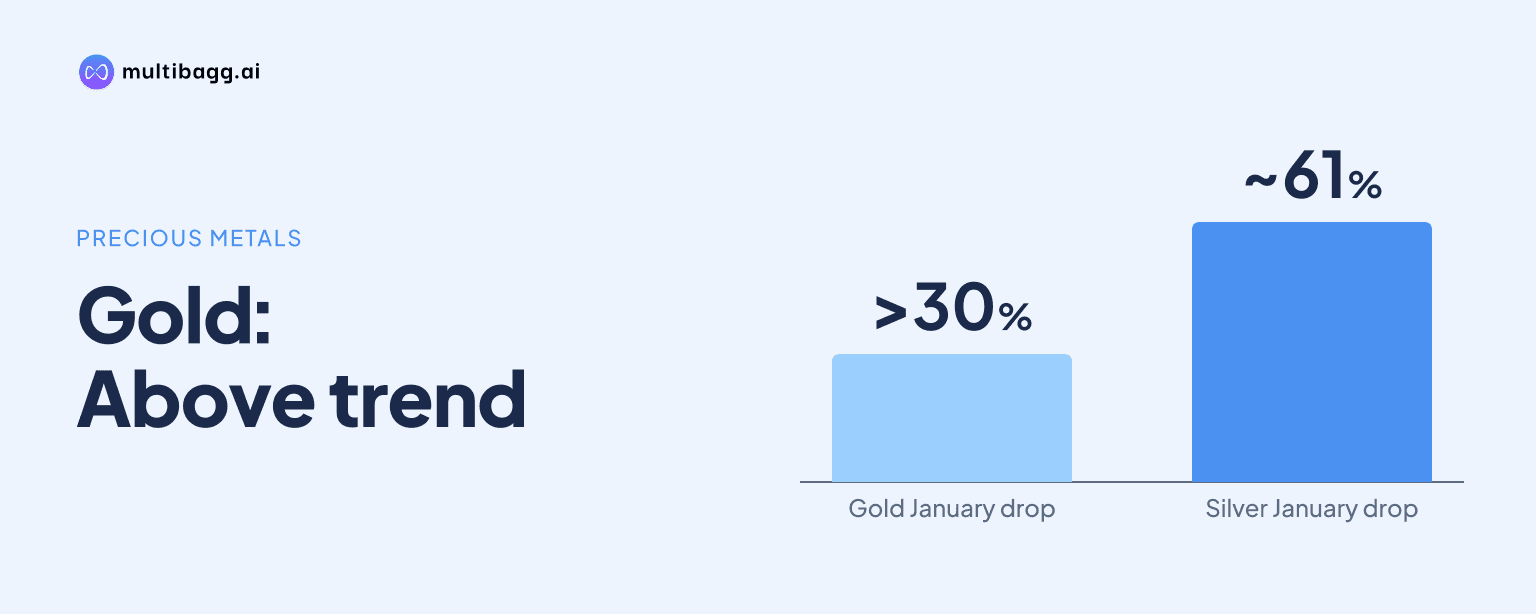
Gold and silver prices remain above their long-term trend after a crash that took Indian silver about 61% below its January peak. Gold has also fallen more than 30% from its January high in India, but both metals remain above last Diwali season's levels while structural demand factors continue to offer support.
Why have gold and silver prices fallen so sharply?
Gold and silver have fallen as a stronger dollar, uncertainty over US Federal Reserve policy and higher bond-yield concerns have outweighed safe-haven demand. Hawkish Federal Reserve commentary reinforced expectations of further monetary tightening, adding pressure to gold as it traded near a 14-month low.
The retreat has been substantial from January's highs. Gold had climbed to nearly $5,600 an ounce internationally before falling below $4,000 and later showing a modest rebound. In Indian markets, the correction has brought both metals closer to levels seen in late 2025, although the scale of the declines differs markedly.
Are gold and silver still above their long-term trend?
Gold and silver remain above their broader long-term trend because prices are still higher than during last year's Diwali season and the longer-term upward channel has been described as intact. The current decline has therefore been viewed by some market participants as a leverage-driven flush and sentiment reset rather than a confirmed reversal of the wider trend.
For Gold and silver, the distinction between a correction and a trend reversal matters. Gold was reported near its 20-day exponential moving average, while ₹1,40,000 to ₹1,45,000 per 10 grams was identified as a key support zone, helped by a firm USD/INR backdrop. The medium-term bias was described as constructive if gold holds above ₹1,40,000, but the cited levels also show that the market remains volatile.
Have gold and silver prices formed a bottom?
Gold and silver have not formed a convincing bottom, according to the social-media discussion, because the forces behind the sell-off have not changed enough to establish a durable floor. Lower prices may be attracting some buying, but oversold conditions alone do not confirm that the decline has ended.
Spot gold was recently little changed at $3,722.84 an ounce after touching $3,693.13, its lowest level since September 2025. Another reading placed gold around $3,737 and silver at $45.4, indicating some stabilisation after the fall. However, a rebound of 0.6% from a 14-month low does not by itself settle the question of whether the metals have bottomed.
Got a follow-up? Ask IRIS
What continues to support Gold and silver over the longer term?
Gold and silver retain longer-term support from persistent inflation, concerns over US fiscal indebtedness, geopolitical uncertainty, central-bank buying and, for silver, a supply deficit. These factors have not disappeared during the correction, which is why the long-term case has remained part of the market debate.
Investors who bought a year ago were still reported to be in profit despite the recent fall. Gold was up around 5% over that period and silver around 2%. One bank retained a positive view on gold, while adopting a more measured near-term outlook and characterising the sell-off as more about positioning than a change in the market regime.
What could determine the next move in Gold and silver?
The next move in Gold and silver will depend heavily on Federal Reserve signals, bond yields, the dollar and whether prices can hold key support levels. Renewed Middle East tensions have not been enough on their own to restore sustained safe-haven buying, showing how strongly monetary-policy expectations are influencing the market.
The outlook cited for gold includes an end-2026 target of $4,500 an ounce and an end-2027 forecast of $5,000, although the same view says a recovery may require patience. Near-term weakness cannot be ruled out, and the unresolved question is whether selling pressure linked to leverage and positioning has fully cleared.
Conclusion
Gold and silver have undergone a sharp correction from January's peaks, with Indian silver down about 61% and gold down more than 30%. Yet prices remain above last Diwali season's levels, while central-bank buying, inflation concerns, fiscal risks, geopolitical uncertainty and silver's supply deficit continue to support the broader long-term case.
Investors will next watch whether gold holds the ₹1,40,000 to ₹1,45,000 per 10 gram support range, along with Fed commentary, bond yields and the dollar. The stated $4,500 end-2026 gold target and $5,000 end-2027 forecast provide longer-term reference points, but neither resolves the risk of further near-term volatility.