










Indian rupee falls to 92.42 as crude and outflows intensify
Key highlights
- Indian rupee fell 14 paise to 92.42 per US dollar in early trade on March 17.
- The rupee opened at 92.35 before weakening to 92.42 in the reported session.
- The rupee touched a reported intraday low of 92.47 on the preceding Friday and closed at 92.30.
- On March 12, the rupee closed at 92.25 after falling 24 paise and touching 92.36 intraday.
powered by IRIS
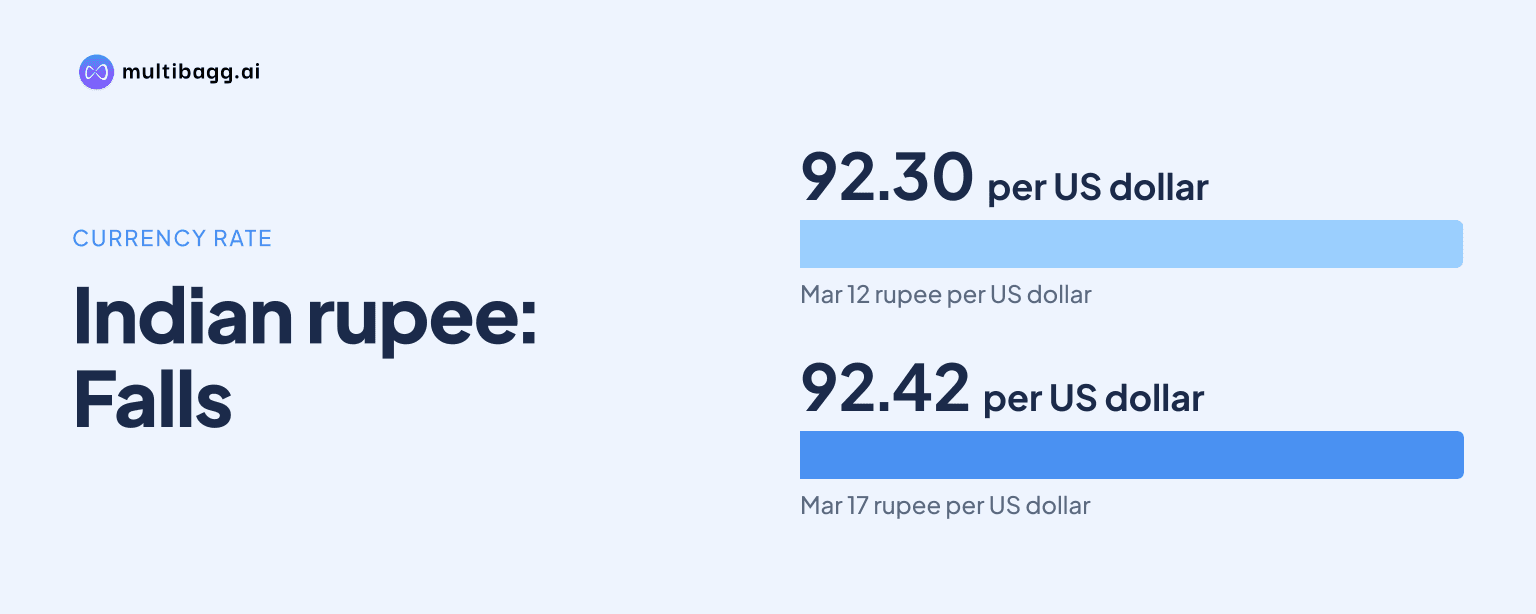
Indian rupee fell 14 paise to 92.42 against the US dollar in early trade on March 17, after crude oil prices rose and foreign fund outflows persisted amid West Asia tensions. The rupee had opened at 92.35 and remained close to record-low levels reported during the preceding sessions.
Why did the rupee weaken to 92.42 against the dollar?
The rupee weakened because higher crude oil prices, foreign fund withdrawals and volatile domestic equity sentiment combined with geopolitical uncertainty to raise demand for dollars. Reports linked the latest pressure to continuing tensions in West Asia and broader risk-off conditions in global markets.
A stronger dollar has also weighed on emerging-market currencies, while the domestic currency has struggled to gain ground even when the greenback eased from higher levels. Forex-market reports said the rupee opened at 92.35 in the March 17 session before trading at 92.42, a decline of 14 paise in early deals.
How has the rupee moved during the recent sessions?
The rupee has moved near successive record lows, with reports showing sharp intraday swings and weak closing levels across the recent trading sessions. It had touched 92.47 intraday on the preceding Friday and closed at a then-historic low of 92.30, before early trading around 92.43 and 92.42 in the following sessions.
The levels show that the move beyond 92 was not confined to one trading day. The currency has remained highly sensitive to changes in oil prices, foreign portfolio flows and news from the West Asia conflict, while volatile domestic equities have added to the pressure cited by forex traders.
Why do higher crude oil prices matter for the rupee?
Higher crude oil prices matter because India imports a large share of its crude requirement, so costlier energy raises the dollar value of the country’s oil purchases. Reports in the discussion put India’s crude import dependence at nearly 80% to 85%, making the currency especially exposed when global oil prices rise.
When oil costs increase, importers need more dollars to pay for energy, which can add to demand for the US currency. The same reports flagged the risk of imported inflation because crude oil, electronic components, fertilisers and industrial machinery are priced in dollars. Higher costs can feed into transport and manufacturing expenses for businesses and households.
Got a follow-up? Ask IRIS
Which sectors could be affected by a weaker rupee?
A weaker rupee can raise costs for sectors that rely heavily on imported fuel or dollar-priced inputs, including aviation, logistics and paints. The social-media discussion specifically identified the risk of margin pressure for energy-intensive businesses if higher input costs cannot be passed on quickly.
The effect is not identical across sectors. IT services and pharmaceutical exporters may become more competitive in overseas markets when dollar revenue converts into more rupees, according to the discussion. However, the cited concern was that gains for exporters could be offset at the economy-wide level by higher energy costs and imported inflation.
What role could the RBI play in the rupee market?
The Reserve Bank of India can be relevant when the currency faces sharp volatility, and reports said there was intervention after the rupee hit an intraday low of 92.36 on March 12. The reported intervention was followed by a slight recovery, though the currency still closed at a fresh record low of 92.25 that day.
The discussion also referred to India’s foreign-exchange reserves as a potential safety net, but did not provide a reserve figure or a stated policy action beyond the reported market intervention. The immediate market focus remains on whether oil prices, foreign flows and geopolitical risks ease enough to reduce pressure on the currency.
Conclusion
The rupee’s move to 92.42 reflects a convergence of higher crude prices, foreign fund outflows, volatile equities and risk aversion tied to West Asia tensions. Recent reported trading levels show the currency repeatedly approaching or setting record lows, with oil-import costs central to the concern for inflation and the external account.
Investors will watch crude oil prices, developments in West Asia, the direction of foreign fund flows and domestic equity-market sentiment. Another key unresolved matter is whether reported RBI intervention is sufficient to limit sharp intraday volatility while the rupee remains near record-low levels.