










GIL Q2 net profit rises 131% as income grows 33%
Key highlights
- GIL’s Q2 FY27 consolidated net profit rose 131% to Rs 560 crore.
- GIL’s Q2 FY27 total income increased 33% to Rs 8,387 crore.
- Finance & Investments generated Rs 485 crore, or 48.8%, of Q2 FY27 profit-making segment PBIT.
- GIL’s H1 FY27 consolidated net profit increased 43% to Rs 844 crore.
powered by IRIS
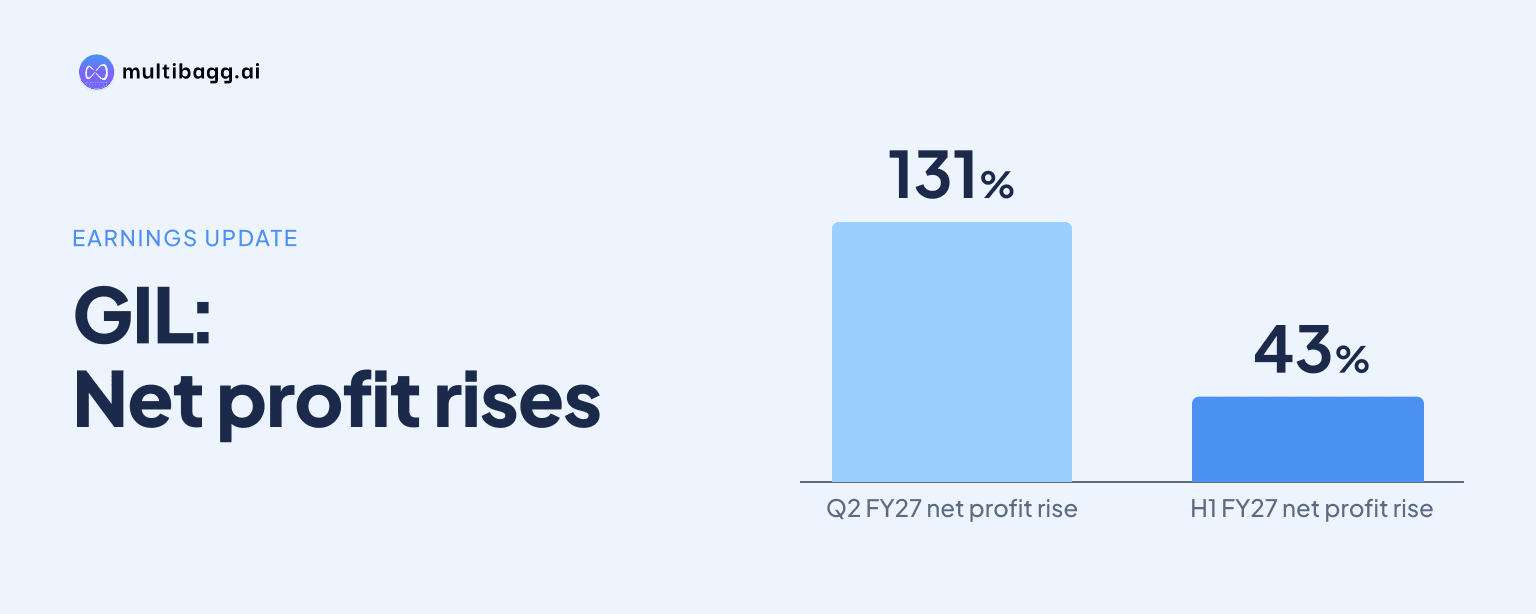
Godrej Industries Limited reported Q2 FY27 consolidated net profit of Rs 560 crore, up 131% from Rs 242 crore a year earlier, while total income increased 33% to Rs 8,387 crore. GIL’s Finance & Investments segment contributed Rs 485 crore, or 48.8%, of profit before interest and tax from profit-making segments.
Know Godrej Industries inside out
Results, valuation, peers and who's buying, in one view.
How did GIL perform in Q2 FY27?
GIL increased Q2 FY27 total income by 33% to Rs 8,387 crore and consolidated net profit by 131% to Rs 560 crore. Total income was Rs 6,290 crore in Q2 FY26, while net profit was Rs 242 crore. The profit figure includes the share of profit in associate companies after reduction of non-controlling interest, according to the presentation.
Profit before depreciation, interest and tax, or PBDIT, rose 16% to Rs 1,653 crore from Rs 1,428 crore. Profit before interest and tax, or PBIT, increased 15% to Rs 1,503 crore from Rs 1,307 crore, while depreciation increased to Rs 149 crore from Rs 121 crore and interest rose to Rs 807 crore from Rs 584 crore. GIL does not attribute the difference between income and net-profit growth to a specific item.
The period comparison shows net profit rising more quickly than both total income and PBIT. Interest expense increased by Rs 223 crore year on year, compared with a Rs 196 crore increase in PBIT, and depreciation increased by Rs 28 crore. The presentation states that PBDIT and PBIT include associates’ profit shares and exceptional items.
Which GIL segments contributed most in Q2 FY27?
GIL’s Finance & Investments segment was the largest contributor to Q2 FY27 PBIT among profit-making segments, generating Rs 485 crore or 48.8% of that PBIT. The segment recorded Rs 1,779 crore of revenue, equal to 20.2% of total segment revenue, leaving its PBIT contribution materially above its revenue mix.
Estate & Property Development generated the largest segment revenue, at Rs 2,562 crore or 29.0% of the total, but its PBIT was Rs 123 crore, or 12.4% of profit-making segment PBIT. Veg Oils generated Rs 165 crore of PBIT, representing 16.6% of the profit-making total, on revenue of Rs 913 crore or 10.3% of segment revenue.
Dairy and Crop Care reported PBIT losses of Rs 4 crore and Rs 6 crore, respectively, and therefore received no PBIT-mix percentage. GIL says segment figures are before elimination of inter-segment transactions. Consequently, segment revenue and PBIT are not directly reconcilable with consolidated total income of Rs 8,387 crore and consolidated PBIT of Rs 1,503 crore.
Got a follow-up? Ask IRIS
What do GIL’s H1 FY27 results show?
GIL reported H1 FY27 total income of Rs 14,747 crore, up 23% from Rs 12,009 crore in H1 FY26, while net profit rose 43% to Rs 844 crore from Rs 592 crore. PBDIT increased 3% to Rs 3,263 crore and PBIT increased 1% to Rs 2,980 crore from Rs 2,942 crore.
The first-half figures show a different pace from the quarter: net profit increased by Rs 252 crore, while PBIT increased by Rs 38 crore. Interest rose by Rs 392 crore to Rs 1,552 crore from Rs 1,160 crore, and depreciation increased by Rs 49 crore to Rs 283 crore. The presentation provides these figures without identifying the drivers of the net-profit movement.
Estate & Property Development was the largest H1 FY27 PBIT contributor, at Rs 625 crore or 31.1% of profit-making segment PBIT. Finance & Investments followed with Rs 585 crore or 29.1%. This differs from Q2 FY27, when Finance & Investments led with 48.8% and Estate & Property Development accounted for 12.4%.
Crop Care illustrates the change between the disclosed periods. It reported H1 FY27 PBIT of Rs 70 crore on revenue of Rs 621 crore, compared with a Q2 FY27 PBIT loss of Rs 6 crore on revenue of Rs 272 crore. Dairy remained loss-making, reporting an H1 FY27 PBIT loss of Rs 6 crore after a Q2 FY27 loss of Rs 4 crore; GIL does not disclose a separate Q1 explanation.
What should readers track after GIL’s Q2 result?
Readers should track whether Finance & Investments continues to contribute a disproportionately large share of segment PBIT relative to revenue. Its Q2 FY27 PBIT mix was 48.8% against a 20.2% revenue mix, whereas its H1 FY27 PBIT mix was 29.1% against a 17.9% revenue mix. Estate & Property Development moved in the opposite direction, leading H1 PBIT with Rs 625 crore after reporting Rs 123 crore in Q2.
Readers should also distinguish reported segment data from consolidated results. GIL calculates PBIT mix as PBIT from profit-making segments, excluding loss-making Dairy and Crop Care from that percentage. The company also says segment numbers are before inter-segment eliminations, while the consolidated Q2 figures include associates’ profit shares and exceptional items in PBDIT and PBIT.
GIL’s Nov. 13, 2026 presentation contains no FY27 consolidated income or profit target. Its forward-looking statement says outcomes could differ materially because of changes in industry structure, political and economic conditions in India and overseas, tax laws, import duties, litigation and labour relations.
Conclusion
GIL’s Q2 FY27 result combined 33% growth in total income with 131% growth in consolidated net profit. Finance & Investments supplied nearly half of profit-making segment PBIT despite contributing about one-fifth of segment revenue, while Estate & Property Development remained the largest revenue segment and became the largest H1 PBIT contributor.
The next reported period will show whether the Q2 segment-profit mix continues, particularly in Finance & Investments and Estate & Property Development, and whether Crop Care sustains its H1 profit after its Q2 loss. GIL has not disclosed an FY27 earnings target, while its Nov. 13, 2026 update identifies economic conditions, taxes, import duties, litigation and labour relations as unresolved factors that may affect results.