










Gland Pharma CDMO revenue rose 31% as FY29 pipeline builds
Key highlights
- Gland’s CDMO revenue rose 31% year on year to Rs 822.7 crore in Q2 FY27.
- CDMO represented 45% of Gland’s Q2 FY27 revenue, up from 42% in Q2 FY26.
- Gland has 15 co-development products anticipated to start commercialisation in FY29.
- US CDMO revenue grew 81% year on year to Rs 321.2 crore in Q2 FY27.
powered by IRIS
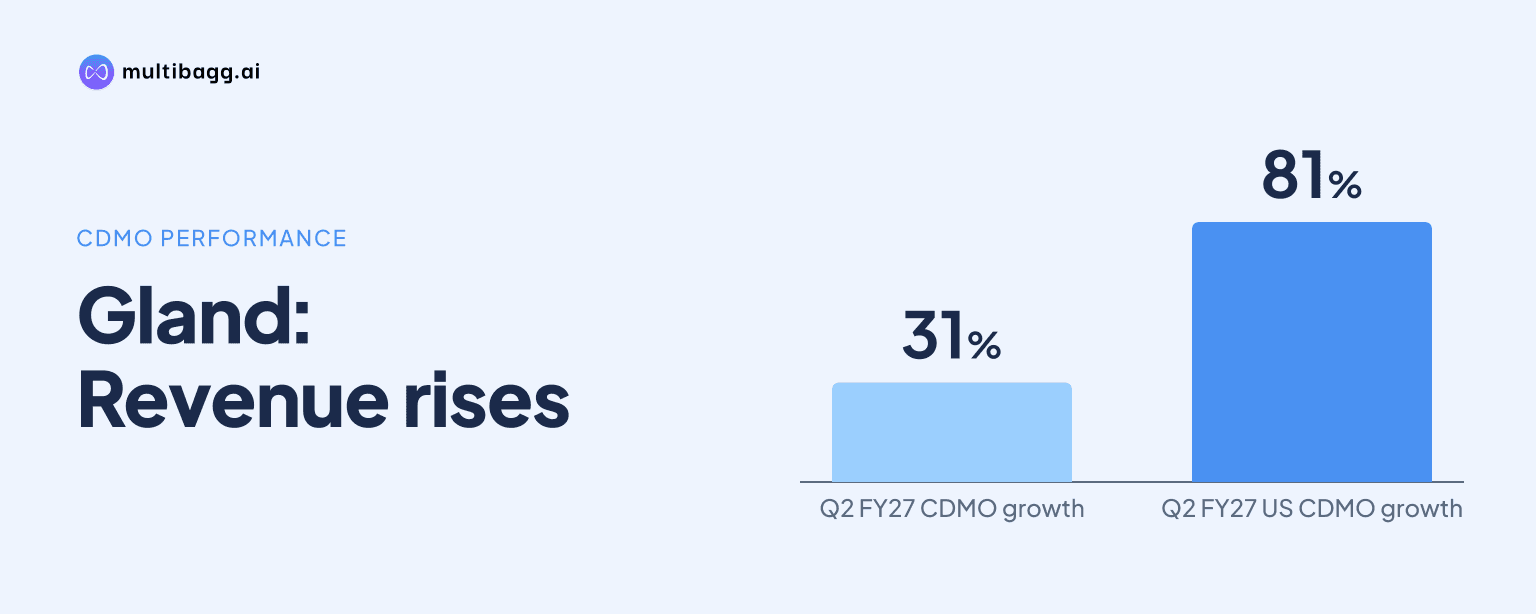
Gland Pharma’s contract development and manufacturing organisation, or CDMO, revenue rose 31% year on year to Rs 822.7 crore in Q2 FY27, increasing its share of revenue to 45%, while 15 co-development products are anticipated to begin commercialisation in FY29.
Know Gland Pharma inside out
Results, valuation, peers and who's buying, in one view.
How fast did Gland’s CDMO business grow in Q2 FY27?
Gland’s CDMO revenue grew 31% year on year to Rs 822.7 crore in Q2 FY27 from Rs 628.9 crore in Q2 FY26. Revenue was 8% lower sequentially than Rs 891.5 crore in Q1 FY27. Gland attributed the year-on-year increase to recent product launches and increased volumes.
For 6M FY27, CDMO revenue increased 25% to Rs 1,714.2 crore from Rs 1,370 crore in 6M FY26. Critical Injectables, which include business-to-business and business-to-consumer operations, rose 18% year on year to Rs 1,010.9 crore in Q2 FY27. CDMO therefore grew faster than Critical Injectables during the quarter.
Gland’s total business revenue increased 23% year on year to Rs 1,833.6 crore in Q2 FY27 and rose 21% to Rs 3,633.9 crore in 6M FY27. CDMO accounted for 45% of quarterly revenue, compared with 42% in Q2 FY26 and 50% in Q1 FY27. Critical Injectables represented the other 55%, down from 58% a year earlier.
Which markets drove Gland’s CDMO expansion?
Gland’s United States CDMO revenue rose 81% year on year to Rs 321.2 crore in Q2 FY27, supported by launches of Dalbavancin and Multi-Vitamin. It also increased from Rs 265.3 crore in Q1 FY27, unlike total CDMO revenue, which declined 8% sequentially. US CDMO revenue rose 64% to Rs 586.5 crore in 6M FY27 from Rs 356.8 crore a year earlier.
Europe CDMO revenue increased 31% year on year to Rs 367.6 crore in Q2 FY27, making it the larger of Gland’s two disclosed regional CDMO revenue bases. Gland cited the Dalbavancin launch and volume expansion in Daptomycin. The European figure was below Rs 391.6 crore in Q1 FY27, although 6M FY27 revenue increased 25% to Rs 759.3 crore from Rs 606.6 crore.
The US generated Rs 1,179.5 crore of total revenue in Q2 FY27, up 42% year on year, and made up 64% of Gland’s quarterly revenue. Europe generated Rs 371 crore, up 30%, and contributed 20%. US Critical Injectables revenue rose 32% to Rs 858.3 crore, with Gland citing Sugammadex and volume growth in Ketorolac, Chlorothiazide and Heparin.
What products are planned for FY29 commercialisation?
Gland has 15 products in co-development that are anticipated to start commercialisation in FY29. The portfolio comprises seven products using the US Food and Drug Administration’s 505(b)(2) pathway and eight Abbreviated New Drug Applications, or ANDAs. The presentation does not disclose product names, partner names, launch dates or expected revenue for these 15 products.
The co-development portfolio is separate from Gland’s in-house complex injectable pipeline, where six products have been launched and three are in line for approval. Gland said complex injectables are expected to remain a central pillar of long-term growth, with additional products being added to the pipeline. The presentation does not provide a timetable or revenue forecast for the three products in line for approval.
Gland filed 11 ANDAs and received 10 approvals in Q2 FY27. Its cumulative US ANDA record reached 399 filings, of which 350 were approved and 49 were pending; the count includes technology-transfer ANDAs. The company also launched four US molecules during the quarter: Sugammadex, Erythromycin, Fluorouracil and Atropine sulfate.
Got a follow-up? Ask IRIS
How is Gland supporting product development and manufacturing?
Gland spent Rs 107.7 crore on research and development in Q2 FY27, equal to 6% of consolidated revenue, compared with Rs 81.7 crore in Q2 FY26. The company said the expenditure was mainly focused on complex product development and filings. The Rs 26 crore year-on-year increase coincided with 11 ANDA filings during the quarter.
Gland had filed 24 Ready-to-Use, or RTU, infusion-bag products and received approval for 18, with a further eight under development. It said the total RTU bag portfolio addresses an approximate US market opportunity of $640 million. The presentation does not state commercialisation dates for the six filed products not yet approved or the eight development products.
Technology-transfer activities under Gland’s CDMO partnership with a global pharmaceutical company were advancing according to plan, and Gland said it had added a few more technology-transfer dossiers. Separately, it secured manufacturing contracts for microspheres and respiratory products. Contract values, durations and expected sales contributions were not disclosed.
What operating indicators accompanied the pipeline investment?
Gland reported total cash of Rs 3,441.2 crore and net cash of Rs 3,221.6 crore at the end of 6M FY27, compared with Rs 3,359.1 crore and Rs 3,115.7 crore in FY26. Net cash is defined as cash and cash equivalents less total borrowings, including current maturities. Cash flow from operations was Rs 602.7 crore in 6M FY27.
Gland’s cash conversion cycle declined to 158 days in 6M FY27 from 164 days in FY26 and 172 days in FY25. Inventory days fell to 123 from 130 in FY26, while receivable days declined to 96 from 97. Net working capital nevertheless increased to Rs 2,595.5 crore from Rs 2,485.5 crore.
Two Gland facilities were audited by the US Food and Drug Administration. The VSEZ facility had zero observations, while the Dundigal audit concluded in October 2026 with four procedural observations. Capital expenditure was Rs 256.2 crore in 6M FY27, after Rs 493.8 crore in FY26, while fixed-asset turnover rose to 1.7 times from 1.5 times.
Conclusion
Gland’s Q2 FY27 results show CDMO expanding faster than Critical Injectables, with 31% growth to Rs 822.7 crore and a 45% revenue contribution. US CDMO revenue recorded the fastest disclosed increase at 81%, while European CDMO revenue remained the larger disclosed regional contribution at Rs 367.6 crore. Product launches and volume growth were the stated drivers.
The next disclosed milestone is the anticipated FY29 start of commercialisation for 15 co-development products. Before then, Gland’s disclosed progress markers include three complex products in line for approval, 49 pending US ANDAs, additional RTU bag development, and technology-transfer activity under its global pharmaceutical company partnership.