










Gland Pharma’s India and overseas sales fall in Q2 FY27
Key highlights
- India revenue fell 42% year on year to Rs 38.7 crore in Q2 FY27.
- Rest-of-world revenue declined 21% year on year to Rs 204.4 crore in Q2 FY27 after delayed Middle East tenders.
- Other core markets revenue fell 18% year on year to Rs 40 crore in Q2 FY27.
- India, other core markets and rest of world represented stated Q2 FY27 contributions of 2%, 2% and 11%, respectively.
powered by IRIS
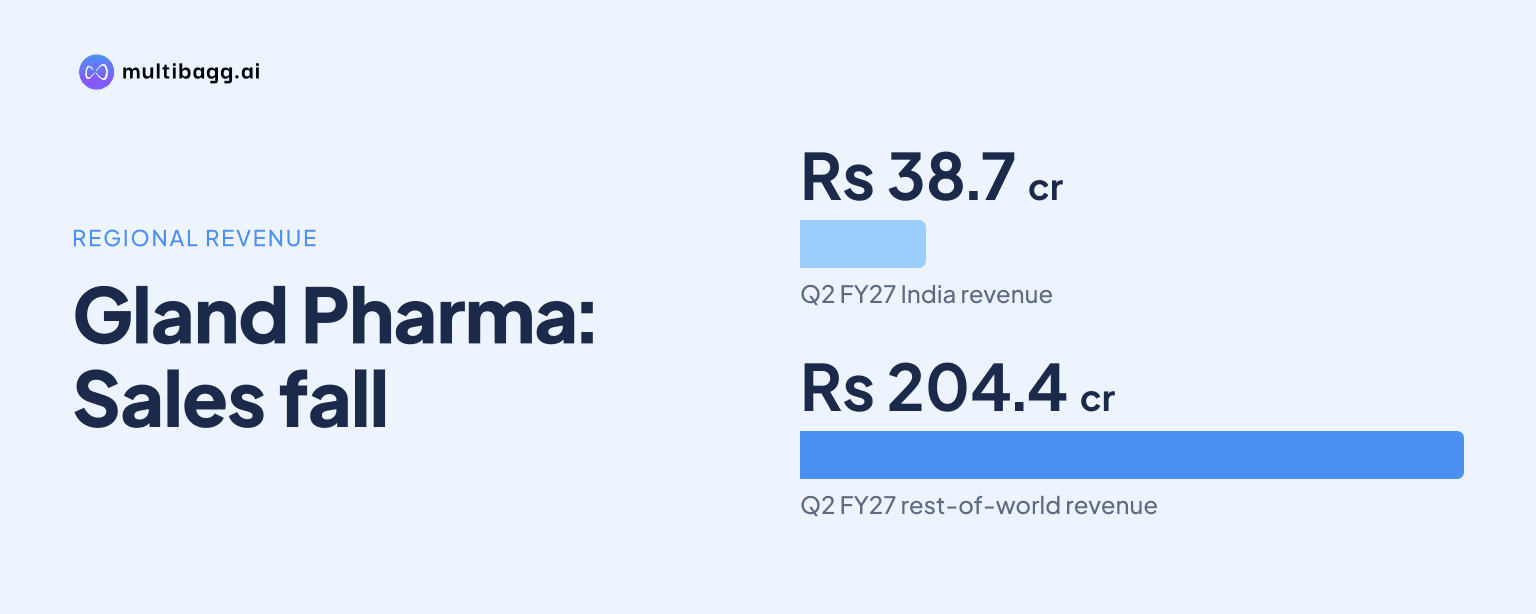
Gland Pharma Limited reported Q2 FY27 revenue declines of 42% in India, 21% in the rest of the world and 18% in other core markets, as management cited lower volume uptake, delayed Middle East tenders and lower volumes in existing products. India generated Rs 38.7 crore, the rest of the world Rs 204.4 crore and other core markets Rs 40 crore.
Know Gland Pharma inside out
Results, valuation, peers and who's buying, in one view.
Why did Gland Pharma’s sales decline in India and other overseas markets?
Gland Pharma said lower volume uptake affected India, delayed tender business in the Middle East reduced rest-of-world volumes, and lower volumes in existing products caused the other-core-markets decline. These explanations apply to three regions which together accounted for 15% of Q2 FY27 revenue contribution: India at 2%, other core markets at 2%, and rest of the world, or RoW, at 11%.
The quarterly pattern shows that these markets were smaller contributors than the United States and Europe, but their changes were material within their own sales bases. India revenue declined from Rs 66.5 crore in Q2 FY26 to Rs 38.7 crore in Q2 FY27. Other core markets, comprising Canada, Australia and New Zealand, fell from Rs 48.8 crore to Rs 40 crore, while RoW revenue decreased from Rs 259 crore to Rs 204.4 crore.
How much did Gland Pharma’s regional revenue change in Q2 FY27?
Gland Pharma’s India operation had the sharpest year-on-year decline, with total revenue down 42%, followed by RoW at 21% and other core markets at 18%. The presentation reports these comparisons against Q2 FY26, while also showing that all three regions declined from Q1 FY27 into Q2 FY27.
The sequential changes were also pronounced. RoW revenue dropped Rs 99.5 crore from Rs 303.9 crore in Q1 FY27, India declined Rs 27.9 crore from Rs 66.6 crore, and other core markets reduced Rs 13.4 crore from Rs 53.4 crore. The presentation does not identify a separate pricing, currency or customer-loss factor; it attributes the regional declines to the specified volume and tender issues.
Which Gland Pharma business segments drove the regional declines?
Gland Pharma’s contract development and manufacturing organisation, or CDMO, revenue fell more sharply than critical injectables in India and other core markets, while both businesses declined in RoW. In India, CDMO revenue fell 55% year on year to Rs 17.7 crore, compared with a 24% decline in critical injectables to Rs 21 crore.
Other core markets followed a similar split. CDMO revenue decreased 34% year on year to Rs 16.7 crore in Q2 FY27 from Rs 25.3 crore, whereas critical injectables were nearly level year on year, decreasing 1% to Rs 23.3 crore from Rs 23.5 crore. Yet critical injectables had risen to Rs 33.5 crore in Q1 FY27, making the Q2 FY27 figure Rs 10.2 crore lower sequentially.
RoW’s decline was led by critical injectables. Critical-injectables revenue fell 31% year on year from Rs 151.8 crore in Q2 FY26 to Rs 105 crore in Q2 FY27, while CDMO revenue declined 7% from Rs 107.2 crore to Rs 99.5 crore. Management linked the overall RoW performance to lower volumes resulting from delayed Middle East tender business, without allocating that impact between CDMO and critical injectables.
Got a follow-up? Ask IRIS
How did Gland Pharma’s first-half regional sales compare with last year?
Gland Pharma’s 6M FY27 revenue also declined in all three regions, although the percentage drops were smaller than the Q2 FY27 decline in India and RoW. India revenue declined 16% year on year to Rs 105.3 crore, other core markets fell 24% to Rs 93.4 crore, and RoW decreased 9% to Rs 508.3 crore.
The half-year results show differences between the two business categories. India CDMO revenue fell 6% to Rs 66 crore from Rs 70 crore, while India critical injectables declined 30% to Rs 39.3 crore from Rs 55.9 crore. In other core markets, CDMO fell 41% to Rs 36.6 crore, compared with a 7% decline to Rs 56.8 crore in critical injectables.
RoW’s six-month decline was less severe in CDMO than in critical injectables. CDMO revenue was Rs 265.8 crore in 6M FY27, down 3% from Rs 274.9 crore in 6M FY26, while critical injectables declined 14% from Rs 281.9 crore to Rs 242.5 crore. This comparison indicates that the Q2 slowdown followed a stronger Q1 FY27 revenue level of Rs 166.4 crore in RoW CDMO, compared with Rs 99.5 crore in Q2 FY27.
How do these declines compare with Gland Pharma’s larger markets?
Gland Pharma’s regional weakness contrasted with reported growth in its two largest disclosed geographies, the United States and Europe. The US contributed 64% of Q2 FY27 revenue and recorded 37% year-on-year total-revenue growth, while Europe contributed 20% and reported 30% growth. India, other core markets and RoW together represented 15%, based on the stated 2%, 2% and 11% contributions.
The United States reported Q2 FY27 total revenue of Rs 981 crore, compared with Rs 827.9 crore in Q2 FY26, while Europe reported Rs 371 crore compared with Rs 284.7 crore. In Europe, CDMO rose 31% year on year to Rs 367.6 crore, supported by recent Dalbavancin launches and volume expansion in Daptomycin, according to management. The presentation therefore shows different regional conditions rather than a uniform change across all markets.
The US business update also cited launches of Dalbavancin and Multi-Vitamin in CDMO, plus Sugammadex and volume expansion in products including Ketorolac, Chlorthiazide and Heparin in critical injectables. Gland Pharma launched four molecules in the US during Q2 FY27. These disclosed drivers sit alongside the negative volume and delayed-tender explanations in the three declining regions, but the presentation gives no timing for a recovery in India, other core markets or RoW.
Conclusion
Gland Pharma’s Q2 FY27 geographic data show that India experienced the largest proportional contraction, while the RoW reduction had the biggest absolute effect among the three declining regions at Rs 54.6 crore year on year. The segment mix differed by market: India and other core markets had steeper CDMO declines, whereas RoW critical injectables fell 31%.
The next reported periods should show whether Middle East tender business resumes and whether volume uptake improves in India and other core markets. Management’s presentation identifies recent launches and existing-product volume expansion as drivers in the US and Europe, but it does not disclose a regional sales target, tender-resolution date or recovery forecast for the three contracting markets.