










Gland Pharma Q2 FY27 Revenue Rises 23% to ₹18,336 Million
Key highlights
- Gland Pharma Limited reported Q2 FY27 revenue of ₹18,336 million, up 23% year-on-year.
- Q2 FY27 profit after tax increased 58% year-on-year to ₹2,908 million.
- Adjusted EBITDA rose 50% year-on-year to ₹5,030 million, with a 27% margin.
- Q2 FY27 gross profit was ₹11,638 million, up 25% year-on-year, at a 63% margin.
powered by IRIS
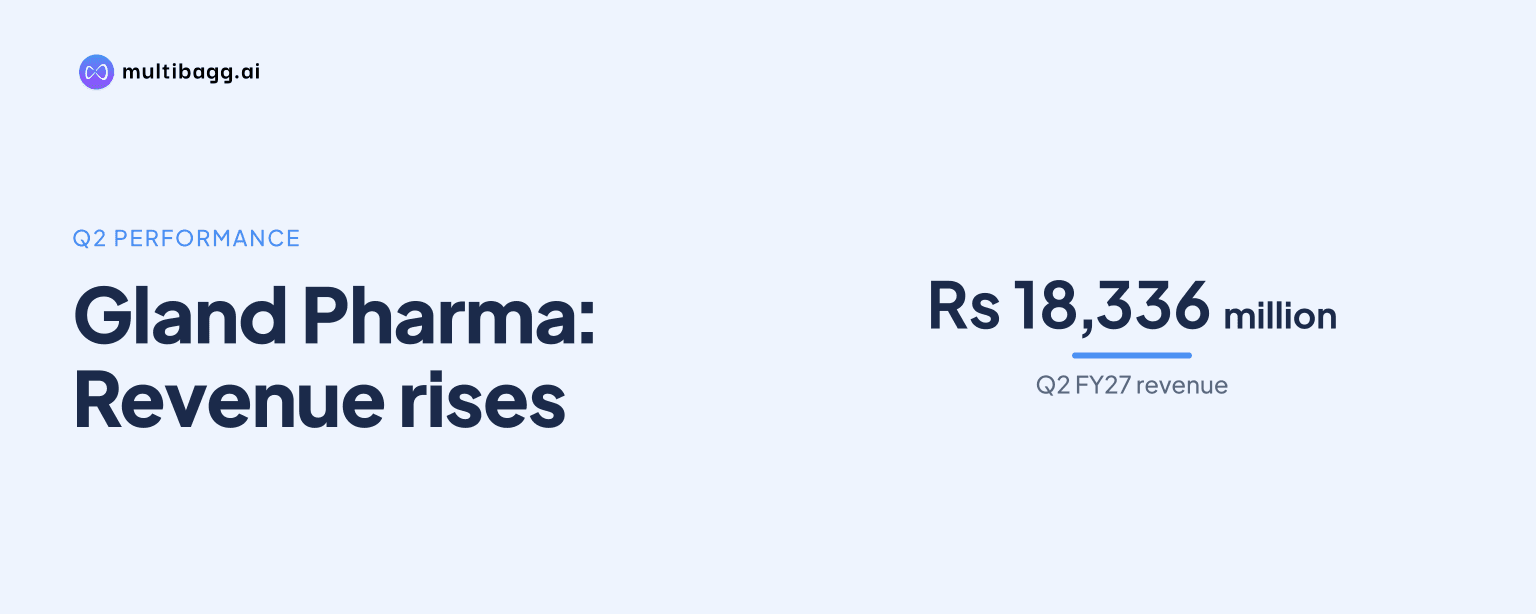
Gland Pharma Limited reported Q2 FY27 revenue of ₹18,336 million, up 23% year-on-year. The company also reported a 58% rise in profit after tax to ₹2,908 million and adjusted EBITDA of ₹5,030 million, reflecting stronger operating performance during the quarter ended September 30, 2026.
Know Gland Pharma inside out
Results, valuation, peers and who's buying, in one view.
What did Gland Pharma report in Q2 FY27?
Gland Pharma reported consolidated revenue from operations of ₹18,336 million for the second quarter of FY27, compared with ₹14,869 million in the corresponding quarter of FY26. The 23% year-on-year increase was accompanied by reported EBITDA of ₹4,804 million, up 53% from ₹3,139 million a year earlier.
Adjusted EBITDA rose 50% year-on-year to ₹5,030 million, with an adjusted EBITDA margin of 27%. Profit after tax increased 58% to ₹2,908 million. The results indicate that profit growth exceeded revenue growth during the quarter, supported by the improvement in operating profitability reported by the company.
Gross profit for the quarter stood at ₹11,638 million, a 25% increase year-on-year, while the gross margin was 63%. For the first six months of FY27, gross profit was ₹23,397 million, up 22% year-on-year, with a gross margin of 64%.
How did the quarter unfold for Gland Pharma?
The company discussed the quarterly performance during its earnings call on November 6, 2026, with Executive Chairman Srinivas Sadu and Chief Financial Officer Ravi Mitra representing management. The company subsequently reported its unaudited financial results for the quarter and half year ended September 30, 2026.
Management highlighted growth in the CDMO business as part of the quarterly discussion. It stated during the question-and-answer session that CDMO margins are about 5% to 10% higher than the company’s own business, which includes lower-margin India and rest-of-world operations. Cenexi is fully reported within the CDMO segment, according to management.
Gland Pharma also reported India revenue of ₹387 million in Q2 FY27. The company described India as a relatively small part of its overall business. Available earnings-call highlights stated that India revenue declined 42% year-on-year, with volumes in India and rest-of-world markets affected by lower uptake and delayed tender business.
The company did not provide a quantified outlook for the expected contribution from its India initiatives. Management said it was continuing to assess selective opportunities for portfolio expansion and market development in the country.
What operational investments is Gland Pharma making?
Gland Pharma said it continues to invest in vial capacity expansion, ophthalmic capabilities, blow-fill-seal infrastructure, liposomal platforms and other specialised manufacturing technologies across its India operations. These areas are relevant to sterile injectables and specialised drug-delivery formats, which form part of the company’s manufacturing focus.
The company has also onboarded a head of strategy and innovative medicines in India and a business-development head based in China. Management said these appointments are intended to pursue innovative and speciality products from China for the Indian market.
Rather than entering the Indian generics market through a broad-based strategy, Gland Pharma indicated that it aims to in-license innovative products. Management said it plans to use access to Fosun subsidiaries and other companies, while seeking lower investment requirements than licensing products for larger markets.
The strategy is still at an evaluation and development stage. The company did not disclose product names, transaction values, launch timelines or a revenue target for the India-focused in-licensing effort.
Got a follow-up? Ask IRIS
Why do the margin figures matter to investors?
The gap between revenue growth and profit growth is an important feature of the quarter. Revenue rose 23%, while adjusted EBITDA increased 50% and profit after tax rose 58%. Reported EBITDA increased 53%, showing that the company’s reported operating profit grew faster than sales in the period.
The 63% quarterly gross margin and 27% adjusted EBITDA margin provide context for that improvement. Gross profit grew 25%, slightly faster than revenue, while management’s comments on CDMO profitability point to the business mix as a relevant operating factor. However, the company did not disclose a detailed segment-wise revenue or profit break-up in the provided material.
For investors, the India revenue trend remains a separate consideration. India revenue of ₹387 million was small relative to total quarterly revenue of ₹18,336 million, but the 42% year-on-year decline reported in call highlights shows that lower uptake and delayed tenders affected that market during the quarter.
No share-price movement, dividend decision or financial guidance was disclosed in the provided material. The available disclosures therefore support an assessment based on reported earnings, margins, operational investments and management commentary rather than a stated forward financial forecast.
How does the first-half performance provide context?
The six-month gross profit figure of ₹23,397 million, up 22% year-on-year, indicates that the gross-profit improvement reported in the second quarter was also visible across the first half of FY27. The 64% first-half gross margin was one percentage point above the 63% margin reported for the second quarter.
The broader context includes Gland Pharma’s continued focus on specialised manufacturing capacity and its CDMO operations. The company’s stated investments in vials, ophthalmics, blow-fill-seal technology and liposomal platforms suggest that operating capability remains an important part of its business plan alongside product and market expansion.
The company also received approval for Methylprednisolone Acetate Injectable Suspension USP in single-dose and multiple-dose vials on November 3, 2026, shortly before the Q2 results period disclosures. The provided material does not quantify any immediate revenue contribution from that approval.
Conclusion
Gland Pharma’s Q2 FY27 results showed higher revenue, gross profit, operating profit and net profit, with revenue reaching ₹18,336 million and profit after tax rising to ₹2,908 million. The results also showed a stronger profit-growth rate than revenue growth, while management linked CDMO operations to relatively higher margins.
The next areas to watch are the execution of investments in specialised manufacturing infrastructure, the development of innovative-product in-licensing for India, and the resolution of lower uptake and delayed tender effects in India and rest-of-world markets. Gland Pharma has not disclosed a quantified guidance target for these initiatives.