










Global Surfaces Limited Revenue Rises 10.7%, Q2 Loss at Rs 5.3 Crore
Key highlights
- Global Surfaces reported Q2 FY27 consolidated revenue of Rs 59.9 crore, up 10.7% year-on-year.
- Q2 FY27 EBITDA was Rs 1.3 crore, compared with an EBITDA loss of Rs 3.6 crore a year earlier.
- Global Surfaces reported a Q2 FY27 consolidated loss after tax of Rs 5.3 crore.
- H1 FY27 EBITDA increased to Rs 9.6 crore from Rs 4.4 crore, and the margin rose to 7.66% from 3.42%.
powered by IRIS
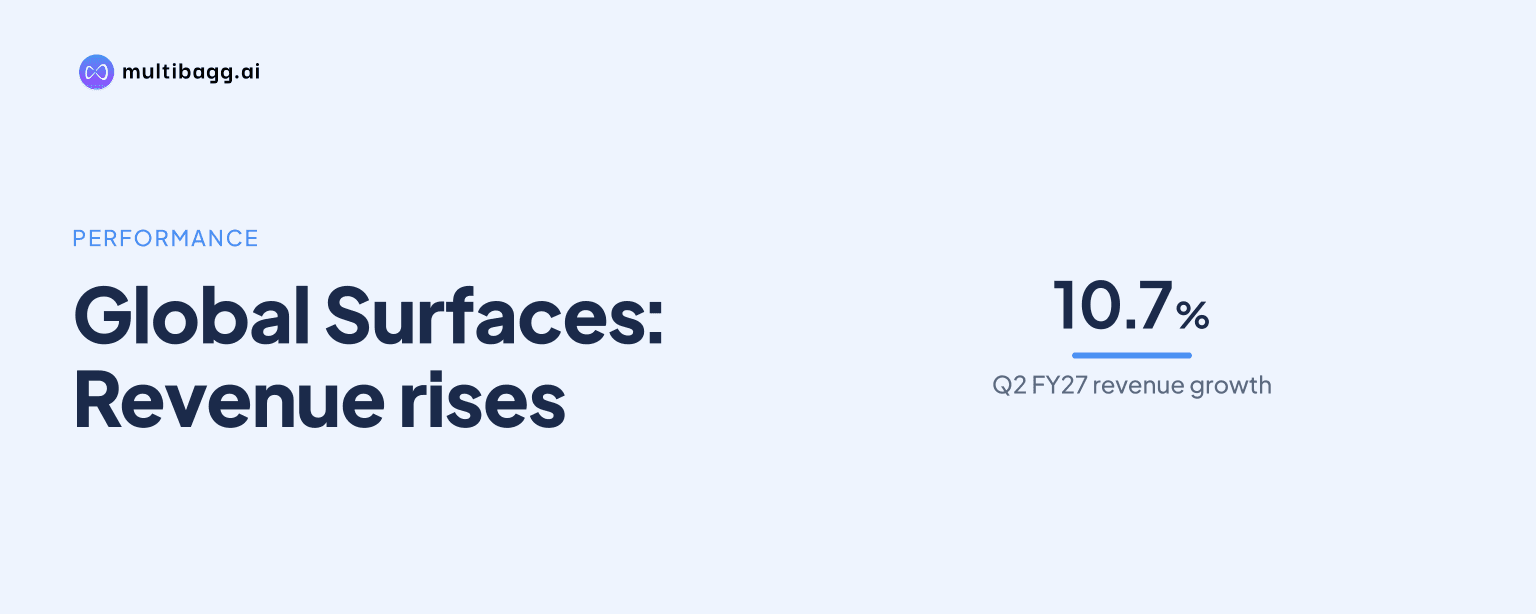
Global Surfaces Limited reported Q2 FY27 consolidated revenue of Rs 59.9 crore, up 10.7% year-on-year, but its net loss widened to Rs 5.3 crore from Rs 4.7 crore in Q2 FY26. The results show a return to positive EBITDA despite continuing pressure from finance costs and lower other income.
Know Global Surfaces inside out
Results, valuation, peers and who's buying, in one view.
What did Global Surfaces report in Q2 FY27?
Global Surfaces reported consolidated revenue from operations of Rs 59.9 crore for the July to September 2026 quarter, compared with Rs 54.1 crore in the corresponding quarter of the previous year. The 10.7% increase marked revenue growth after a period of low capacity utilisation across the company’s India and Dubai operations.
The company reported EBITDA of Rs 1.3 crore in Q2 FY27, compared with an EBITDA loss of Rs 3.6 crore in Q2 FY26. Its EBITDA margin improved to 2.17% from negative 6.65% a year earlier. Total expenses rose 1.6% year-on-year to Rs 58.6 crore, a slower pace than the increase in revenue.
However, Global Surfaces remained loss-making at the net-profit level. The supplied results information reported a Q2 FY27 loss after tax of Rs 5.3 crore, against a Rs 4.7 crore loss in the year-ago quarter, citing lower other income and elevated finance costs. Another supplied summary referred to the quarterly loss as Rs 5.4 crore, while the investor presentation-based summary reported Rs 5.3 crore.
How did the standalone and segment figures compare?
The standalone Q2 FY27 filing reported revenue of Rs 19.65 crore and profit after tax of Rs 0.05 crore, compared with revenue of Rs 54.08 crore and a loss of Rs 4.66 crore in Q2 FY26. This standalone data should not be compared directly with the consolidated revenue of Rs 59.9 crore, which includes the wider group’s operations.
The India segment generated revenue of Rs 19.6 crore in Q2 FY27, representing 27.2% of total segment revenue. India segment revenue increased 19% year-on-year, while its segment result was Rs 0.3 crore and the segment result margin was 1.4%.
The distinction between standalone and consolidated data is important for investors reviewing the results. The standalone profit figure of Rs 0.05 crore reflects a positive comparison with a prior-year loss, while the consolidated accounts continued to show a material loss because group-level costs and other items remained significant.
What were the half-year operating trends?
Global Surfaces reported H1 FY27 EBITDA of Rs 9.6 crore, compared with Rs 4.4 crore in H1 FY26. The EBITDA margin improved to 7.66% from 3.42% in the prior-year half, indicating better operating profitability over the six-month period.
H1 FY27 revenue was Rs 125.3 crore, down 2.6% from Rs 128.6 crore in H1 FY26. Despite the improvement in EBITDA, the company reported a profit-after-tax loss of Rs 5.3 crore for the half year.
The results therefore indicate that operating performance improved faster than reported revenue for the half year. But the continuing loss after tax shows that the benefit of the EBITDA recovery had not fully offset finance costs and other non-operating factors disclosed in the supplied results summary.
Got a follow-up? Ask IRIS
What is Global Surfaces doing to develop its markets?
Global Surfaces began domestic dispatches in India in October 2026 after expanding its marketing team. The company had earlier said it planned to build its domestic business through a dealer-led distribution network serving B2B and B2C customers in major cities under the Global Surfaces brand.
The company also said it was pursuing further diversification in the UAE market using its existing manufacturing capabilities and infrastructure. These initiatives come as the company seeks to increase volumes from its installed facilities rather than relying only on existing export and regional business channels.
Capacity utilisation remained modest. Global Surfaces reported utilisation of 36% at its India operations and about 20% in Dubai, with overall utilisation of 27% to 28%. In its March 2026 presentation, the company reported three facilities across India and the UAE with total annual engineered-stone capacity of 11,44,540 square metres.
Why do the results matter for investors?
The Q2 figures matter because Global Surfaces moved back to positive EBITDA while keeping expense growth below revenue growth. The improvement from an EBITDA loss of Rs 3.6 crore to positive EBITDA of Rs 1.3 crore is the clearest operating change in the quarter.
At the same time, the wider consolidated loss shows that positive EBITDA has not yet translated into positive net profit. Investors assessing the company’s financial performance will need to distinguish between the standalone numbers, India segment data and the consolidated results, as each describes a different part of the business.
The board approved the conversion of Rs 110.44 crore of unsecured loans into equity, with the amount classified as an advance towards equity subscription pending regulatory formalities. This is a disclosed capital-structure development that is relevant alongside the company’s operating recovery and continuing net loss.
Conclusion
Global Surfaces recorded higher consolidated Q2 FY27 revenue and a return to positive EBITDA, supported by limited expense growth. Yet the company remained loss-making after tax, while its disclosed utilisation levels indicate substantial unused capacity in both India and Dubai.
Investors can watch for the transcript of the Q2 and H1 FY27 earnings call, which was held on November 3, 2026, after the company uploaded the audio recording. The key disclosed operating matters remain the domestic India rollout, UAE market diversification, utilisation improvement and completion of regulatory formalities for the proposed Rs 110.44 crore loan conversion into equity.