










Global Surfaces secures Marquartz licence backed by over 20 patents
Key highlights
- Global Surfaces FZE received exclusive Marquartz manufacturing rights in MENA and FROR in India.
- The Marquartz technology platform is associated with over 20 utility patents secured in the past 7 years.
- Engineered-stone revenue increased from Rs 144.1 crore in FY24 to Rs 220 crore in FY26.
- Natural-stone operations were approved for discontinuation effective March 31, 2026.
powered by IRIS
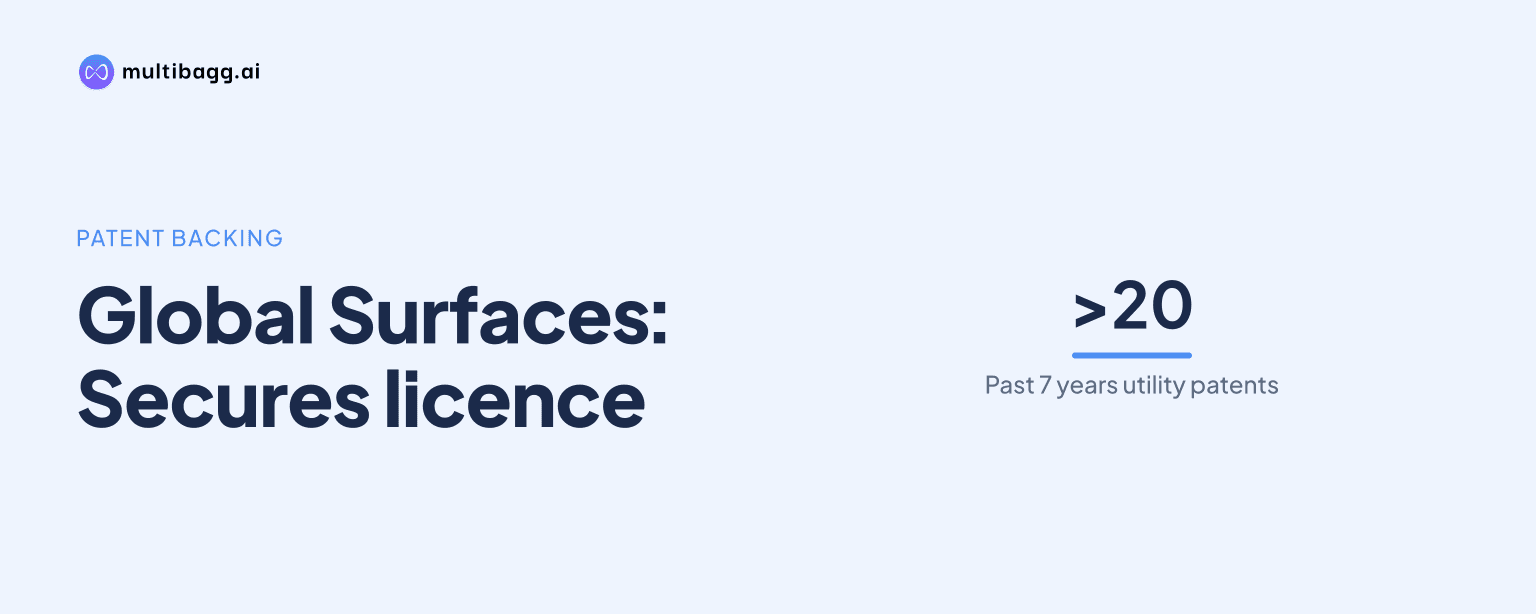
Global Surfaces Limited secured an exclusive Marquartz licence for the Middle East and North Africa region and FROR in India, giving its wholly owned subsidiary access to patented engineered-quartz veining methods associated with over 20 utility patents secured in the past seven years. The agreement permits development, production and manufacture of licensed products.
Know Global Surfaces inside out
Results, valuation, peers and who's buying, in one view.
What does the Global Surfaces Marquartz licence cover?
The Global Surfaces licence gives Global Surfaces FZE exclusive, non-transferable and non-sublicensable rights to use licensed patents and know-how for specified engineered quartz products. The manufacturing territory is the Middle East and North Africa, known as MENA, and FROR in India, while SQIP, LLC is identified as a Florida-based limited liability company.
The agreement permits Global Surfaces FZE to develop, produce and manufacture the licensed engineered-quartz products in that territory. The presentation does not disclose a licence duration, royalty rate, upfront payment, minimum production volume or revenue target, so the financial terms and timetable cannot be assessed from the supplied material.
Marquartz is described as a premium engineered quartz product that combines the aesthetic appearance of natural stone with the practical features of engineered material. Management says the patented product and related know-how are intended to help Global Surfaces manufacture and market unique, high-value engineered quartz products.
Which veining technologies can Global Surfaces use?
Global Surfaces can use patented Non-Push-Up Vein Technology, Push-Up Vein Technology, RIFT VEIN™ TECHNOLOGY and CONVERGENCE™ TECHNOLOGY under the disclosed Marquartz platform. These methods are intended to produce quartz-based slabs that emulate the random veining and colour patterns seen in natural stones such as marble and granite.
The presentation says the technology addresses the uniform appearance of conventional quartz by allowing singular or multiple colour patterns and intricate veining. It describes the RIFT VEIN process as analogous to geological rifting or fracturing, producing irregular patterns intended to resemble those found in natural stone.
The technology has more than 20 utility patents secured over the past seven years, according to the presentation. It also uses Cristobalite, identified as a premium raw material, to make brighter white quartz surfaces with translucent effects; the source says the proprietary methods can create thin veining.
Management lists distinctive quality, market leadership, an exclusive market niche and access to high-value projects as strategic advantages of the licensed product. These are management-presented outcomes rather than reported sales results, as the presentation provides no Marquartz-specific order, revenue or volume figure.
How large is the engineered-stone business for Marquartz?
Global Surfaces’ engineered-stone revenue rose from Rs 144.1 crore in FY24 to Rs 220 crore in FY26, an increase of Rs 75.9 crore over the two financial years. Revenue reached Rs 125.3 crore in H1-FY27, with FY meaning financial year and H1 meaning the first half of the financial year.
The FY24-to-FY26 comparison differs sharply by segment: engineered-stone revenue increased by Rs 75.9 crore, while natural-stone revenue decreased by Rs 4.7 crore. H1-FY27 is a partial period and is therefore not directly comparable with the full-year figures, but the disclosed Rs 125.3 crore of engineered-stone revenue exceeded the Rs 1.9 crore reported from natural stones.
Engineered-stone volume increased from 2,90,915 square metres in FY24 to 3,95,886 square metres in FY26, before reaching 1,85,147 square metres in H1-FY27. The segment includes five existing series, Aurora, Kalm asa, Prismatic, Stratum and Quartzite, and Marquartz is positioned as a premium engineered-quartz offering within this product area.
Got a follow-up? Ask IRIS
How is Marquartz different from natural stone?
Marquartz is manufactured engineered quartz, whereas Global Surfaces’ natural-stone portfolio comprises Granite, Marble and Quartzite quarried from the earth. Engineered quartz combines ground quartz with resins, pigments and other elements because quartz occurs in clusters and is not naturally available in large blocks suitable for slab applications.
Global Surfaces says its engineered quartz comprises 90% ground quartz and 10% pigments and binders. Marquartz uses patented veining processes to mimic marble and granite patterns, while the source describes natural stones as materials formed through geological processes over millions of years.
The business distinction is also reflected in the company’s operating decision for natural stone. The Board of Directors approved discontinuation of operations at the Natural Stone Unit in Industrial Area Bagru, Jaipur, effective March 31, 2026; after that date, only limited activities continued for the orderly closure of existing orders.
Natural-stone volume declined from 37,377 square metres in FY24 to 27,575 square metres in FY26, and was 6,701 square metres in H1-FY27. That compares with engineered-stone volume of 3,95,886 square metres in FY26, showing the much larger reported scale of the segment in which the Marquartz licence sits.
What has Global Surfaces not disclosed about Marquartz?
Global Surfaces has not disclosed a Marquartz launch date, plant location, capacity allocation, customer contract or sales forecast. The presentation identifies the MENA and FROR in India manufacturing territory and the four named technology platforms, but it does not quantify anticipated production or product revenue.
The source also does not state whether Marquartz requires new equipment or whether production will use an existing engineered-stone line. Its disclosed manufacturing process includes mixing quartz aggregates and resin, vacuum vibration pressing, slab hardening, calibration, polishing and quality checks, but it does not link a particular production line to Marquartz.
No Marquartz contribution is separated within the Rs 220 crore of FY26 engineered-stone revenue or the Rs 125.3 crore reported in H1-FY27. As a result, the current figures establish the scale of Global Surfaces’ engineered-stone segment but do not show commercial results from the licensed product.
Conclusion
The Marquartz agreement gives Global Surfaces access to exclusive patented know-how for producing engineered quartz with natural-stone-style veins and colour variation in MENA and FROR in India. The licence is aligned with the company’s larger reported product segment: engineered stones generated Rs 220 crore in FY26 revenue, compared with Rs 13.3 crore from natural stones.
What to watch next is implementation detail that remains undisclosed, including a production start date, capacity allocation, product launch and Marquartz-specific revenue or volume. The source provides no target or scheduled commercial milestone, while the Natural Stone Unit’s discontinuation was effective March 31, 2026.