










Rolex Rings Q2 FY27 revenue rises 43% on auto components
Key highlights
- Rolex Rings reported Q2 FY27 revenue from operations of Rs 389 crore, up 43.4% year on year.
- Automotive-components revenue rose 67.7% to Rs 177 crore, while bearing-rings revenue rose 6.2% to Rs 153 crore.
- Q2 FY27 EBITDA increased 72.0% to Rs 94 crore and EBITDA margin increased 400 basis points to 24.2%.
- An approximately Rs 18 crore customs-duty refund was included in Q2 FY27 revenue, gross profit and EBITDA measures.
powered by IRIS
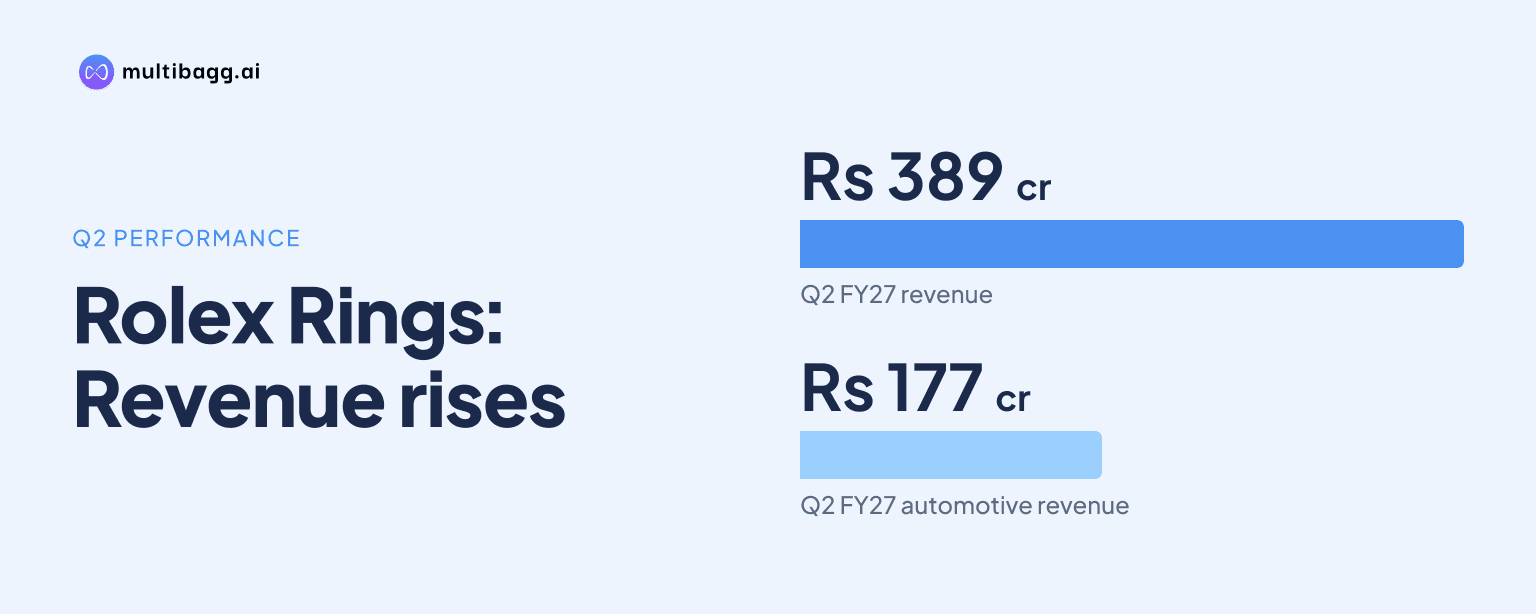
Rolex Rings Limited reported Q2 FY27 revenue from operations of Rs 389 crore, up 43.4% year on year, as automotive-components revenue rose 67.7% to Rs 177 crore. The reported result included an approximately Rs 18 crore one-time customs-duty refund linked to increased US tariffs, which the company said was included in revenue and margin measures.
Know Rolex Rings inside out
Results, valuation, peers and who's buying, in one view.
What drove Rolex Rings' Q2 FY27 revenue growth?
Automotive components drove Rolex Rings' Q2 FY27 growth, while bearing rings recorded a smaller increase. Automotive-components revenue reached Rs 177 crore, compared with Rs 153 crore from bearing rings, and management said the automotive segment accounted for 54% of component sales. Total revenue from operations increased from Rs 271 crore in Q2 FY26 to Rs 389 crore in Q2 FY27; it also included scrap sales, export incentives and the one-time tariff refund.
Exports were central to the automotive-components performance, with 73% of segment revenue generated outside India and exports rising 89% year on year, according to management. Domestic revenue represented 27% of automotive-components sales. Bearing rings had the reverse regional profile, with 75% domestic revenue and 25% exports; management attributed its 6.2% growth to domestic business. In H1 FY27, automotive-components revenue increased 27.8% to Rs 318 crore, while bearing-rings revenue was broadly flat, rising 0.4% to Rs 271 crore.
How much did the tariff refund affect Rolex Rings' margins?
The approximately Rs 18 crore Q2 FY27 customs-duty refund was included in Rolex Rings' revenue from operations, gross profit, gross margin, earnings before interest, tax, depreciation and amortisation (EBITDA), and EBITDA margin. The presentation does not quantify profit or margin excluding the refund, so it does not provide a reported recurring-margin measure after removing this one-time receipt.
Reported gross profit increased to Rs 233 crore from Rs 140 crore, and gross margin rose to 59.8% from 51.6%, an increase of 820 basis points, where one basis point equals one-hundredth of a percentage point. EBITDA grew 72.0% to Rs 94 crore and its margin rose 400 basis points to 24.2%. The Chairman and Managing Director's message separately described gross margin as 55%, up 220 basis points, whereas the detailed profit-and-loss statement and Q2 highlights report 59.8%; the presentation does not explain the difference.
Higher costs accompanied the revenue growth. Other expenses increased to Rs 118 crore in Q2 FY27 from Rs 67 crore in Q2 FY26, while employee costs rose to Rs 21 crore from Rs 19 crore. Management said ocean freight increased nearly three-fold after the escalation of the West Asia conflict, alongside higher fuel and consumable costs, but the presentation does not reconcile these costs separately against the refund benefit.
Got a follow-up? Ask IRIS
How did Rolex Rings' Q2 FY27 results compare with H1 FY27?
Rolex Rings grew faster in Q2 FY27 than in H1 FY27, although both periods included customs-duty refunds. Q2 revenue rose 43.4% and EBITDA rose 72.0%, compared with H1 revenue growth of 23.2% and EBITDA growth of 40.0%. The refund was approximately Rs 18 crore in Q2 and approximately Rs 21.7 crore in H1, according to the company.
Profit after tax (PAT) rose 67.5% to Rs 74 crore in Q2 FY27 and 43.8% to Rs 134 crore in H1 FY27. Q2 PAT margin was 19.1%, up 280 basis points year on year, while the H1 PAT margin was 19.4%, also up 280 basis points. H1 export revenue accounted for 50.1% of revenue, compared with 44.1% in FY26, while commercial vehicles and heavy commercial vehicles represented 31.1% of end-user revenue, up from 21.9% in FY26.
What is Rolex Rings expecting in H2 FY27?
Rolex Rings expects H2 FY27 to be stronger than H1 FY27, based on one to two new customer plants beginning supplies in Q3 FY27 and the continued ramp-up of programmes won last year. Management said its order book averaged Rs 120 crore to Rs 125 crore a month and that labour availability had fully normalised from the start of Q2, allowing it to convert orders into planned output.
Management cited capacity utilisation of 63% to 65% and said it was discussing commercial-vehicle and industrial products with a large original equipment manufacturer in Europe. It also said US automotive revenue more than doubled year on year in Q2 FY27 and that it had not lost a customer because of tariffs. These are management statements on demand, programmes and customer relationships rather than a numerical revenue forecast.
Rolex Rings has also received registrations and initial approvals in defence and aerospace, with management expecting revenue from these segments within the next 12 months. Management said the company had completed a Rs 180 crore buyback and had a debt-free balance sheet. The September 2026 balance sheet reported cash and cash equivalents of Rs 72.9 crore and no borrowings under either current or non-current financial liabilities.
Conclusion
Rolex Rings' Q2 FY27 acceleration came principally from automotive components, where revenue rose 67.7% to Rs 177 crore, rather than bearing rings, which increased 6.2% to Rs 153 crore. EBITDA reached Rs 94 crore and PAT was Rs 74 crore, but the approximately Rs 18 crore customs-duty refund was included in revenue, gross-profit and EBITDA measures, making the reported margins inclusive of that one-time benefit.
The next result will show whether supplies to one to two new customer plants in Q3 FY27, the Rs 120 crore to Rs 125 crore monthly order book and 63% to 65% capacity utilisation support management's expectation of a stronger H2 FY27. The timing of initial defence and aerospace revenue, expected within 12 months, and the persistence of higher freight, fuel and consumable costs are also disclosed matters to watch.