










Rolex Rings FY26 revenue below FY24; EBITDA margin at 20.1%
Key highlights
- Rolex Rings’ FY26 revenue from operations was Rs 1,143.5 crore, below Rs 1,221.8 crore in FY24.
- FY26 EBITDA margin was 20.1%, compared with 21.4% in FY24 and 22.7% in FY22.
- Rolex Rings ended FY26 with zero gross debt and Rs 367 crore of cash, cash equivalents and investments.
- FY26 adjusted PAT was Rs 192.7 crore, while reported PAT was Rs 141.1 crore after exceptional items.
powered by IRIS
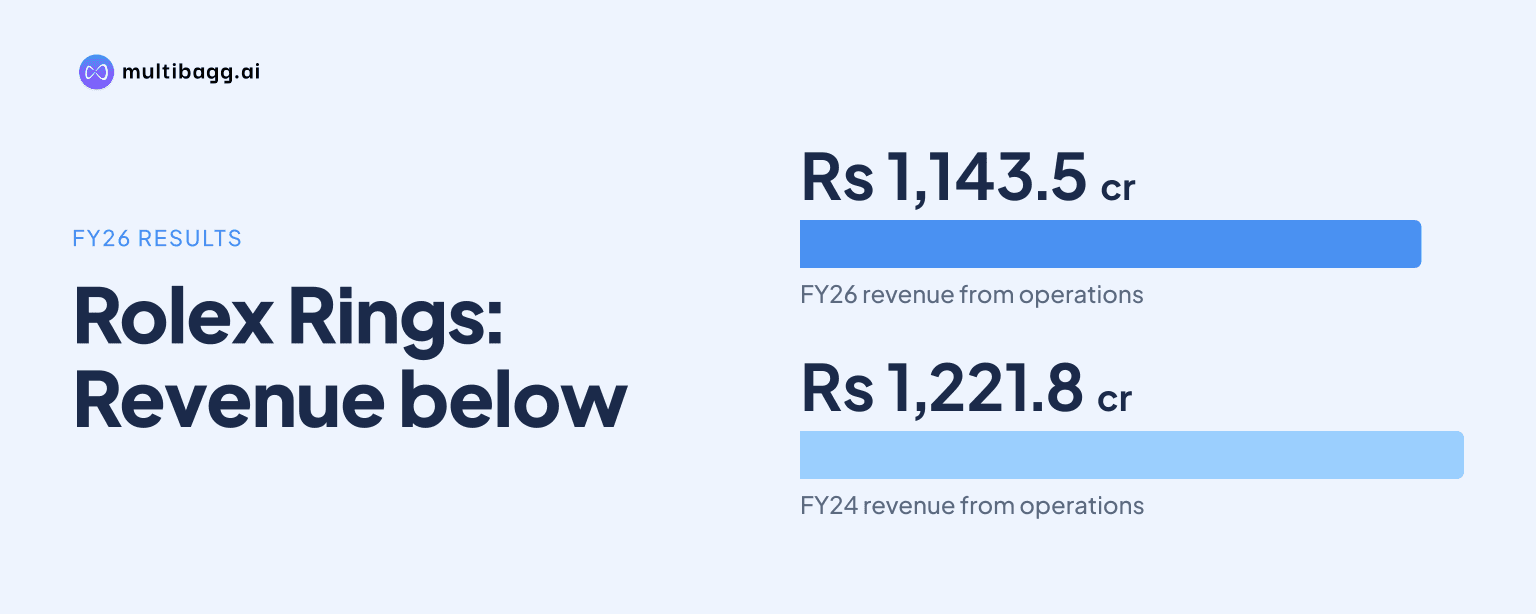
Rolex Rings Limited reported FY26 revenue from operations of Rs 1,143.5 crore, below the FY24 peak of Rs 1,221.8 crore, while EBITDA margin was 20.1%, versus 21.4% in FY24. Rolex Rings nevertheless ended FY26 with zero gross debt and reported Rs 367 crore of cash, cash equivalents and investments.
Know Rolex Rings inside out
Results, valuation, peers and who's buying, in one view.
How did Rolex Rings’ FY26 revenue compare with earlier years?
Rolex Rings’ FY26 revenue from operations was Rs 1,143.5 crore, compared with Rs 1,154.8 crore in FY25 and the five-year high of Rs 1,221.8 crore in FY24. Revenue was Rs 78.3 crore below FY24, although it remained above Rs 1,010.2 crore in FY22. The reported figure includes other operating revenue such as scrap sales, export incentives and windmill income.
The two principal product categories moved differently in FY26. Bearing-rings revenue rose to Rs 539 crore from Rs 485 crore in FY25, but remained below Rs 570 crore in FY24. Automotive-components revenue fell to Rs 520 crore from Rs 576 crore in FY25 and Rs 557 crore in FY24, so the recovery in bearing rings did not offset the Rs 56 crore year-on-year fall in automotive components.
Why did Rolex Rings’ EBITDA margin decline in FY26?
Rolex Rings’ earnings before interest, tax, depreciation and amortisation, or EBITDA, declined to Rs 230.2 crore in FY26 from Rs 240.6 crore in FY25 and Rs 262 crore in FY24. EBITDA margin fell to 20.1% from 20.8% in FY25, continuing a five-year movement from 22.7% in FY22, 22.1% in FY23 and 21.4% in FY24. The FY26 margin was 2.6 percentage points below FY22.
Gross profit increased to Rs 588.8 crore in FY26 from Rs 570.2 crore in FY25, while gross margin rose to 51.5% from 49.4%. However, employee costs increased to Rs 72 crore from Rs 68.9 crore and other expenses rose to Rs 286.5 crore from Rs 260.7 crore. These changes coincided with a Rs 11.3 crore fall in revenue, leaving EBITDA Rs 10.4 crore lower year on year.
What happened to Rolex Rings’ reported and adjusted profit?
Rolex Rings’ reported profit after tax, or PAT, was Rs 141.1 crore in FY26, down from Rs 174 crore in FY25 and Rs 156 crore in FY24. Reported PAT margin declined to 12.3% from 15.1% in FY25, while earnings per share fell to Rs 5.18 from Rs 6.39. Profit before tax was Rs 190.3 crore, compared with Rs 207.7 crore in the preceding year.
The presentation separately reports adjusted PAT of Rs 192.7 crore for FY26, compared with Rs 192.6 crore in FY25 and Rs 188 crore in FY24. Adjusted PAT excludes exceptional items. Rolex Rings says it paid Rs 101 crore to consortium lenders for Right of Recompense, or RoR, obligations in FY26; its financial-parameter disclosure says Rs 49.2 crore of the remaining obligation was recognised in the fourth quarter of FY26.
Return measures also declined over the five-year record. Adjusted return on capital employed, or RoCE, was 20.1% in FY26 against 26.7% in FY24 and 30.7% in FY23. Return on equity, or RoE, was 15.9%, down from 20.9% in FY24 and 26.7% in FY23. The presentation says both measures are calculated on adjusted PAT.
Got a follow-up? Ask IRIS
How did Rolex Rings become debt-free while building liquidity?
Rolex Rings recorded zero gross debt in FY26, compared with Rs 14 crore in FY25, Rs 18 crore in FY24 and Rs 223 crore in FY22. The company says it exited Corporate Debt Restructuring in 2022 after clearing all dues and settled Rs 101 crore of RoR payments in 2026. The March 2026 balance sheet did not show current or non-current borrowings, against current borrowings of Rs 202.4 crore in March 2022.
The presentation’s net-debt measure reports Rs 367 crore of cash, cash equivalents and investments in FY26, up from Rs 329 crore in FY25 and Rs 136 crore in FY24. The March 2026 balance sheet included Rs 288.2 crore of investments, Rs 69.3 crore of cash and cash equivalents, and Rs 9.9 crore of bank balances other than cash. Total equity rose to Rs 1,213.6 crore from Rs 898.2 crore in March 2024, while total liabilities declined to Rs 157.6 crore from Rs 222.7 crore.
What do Rolex Rings’ FY26 mix and working-capital figures show?
Rolex Rings’ indicative end-user revenue mix became more weighted towards passenger vehicles, or PV, in FY26. PV represented 52.1% of revenue excluding scrap sales and other operating income, compared with 46.5% in FY25 and 40.3% in FY24. Commercial vehicles and heavy commercial vehicles, or CV and HCV, represented 21.9%, down from 28.7% in both FY24 and FY25, while industrial end users accounted for 18.3%, up from 17.1% in FY25.
The geographical mix shifted towards domestic sales in FY26, with domestic revenue at 55.9% and exports at 44.1%. In FY25, exports accounted for 52% and domestic revenue for 48%. Working-capital days increased to 195 from 186, as inventory days rose to 158 from 151 and debtor days rose to 66 from 65, while creditor days declined to 29 from 30.
Operating cash flow moderated in FY26. Net cash from operating activities was Rs 189.6 crore, compared with Rs 227.2 crore in FY25 and Rs 221.4 crore in FY24. Capital expenditure fell to Rs 36 crore from Rs 52 crore in FY25, while cash generated from operations was Rs 237.7 crore, versus Rs 280.6 crore a year earlier.
Conclusion
The five-year record shows that Rolex Rings’ FY26 operating revenue and EBITDA margin remained below their FY24 levels, despite a recovery in bearing-rings revenue from FY25 and adjusted PAT of Rs 192.7 crore, broadly unchanged from Rs 192.6 crore. At the same time, the company eliminated gross debt, reported Rs 367 crore of cash, cash equivalents and investments, and increased equity to Rs 1,213.6 crore.
The next disclosed items to watch are the proposed Rs 180 crore buyback announced in April 2026, covering 1 crore equity shares at Rs 180 each, and the additional 9 megawatt solar plant planned by mid-CY2026. Rolex Rings also states a plan to source 60% of consumption from renewable energy by 2030 through owned generation, subject to government policy and approvals.