










GMR Airports Limited October traffic rises 0.3% as Delhi offsets
Key highlights
- GMR Airports reported 10.17 million October 2026 passengers excluding Cebu, up 0.3% year on year.
- Delhi handled 6.55 million October passengers, up 0.5%, while Hyderabad traffic fell 12.1% to 2.29 million.
- GMR Airports’ October passenger traffic rose 10.1% month on month, with domestic traffic up 11.0%.
- Reported YTD FY2027 passenger traffic reached 68.38 million, up 0.4% year on year excluding Cebu.
powered by IRIS
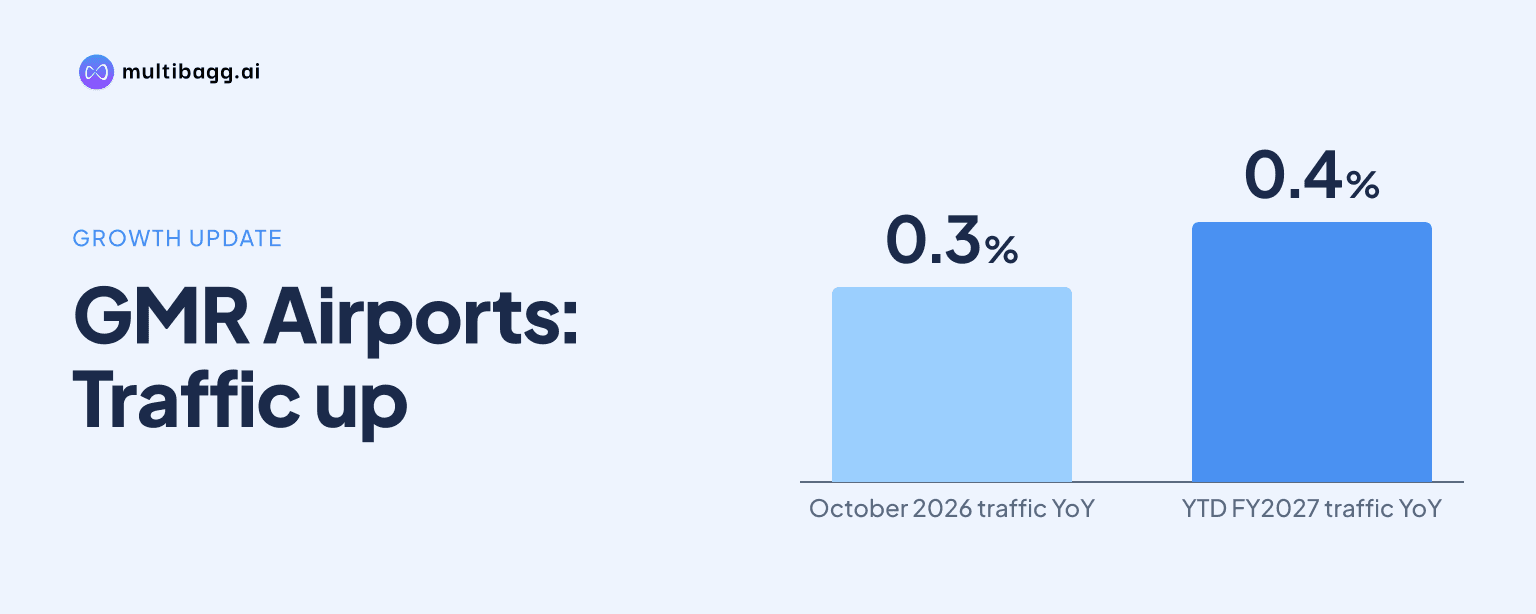
GMR Airports Limited handled 10.17 million passengers in October 2026, up 0.3% year on year excluding Cebu, as Delhi’s 0.5% traffic increase offset declines at Hyderabad, Mopa, Nagpur and Medan. The portfolio total rose 10.1% month on month and reached a company-reported record 68.38 million passengers in YTD FY2027.
Know GMR Airports inside out
Results, valuation, peers and who's buying, in one view.
Why was GMR Airports’ October passenger growth nearly flat?
GMR Airports’ October passenger growth was nearly flat because domestic traffic declined while international traffic grew modestly. The company reported 10,169,867 passengers excluding Cebu, up 0.3% year on year, or YoY. Domestic traffic was about 7.6 million passengers, down 0.7% YoY, while international traffic was about 2.5 million, up 3.4% YoY.
GMR Airports attributed muted international growth to flight disruptions associated with West Asian geopolitical instability and subdued domestic growth to airline route rationalisation. The company also said aircraft-grounding constraints linked to maintenance issues affected domestic traffic in the broader Indonesian aviation market, relevant to Medan’s 4.8% October passenger decline.
The October result was higher than the preceding month. GMR Airports reported 10.1% month-on-month, or MoM, growth in total passengers, comprising an 11.0% increase in domestic traffic and a 7.3% increase in international traffic. The company said average monthly traffic remained about 10 million passengers in YTD FY2027, meaning October’s recovery did not alter the slower YoY portfolio growth rate.
Which airports drove GMR Airports’ October traffic result?
Delhi drove GMR Airports’ October result, handling 6,549,360 passengers, up 0.5% YoY. This was the portfolio’s largest passenger base, compared with 2,287,296 at Hyderabad and 537,598 at Medan. Delhi’s gain was offset by Hyderabad’s 12.1% fall, Mopa’s 18.4% decline, Nagpur’s 1.0% decline and Medan’s 4.8% decline.
Hyderabad recorded an October total of about 2.3 million passengers, including about 1.8 million domestic passengers and about 0.4 million international passengers. Domestic traffic fell 13.3% YoY and international traffic fell 6.9% YoY. Mopa handled about 0.37 million passengers, where domestic traffic declined 17.8% and international traffic fell 28.7%.
Nagpur’s reference comparison requires caution because GMR Airports assumed operational control on 25 June 2026. Vizag had no YoY comparison because commercial operations started on 17 August 2026, after its 1 August 2026 inauguration. Its October traffic of 191,429 passengers is included in the reported consolidated October metric, while the YTD total includes its traffic from 17 August to 31 October 2026.
How did Delhi and Hyderabad passenger trends differ?
Delhi’s October passenger gain came from international traffic, while its domestic segment declined. International passengers rose 6.2% YoY to about 1.9 million, whereas domestic passengers fell 1.7% to about 4.7 million. Total traffic nevertheless increased 0.5% to about 6.5 million, reflecting the larger domestic base and the international increase.
Delhi also reported 9.3% MoM total traffic growth in October, with domestic traffic up 9.7% and international traffic up 8.3%. Airlines resumed service on two international routes, increased frequencies on 14 existing international routes, launched seven domestic routes and increased frequency on one domestic route. Delhi connected to 163 destinations, comprising 91 domestic and 72 international destinations.
Hyderabad’s October traffic fell 12.1% YoY but rose 9.8% sequentially. Domestic passenger traffic increased 6.0% MoM to about 1.8 million, while international traffic rose 5.8% MoM to about 0.44 million. The airport connected to 101 destinations, including 74 domestic and 27 international destinations, during the reported period.
Mopa had the highest sequential passenger increase among the airports detailed in the update, with total traffic up 28.9% MoM. Domestic traffic rose 29.7% to about 0.35 million passengers and international traffic rose 15.1% to about 0.02 million. This sequential improvement did not reverse Mopa’s 18.4% YoY decline in October traffic.
Got a follow-up? Ask IRIS
What do aircraft movements and cargo data show?
Aircraft movements, or ATMs, were broadly stable across GMR Airports’ reported portfolio excluding Cebu and Vizag. The total was 65,778 movements in October, up 0.2% YoY, compared with 0.3% passenger growth. Delhi recorded 40,222 movements, up 0.9%, while Hyderabad’s 15,273 movements fell 17.4% and Mopa’s 2,684 movements declined 17.5%.
Medan was an exception between traffic and flight activity: its 4,125 October ATMs rose 2.3% YoY despite a 4.8% fall in passengers. Nagpur recorded 1,991 movements, up 4.7% on the reference comparison, while Vizag recorded 1,483 movements without a comparable prior-year figure. The reported consolidated movement total includes October Nagpur and Vizag operations under the company’s stated timing conventions.
Cargo expanded at the two largest Indian airports despite their different passenger outcomes. Delhi handled about 1.16 lakh metric tonnes in October, up 22.6% YoY, and about 7.5 lakh metric tonnes in YTD FY2027, up 13.7%. Hyderabad handled about 0.20 lakh metric tonnes in October, up 25.3%, and about 1.22 lakh metric tonnes year to date, up 8.6%.
GMR Airports described Delhi’s October and YTD cargo volumes as highest-ever, alongside record YTD passenger traffic, ATMs and cargo throughput. It also described Hyderabad’s October and YTD cargo volumes as highest-ever, even though Hyderabad’s YTD passenger traffic of 15,868,734 was down 11.8% YoY. The contrast shows cargo growth and passenger traffic moved differently at Hyderabad.
What does GMR Airports’ YTD FY2027 traffic record mean?
GMR Airports’ YTD FY2027 traffic reached 68,382,184 passengers excluding Cebu, up 0.4% YoY and described by the company as its highest-ever YTD total. Domestic traffic was about 51.7 million and international traffic about 16.7 million, both identified as highest-ever YTD levels. Delhi accounted for 66% of the reported YTD total.
Delhi handled 45,051,918 passengers in YTD FY2027, up 4.3% YoY, including about 32.8 million domestic passengers and 12.3 million international passengers. Its 1.9 million-passenger YoY increase supported the portfolio record. Delhi’s 273,553 YTD ATMs also rose 6.0% YoY, while its YTD cargo volume increased 13.7%.
The YTD comparison remained uneven across other airports. Hyderabad handled 15,868,734 passengers, down 11.8% YoY; Mopa handled 2,390,084, down 15.0%; and Medan handled 3,716,910, down 9.4%. Nagpur’s 1,688,239 passengers were up 3.4% on the reference comparison, but GMR Airports notes that its operational control began only in June 2026.
Cebu is excluded from the consolidated total because its divestment has been completed. GMR Airports said it will continue as Cebu’s Technical Services Provider until December 2026. The traffic table separately lists Cebu at 854,551 passengers in October, up 2.7% YoY, but the total line specifically excludes Cebu and Vizag.
Conclusion
GMR Airports’ October traffic outcome combined a 0.3% YoY portfolio increase with sharply different airport results. Delhi’s growth, international passenger increase and expanding connectivity countered passenger declines at Hyderabad, Mopa and Medan, while October’s 10.1% MoM increase showed a sequential recovery. The 68.38 million YTD passenger total was record-level according to the company, but its YoY growth remained 0.4%.
The next monthly update will show whether route additions and frequency increases at Delhi continue to support traffic, and whether airline route rationalisation and West Asia-related disruptions ease. Readers should also watch the effect of the Cebu Technical Services Provider arrangement through December 2026, as well as the developing comparison bases for Nagpur after 25 June 2026 and Vizag after 17 August 2026.