










Indira Gandhi International Airport cargo grows 22.6% in October
Key highlights
- Delhi Airport cargo throughput rose 22.6% year on year to about 1.16 lakh metric tonnes in October 2026.
- Delhi Airport handled about 6.5 million passengers in October 2026, up 0.5%, as domestic traffic declined 1.7%.
- Delhi Airport’s YTD FY2027 cargo throughput was about 7.5 lakh metric tonnes, up 13.7% year on year.
- Delhi Airport connected to 163 destinations in October 2026, including 91 domestic and 72 international destinations.
powered by IRIS
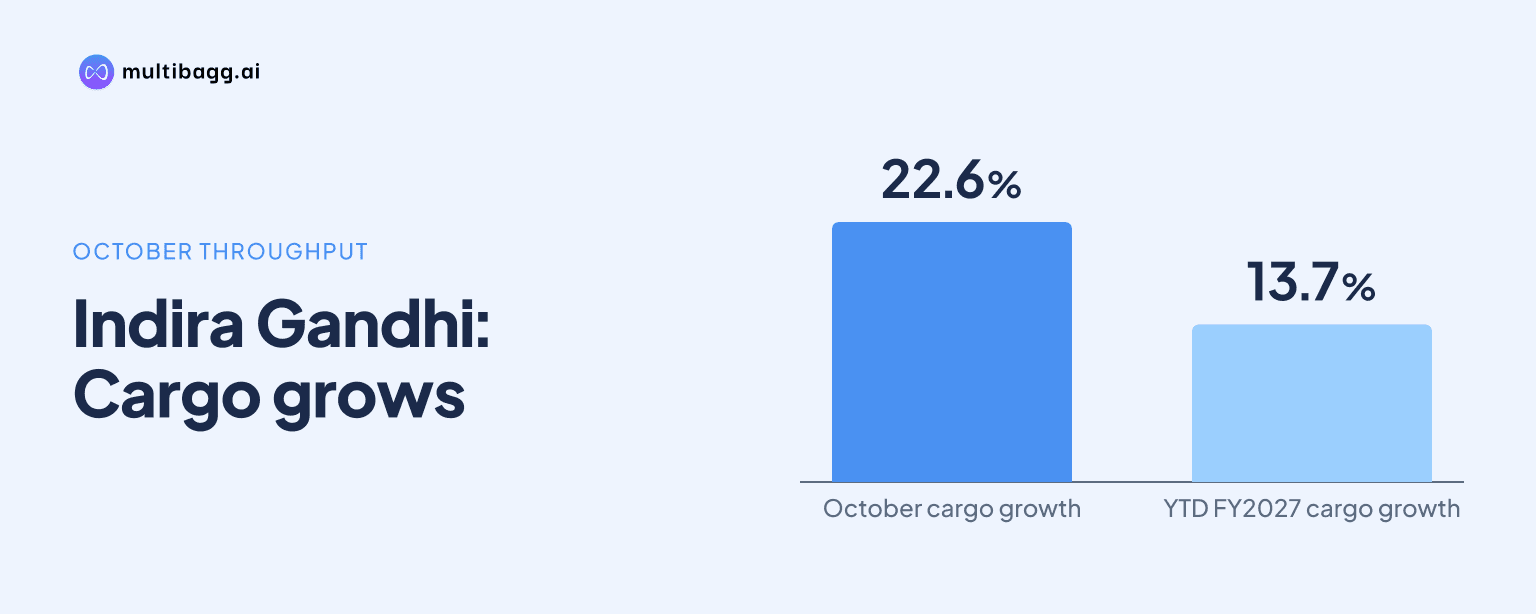
Indira Gandhi International Airport, referred to as Delhi Airport, recorded 22.6% year-on-year cargo growth to about 1.16 lakh metric tonnes in October 2026, while total passenger traffic rose 0.5% to about 6.5 million. The monthly result combined a 1.7% domestic-passenger decline with 6.2% international-passenger growth.
Know GMR Airports inside out
Results, valuation, peers and who's buying, in one view.
How did Delhi Airport cargo growth compare with passenger growth?
Delhi Airport’s cargo throughput grew 22.6% year on year in October 2026, compared with 0.5% growth in total passenger traffic. Cargo handled was about 1.16 lakh metric tonnes, which management described as the airport’s highest-ever monthly cargo volume, while passenger traffic totalled about 6.5 million.
The 22.1-percentage-point difference between cargo and total-passenger growth shows that the two operating measures moved at markedly different rates during October. Delhi Airport also reported about 7.5 lakh metric tonnes of cargo in YTD FY2027, up 13.7% year on year and its highest-ever volume for the period.
Delhi Airport’s 45.1 million YTD FY2027 passengers were also its highest-ever total for a comparable year-to-date period, according to management. Both passenger and cargo operations therefore set YTD volume records, but cargo reported the faster growth rate in October and across YTD FY2027.
Why was Delhi Airport passenger growth limited in October 2026?
Delhi Airport’s total passenger traffic rose only 0.5% in October 2026 because domestic passengers fell 1.7% year on year, offsetting a 6.2% increase in international passengers. Domestic traffic was about 4.7 million, down by 0.08 million, while international traffic was about 1.9 million, up by 0.11 million.
Management attributed subdued domestic traffic growth across its airport portfolio to airline route rationalisation. It separately said muted international traffic growth reflected flight disruptions caused by West Asian geopolitical instability, providing the disclosed context for Delhi Airport’s October traffic mix.
The year-to-date trend was higher than the single-month result. Delhi Airport handled 32.8 million domestic passengers in YTD FY2027, up 1.6 million or 5.0%, and 12.3 million international passengers, up 0.3 million or 2.6%, taking the total to 45.1 million, up 1.9 million or 4.3%.
Delhi Airport also reported 9.3% sequential growth in total October passenger traffic, with domestic traffic up 9.7% month on month and international traffic up 8.3%. The source therefore shows a rise from the preceding month despite near-flat growth against October 2025.
Got a follow-up? Ask IRIS
Did aircraft movements and route additions support Delhi Airport traffic?
Delhi Airport recorded 40,222 aircraft movements in October 2026, up 0.9% year on year, slightly ahead of its 0.5% passenger increase. Management said international aircraft movements reached their highest-ever monthly level at about 10,000, up 9.8% year on year.
For YTD FY2027, aircraft movements reached 273,553, up 6.0% year on year and described by management as a record YTD level. The total included about 209,000 domestic movements, up 6.0%, and about 65,000 international movements, up 5.7%.
Delhi Airport connected to 163 destinations in October 2026, comprising 91 domestic and 72 international destinations. Airlines resumed two international routes and raised frequencies on 14 existing international routes, while launching seven domestic routes and increasing frequency on one existing domestic route.
The network activity occurred alongside the October split between domestic and international passenger performance. International passengers increased 6.2% to about 1.9 million, while domestic passengers declined 1.7% to about 4.7 million; the presentation does not disclose the airlines, route names, capacity additions or start dates behind the route changes.
How did Delhi Airport compare with the wider GMR Airports portfolio?
Delhi Airport handled 6,549,360 passengers in October 2026, compared with 10,169,867 for GMR Airports’ total excluding Cebu and Vizag. Delhi Airport’s 0.5% growth was marginally above the comparable portfolio’s 0.3% increase, while Hyderabad and Mopa reported passenger declines of 12.1% and 18.4%, respectively.
In YTD FY2027, Delhi Airport processed 45,051,918 passengers against 68,382,184 across the comparable GMR Airports total, and management said Delhi Airport accounted for 66% of total traffic. Its 4.3% YTD growth exceeded the portfolio’s 0.4% increase, with the company identifying Delhi Airport as the main driver of the group’s record 68.3 million YTD passenger total.
Hyderabad Airport also reported a record October cargo result, handling about 0.20 lakh metric tonnes, up 25.3% year on year. Its percentage growth was above Delhi Airport’s 22.6%, but Delhi Airport’s 1.16 lakh metric tonnes of October cargo was substantially larger than Hyderabad’s reported volume.
GMR Airports described Delhi Airport as India’s largest cargo handling airport and said it recorded its highest-ever monthly and YTD cargo volumes. The source does not provide cargo volumes for the group’s other airports beyond Hyderabad, so it does not establish a full portfolio cargo comparison.
Conclusion
Delhi Airport’s October 2026 data show cargo expanding faster than passenger traffic: cargo rose 22.6% to about 1.16 lakh metric tonnes, while passengers increased 0.5% to about 6.5 million. Domestic passenger weakness limited the monthly total, but international passengers, international aircraft movements and cargo volumes increased, and the airport reported record YTD passenger, movement and cargo levels.
The next monthly updates will show whether October’s seven new domestic routes, two resumed international routes and frequency increases translate into passenger growth. Management’s disclosed factors to watch are continued airline route rationalisation affecting domestic traffic and West Asian geopolitical instability affecting international flights, while YTD FY2027 cargo stood at a record 7.5 lakh metric tonnes.