










GNG Electronics inventory hits Rs 911.6 crore as debt rises
Key highlights
- GNG Electronics’ inventory increased Rs 168.5 crore to Rs 911.6 crore in Sep-26.
- GNG Electronics’ current borrowings increased Rs 168.5 crore to Rs 572.3 crore in Sep-26.
- GNG Electronics’ total borrowings were Rs 610.5 crore in Sep-26, up Rs 204.8 crore from Mar-26.
- GNG Electronics reported H1 FY27 revenue of Rs 1,037.3 crore, up 37.9% year on year.
powered by IRIS
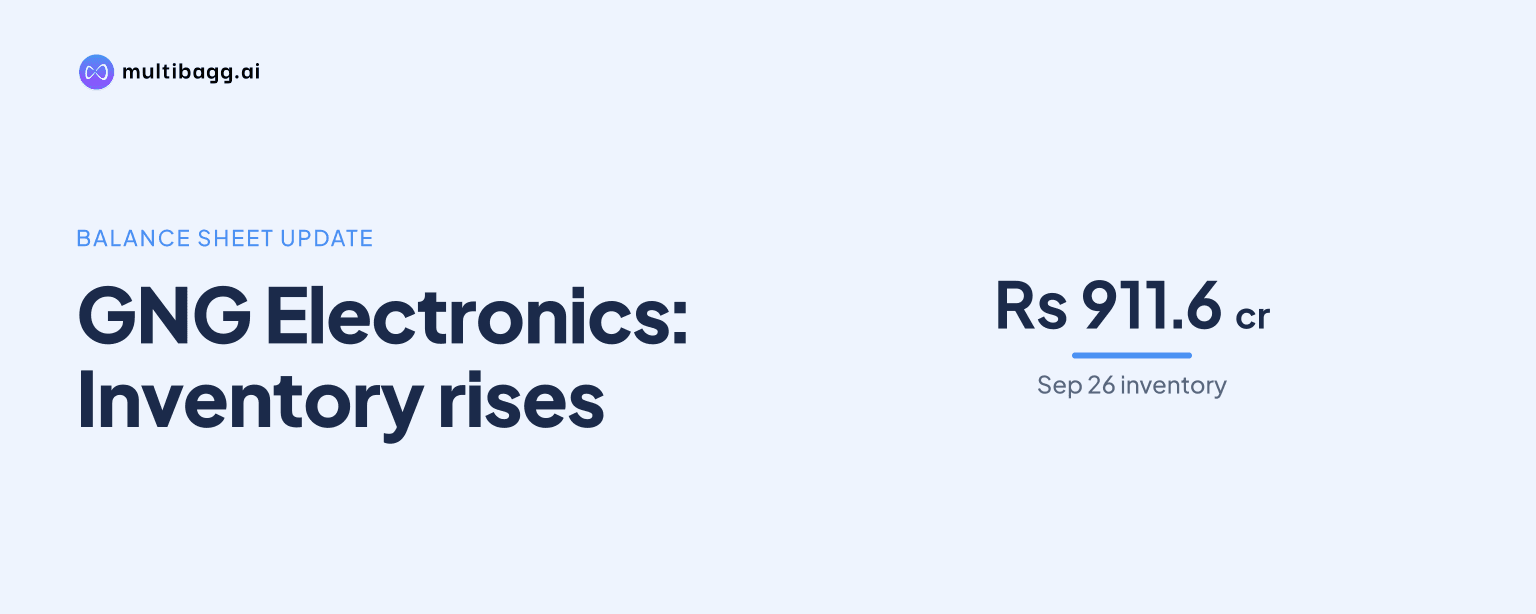
In Sep-26, GNG Electronics Limited held Rs 911.6 crore of inventory, up Rs 168.5 crore from Mar-26, while total borrowings rose Rs 204.8 crore to Rs 610.5 crore. Current borrowings accounted for Rs 572.3 crore, and first-half FY27 (H1 FY27) revenue grew 37.9% year on year to Rs 1,037.3 crore.
Know GNG Electronics inside out
Results, valuation, peers and who's buying, in one view.
How did GNG Electronics’ inventory and borrowings change by Sep-26?
GNG Electronics increased inventory to Rs 911.6 crore in Sep-26 from Rs 743.1 crore in Mar-26, a rise of Rs 168.5 crore. Current borrowings increased by the same Rs 168.5 crore, to Rs 572.3 crore from Rs 403.8 crore. Inventory was the largest current-asset category at Sep-26, within total current assets of Rs 1,529.2 crore.
The matching Rs 168.5 crore increases in inventory and current borrowings are a numerical comparison rather than evidence that one directly financed the other. The presentation does not provide a cash-flow statement, inventory-ageing data, facility-level borrowing terms or a use-of-funds reconciliation. It does show that higher short-term borrowings coincided with a larger stock balance over the six months to Sep-26.
What else drove GNG Electronics’ current-asset growth?
GNG Electronics’ trade receivables rose Rs 99.4 crore to Rs 306.2 crore in Sep-26 from Rs 206.8 crore in Mar-26. Cash and cash equivalents increased Rs 26.5 crore to Rs 95.4 crore, bank balances other than cash and cash equivalents rose Rs 39.1 crore to Rs 88.4 crore, and other current assets increased Rs 33.3 crore to Rs 127.5 crore.
Inventory and receivables together increased Rs 267.9 crore, accounting for most of the Rs 366.8 crore increase in total current assets. Current assets exceeded current liabilities by Rs 838.8 crore in Sep-26, compared with Rs 698.8 crore in Mar-26, as total current liabilities increased Rs 226.8 crore to Rs 690.4 crore.
GNG Electronics’ total assets increased Rs 372.9 crore to Rs 1,626.9 crore in Sep-26 from Rs 1,254.0 crore in Mar-26. Non-current assets rose only Rs 6.1 crore to Rs 97.7 crore, compared with the Rs 366.8 crore increase in current assets. Right-of-use assets rose Rs 14 crore to Rs 40.2 crore, while other financial assets declined Rs 8 crore to Rs 9.5 crore.
How was GNG Electronics’ asset expansion reflected in financing?
GNG Electronics funded the Rs 372.9 crore increase in total assets through increases in equity and liabilities. Total equity rose Rs 94.3 crore to Rs 853.6 crore, total current liabilities rose Rs 226.8 crore to Rs 690.4 crore, and total non-current liabilities increased Rs 51.8 crore to Rs 82.9 crore between Mar-26 and Sep-26.
Beyond current borrowings, trade payables rose Rs 39.3 crore to Rs 66.3 crore, current tax liability increased Rs 7.1 crore to Rs 11.3 crore, and current provisions rose Rs 6.6 crore to Rs 12.5 crore. Other equity increased Rs 94 crore to Rs 829 crore, while equity share capital remained Rs 22.8 crore at both reporting dates.
Non-current borrowings rose Rs 36.3 crore to Rs 38.2 crore in Sep-26 from Rs 1.9 crore in Mar-26. Combined current and non-current borrowings were therefore Rs 610.5 crore, compared with Rs 405.7 crore at Mar-26. Current borrowings represented Rs 572.3 crore of the Sep-26 total, leaving most reported borrowings classified as current.
Got a follow-up? Ask IRIS
How did GNG Electronics’ H1 FY27 earnings compare with the prior year?
GNG Electronics reported revenue from operations of Rs 1,037.3 crore in H1 FY27, up 37.9% from Rs 752.2 crore in H1 FY26. Gross profit increased Rs 103.9 crore to Rs 258.3 crore, while gross profit margin rose 438 basis points to 24.9% from 20.5%. One basis point equals one-hundredth of a percentage point.
Earnings before interest, tax, depreciation and amortisation (EBITDA) increased 79.1% to Rs 146.8 crore from Rs 82 crore, and EBITDA margin rose to 14.2% from 10.9%. Profit after tax (PAT) increased 66.6% to Rs 85.3 crore from Rs 51.2 crore, while PAT margin rose to 8.2% from 6.8%.
Finance cost rose Rs 16.8 crore to Rs 35.9 crore in H1 FY27 from Rs 19.1 crore a year earlier. The presentation reports the higher finance cost alongside Sep-26 borrowings of Rs 610.5 crore, but does not allocate finance cost between current borrowings, non-current borrowings, lease liabilities or individual facilities. It also does not disclose inventory turnover, collection days or borrowing rates.
What should readers watch in GNG Electronics’ next results?
GNG Electronics’ next balance sheet can show whether inventory, receivables and borrowings continue to increase after Sep-26. Inventory rose Rs 168.5 crore and receivables rose Rs 99.4 crore in the six months from Mar-26, while H1 FY27 revenue rose 37.9% year on year. Subsequent disclosures can indicate whether current-asset growth remains concentrated in these two categories.
Management said in its second-quarter FY27 commentary that rising memory prices and supply constraints were a near-term catalyst for refurbished information and communication technology products. It also reported operations across 55 countries, 5,542 customer touchpoints and 820 suppliers during the quarter. The presentation does not disclose a numerical inventory target, debt-reduction target or scheduled refinancing event.
Conclusion
GNG Electronics’ Sep-26 balance sheet shows that inventory, receivables and borrowings all increased from Mar-26. Inventory reached Rs 911.6 crore, receivables reached Rs 306.2 crore and total borrowings reached Rs 610.5 crore, while H1 FY27 revenue, EBITDA and PAT grew 37.9%, 79.1% and 66.6%, respectively, from the prior year.
The next reported balance sheet and finance-cost line will show whether the Sep-26 working-capital position persists as management cites memory prices and supply constraints as a near-term catalyst. Management has not set an inventory, borrowing or refinancing target in the presentation, leaving later reported balances, margins and finance costs as the disclosed measures to monitor.