










Goldiam derives 91.2% of Q2 export sales from lab-grown
Key highlights
- Lab-grown diamond jewellery contributed 91.2% of Goldiam’s Q2 FY27 B2B export revenue, versus 90% in Q2 FY26.
- US retailers held 58.5% of Goldiam’s inventory on consignment as of September 2026.
- Goldiam’s Q2 FY27 total income was Rs 291.66 crore, up 44% year on year.
- Goldiam disclosed an order book of about Rs 225 crore as of September 30, 2026.
powered by IRIS
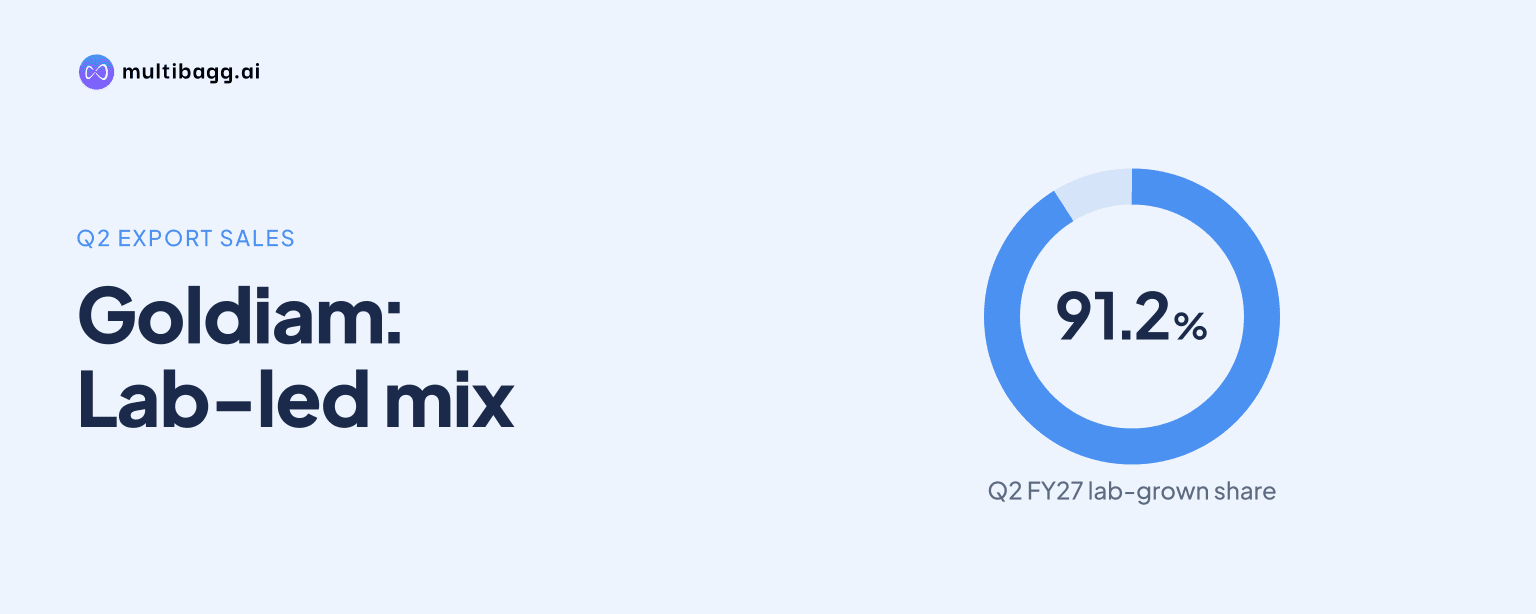
Goldiam derived 91.2% of export revenue from lab-grown diamond jewellery in the second quarter of fiscal year 2027 (Q2 FY27), up from 90% in Q2 FY26, while 58.5% of inventory was held with United States (US) retailers on consignment as of September 2026. In-store sales supplied 81% of Q2 FY27 export revenue.
Know Goldiam International inside out
Results, valuation, peers and who's buying, in one view.
How dependent is Goldiam on lab-grown diamond jewellery?
Goldiam was dependent on lab-grown diamond jewellery for 91.2% of business-to-business (B2B) export sales in Q2 FY27, compared with 90% in Q2 FY26. Natural diamond jewellery represented the remaining 9% in Q2 FY27, down from 10% a year earlier. The 1.2-percentage-point increase shows that the product transition described by Goldiam continued during the quarter.
In-store retail was Goldiam’s largest route to market in Q2 FY27. Lab-grown jewellery sold in-store accounted for 75% of total export revenue and natural jewellery sold in-store contributed 6%, producing an 81% in-store share. Online lab-grown jewellery accounted for 16% and online natural jewellery for 3%, taking online to 19.4%, versus 20% in Q2 FY26.
The mix shift coincided with higher consolidated income. Goldiam reported total income of Rs 291.66 crore in Q2 FY27, up 44% from Rs 201.9 crore in Q2 FY26. Management attributed the highest-ever Q2 revenue to sustained demand from large US retailers and said retailer vendor consolidation and Goldiam’s wallet-share gains contributed to growth.
Where is Goldiam’s inventory held?
Goldiam held 58.5% of inventory with US retailers on consignment as of September 2026, making customer-held finished jewellery its largest inventory category. Goldiam said this stock was placed in retailers’ stores. Factory inventory, comprising work in progress and stock, represented 31.0%, while business-to-consumer (B2C) inventory at ORIGEM represented 10.5%.
This inventory structure corresponds with Goldiam’s 81% in-store export-revenue exposure in Q2 FY27. Customer-held inventory was 27.5 percentage points greater than the 31.0% factory share. The presentation does not disclose the rupee value of total inventory, individual consignment duration or retailer sell-through, so those measures cannot be calculated from the disclosure.
Goldiam’s 10.5% B2C inventory allocation sits alongside the ORIGEM retail operation. ORIGEM had 29 operational stores at the time of the Q2 FY27 presentation and generated Rs 11.3 crore of revenue in the quarter. That revenue is separate from the B2B export-mix percentages, while the ORIGEM Life-Time Exchange programme offers 110% of the prevailing diamond rate.
Got a follow-up? Ask IRIS
How do Goldiam’s lab-grown and mined jewellery realisations compare?
Goldiam reported a realisation of US dollars 773 for lab-grown diamond jewellery in Q2 FY27, compared with US dollars 476 for mined diamond jewellery. Both measures increased from Q2 FY26, when lab-grown realisation was US dollars 705 and mined-diamond realisation was US dollars 430. The difference widened to US dollars 297 from US dollars 275 a year earlier.
Management said lab-grown jewellery realisations remained at a premium to mined-diamond jewellery because Goldiam sold higher-caratage jewellery in the lab-grown category. The presentation does not state whether realisation is measured by piece, carat, order or another unit. The disclosed figures therefore show Goldiam’s own category comparison rather than a market-wide diamond-pricing benchmark.
The higher lab-grown realisation was reported in a quarter when earnings grew faster than income. Earnings before interest, tax, depreciation and amortisation (EBITDA) increased 55% year on year to Rs 73.6 crore in Q2 FY27, and the EBITDA margin rose 176 basis points to 25.2%. Profit after tax increased 58% to Rs 49.4 crore, while its margin rose 141 basis points to 16.9%.
What does Goldiam’s order book indicate for the next few months?
Goldiam reported an order book of about Rs 225 crore as of September 30, 2026, which management expects to execute over the next three to four months. The order book provides a stated near-term execution period, but excludes e-commerce sales because Goldiam books those sales on a spot basis. It therefore does not represent all potential online revenue during that period.
For the first half of FY27 (H1 FY27), Goldiam reported total income of Rs 655.32 crore, up 50% from Rs 437.6 crore in H1 FY26. EBITDA increased 88% to Rs 177.53 crore and profit after tax rose 90% to Rs 123.37 crore. The EBITDA margin reached 27.1%, from 21.6%, while the profit-after-tax margin rose to 18.8% from 14.8%.
Goldiam also disclosed cash and cash equivalents, including investments, of Rs 457.825 crore as of September 30, 2026. Its board declared a first interim dividend of Rs 2 per equity share, amounting to Rs 30.111 crore. These figures are separate from the Rs 225 crore order book and do not establish how much of that order book will convert into profit or cash.
Conclusion
Goldiam’s Q2 FY27 disclosure identifies lab-grown jewellery as the core category in its B2B export business, accounting for 91.2% of export revenue, while in-store sales contributed 81%. The 58.5% inventory share held with US retailers on consignment means that most inventory was in customer stores rather than at Goldiam’s factory or ORIGEM outlets.
The next disclosed operating item to watch is management’s expected execution of the roughly Rs 225 crore order book over three to four months after September 30, 2026, excluding spot e-commerce sales. The presentation also provides benchmarks for subsequent updates: the 19.4% online sales share, US dollars 773 lab-grown realisation and 58.5% customer-held inventory share.