










Goodluck India maintains Rs 300 crore FY27 defence target
Key highlights
- Goodluck India maintained its Rs 300 crore FY27 defence-revenue target.
- Goodluck India disclosed defence orders worth Rs 350 crore to stock exchanges.
- 155mm shell capacity is planned to increase from 1.5 lakh to 4 lakh units.
- Management estimates more than Rs 1,000 crore of peak revenue from 4 lakh units of shell capacity.
powered by IRIS
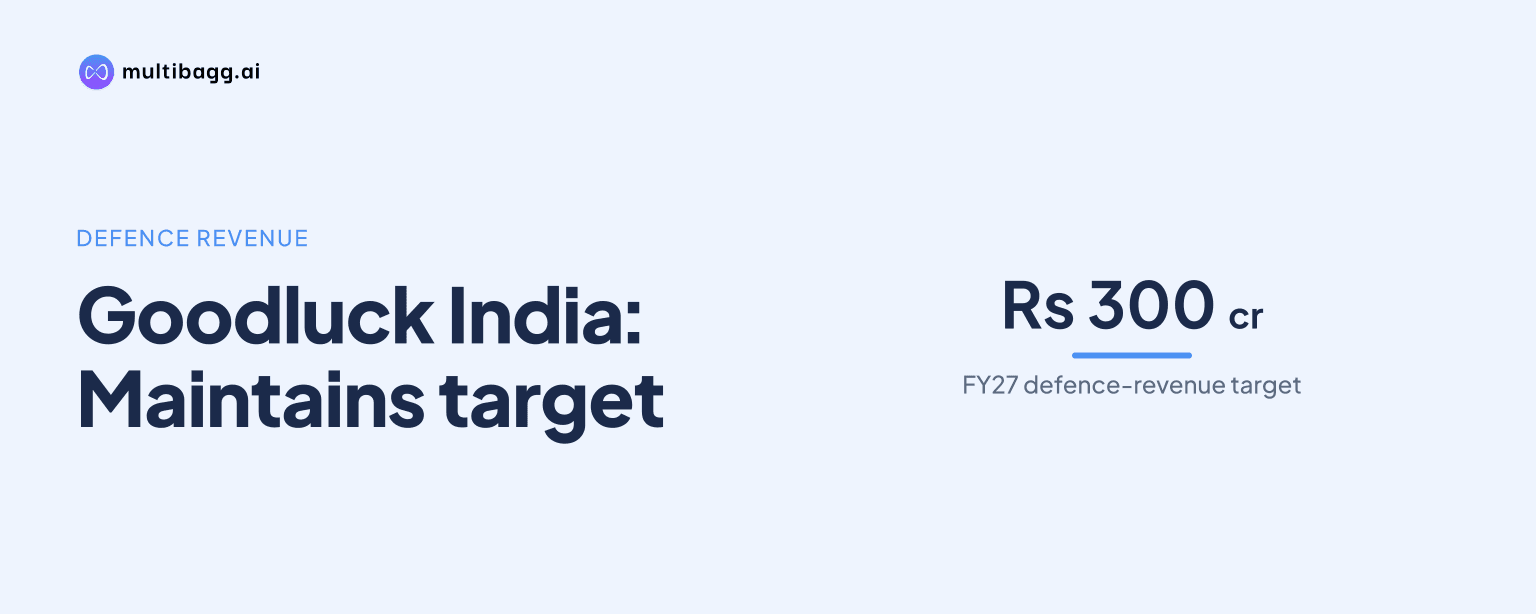
Goodluck India Limited maintained its Rs 300 crore FY27 defence-revenue target in its Q2 FY27 call, even as management said the expansion of 155mm shell capacity from 1.5 lakh to 4 lakh units was on track and could support more than Rs 1,000 crore of peak revenue.
Know Goodluck India inside out
Results, valuation, peers and who's buying, in one view.
What is Goodluck India’s FY27 defence-revenue target?
Goodluck India is maintaining its Rs 300 crore defence-revenue target for FY27. Management reaffirmed the target after an analyst asked whether it still expected to achieve that level, despite the company describing validation, inspection and government-clearance requirements as constraints on execution.
Goodluck India had disclosed defence orders worth Rs 350 crore to stock exchanges. Management said additional orders existed but would generally be announced only after advances were received, and added that order availability was not the principal issue for the defence business.
Production against ongoing defence orders was under way during Q2 FY27, and management expected revenue contribution in the later part of the financial year. The company said it had capacity and manufacturing capability, but the timing of shipments depended on validation activities conducted under government requirements.
How is Goodluck India expanding 155mm shell capacity?
Goodluck India is increasing 155mm shell capacity from 1.5 lakh units to 4 lakh units. Management said the expansion had started and was on track, and that it expected to adhere to the timeline disclosed earlier, although it did not give a commissioning date in the call.
The 4 lakh-unit facility is designed to have flexibility across defence requirements, according to management. It said the new plant would address evolving requirements in the industry and that further capacity expansion could eventually be necessary, which was management’s assessment rather than a committed capital plan.
Goodluck India began with 155mm M107-grade shells and said it had also developed ERFB BB and BT shell products. Management said these products had received orders and had been validated by international purchasers, while research work was continuing towards a 48-kilometre range product.
What revenue could the expanded shell plant generate?
Goodluck India’s management estimated that 4 lakh units of shell capacity could generate more than Rs 1,000 crore of peak revenue. When asked whether this scale could be reached by FY29, management said it should be possible by that period, subject to capacity operation and order execution.
Management continued to state an earnings before interest, tax, depreciation and amortisation, or EBITDA, margin expectation of 30% to 35% for the defence business. It said quarterly performance was above that range, but retained the 30% to 35% range as its conservative view rather than providing a higher margin forecast.
The revenue estimate depends on product mix as well as capacity. Management said realisations could change with market conditions, but argued that technology upgrades from shorter-range to higher-capability shells could support realisations; this was a management view, not a disclosed pricing commitment.
Got a follow-up? Ask IRIS
Why could Goodluck India’s defence revenue be uneven?
Goodluck India said defence revenue may not be evenly distributed between quarters because shipments require validation, inspections and approvals from multiple government departments. Management said these processes could take three, five or six months, making their timing outside the company’s control.
Export permissions can also be affected by geopolitical conditions and the inventory position of receiving countries, according to management. It said metal may not move even where an order is available if the necessary clearance is not granted, while reiterating its confidence in annual FY27 targets.
Management said the majority of 155mm shell enquiries were from export markets and that enquiries and letters of intent exceeded the planned 4 lakh-unit capacity for as long as three years. It did not quantify the total addressable market, saying defence-volume data were classified.
How does the defence plan compare with Goodluck India’s core business?
Goodluck India reported Q2 FY27 consolidated total income of Rs 1,370 crore, compared with Rs 990 crore in Q2 FY26, while sales volume rose 18.1%. Consolidated EBITDA increased to Rs 127 crore from Rs 98 crore, and EBITDA margin was 9.3% versus 9.18% a year earlier.
For H1 FY27, consolidated total income reached Rs 2,660 crore against Rs 1,980 crore in H1 FY26, while EBITDA rose 38% to Rs 267 crore. Profit after tax increased 42.4% to Rs 120 crore from Rs 82.8 crore, although these consolidated figures are not defence-only results.
In the established non-defence operations, capacity utilisation was 98% to 99% in Q2 FY27. Management said it was adding capacity through debottlenecking, precision tubes and galvanised conduit tubes, with an objective of lifting non-defence capacity from 5 lakh tonnes to 6 lakh tonnes over the next 12 to 18 months.
Conclusion
Goodluck India is retaining its Rs 300 crore FY27 defence-revenue objective while scaling 155mm shell capacity from 1.5 lakh to 4 lakh units. The company’s larger defence opportunity rests on higher-capability shell development and management’s estimate of more than Rs 1,000 crore of peak revenue, while its core business generated Rs 2,660 crore of consolidated total income in H1 FY27.
The next disclosures to watch are the later-FY27 revenue contribution from ongoing defence orders, progress on the 4 lakh-unit shell expansion and the proposed amalgamation involving Goodluck Defence and Aerospace Limited. Management said the merger process, which requires approvals including from the Securities and Exchange Board of India and the National Company Law Tribunal, could take about 12 to 16 months.