










Goodluck India Limited Q2 income jumps 38% as costs curb margin
Key highlights
- Goodluck India reported Q2 FY27 consolidated income of Rs 137 crore, up about 38% year on year.
- Q2 FY27 EBITDA was Rs 12.7 crore and EBITDA margin was 9.3%, versus Rs 9.8 crore and 9.18% a year earlier.
- Management said international freight and gas costs reduced Q2 FY27 margin by nearly 150 basis points.
- H1 FY27 PAT rose 42.4% to Rs 120 crore as total income reached Rs 266 crore.
powered by IRIS
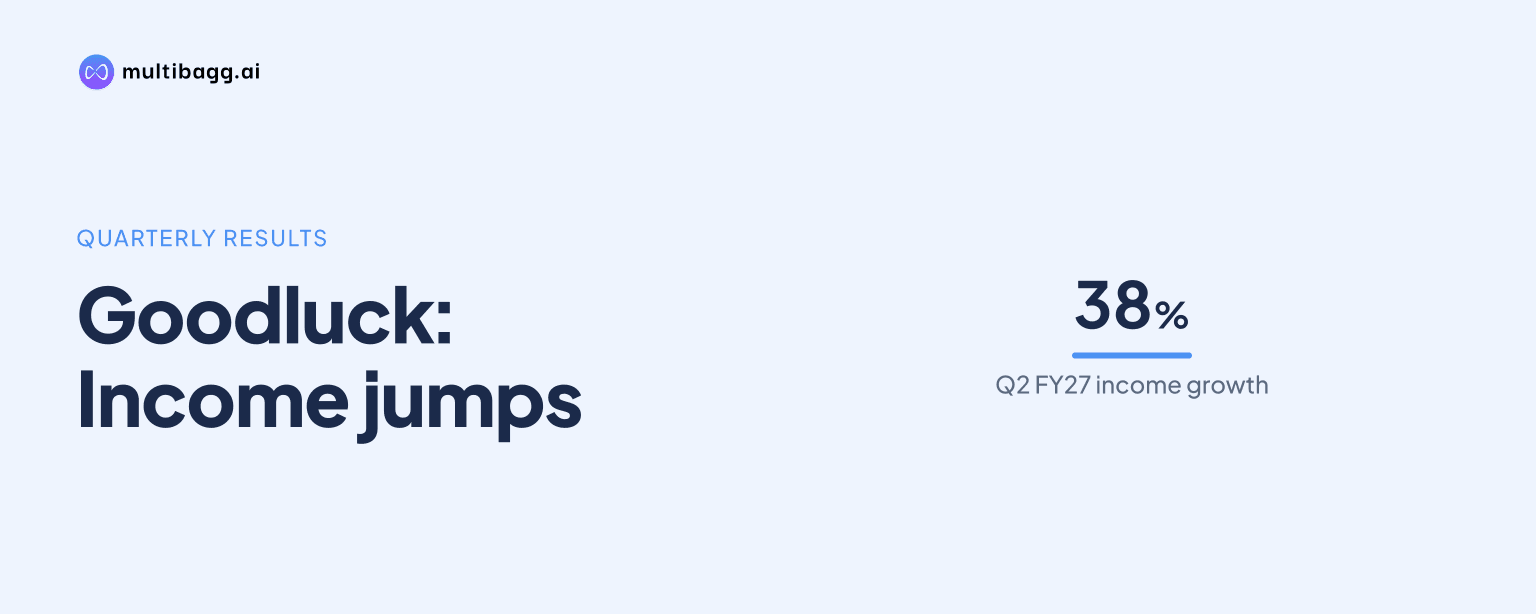
Goodluck India Limited reported consolidated total income of Rs 137 crore in Q2 FY27, up about 38% year on year, but management said higher international freight and gas costs reduced margin by nearly 150 basis points. Reported earnings before interest, tax, depreciation and amortisation (EBITDA) margin was nevertheless 9.3%, versus 9.18% in Q2 FY26.
Know Goodluck India inside out
Results, valuation, peers and who's buying, in one view.
How did Goodluck India perform in Q2 FY27?
Goodluck India delivered higher Q2 FY27 income, EBITDA and profit, led by volume growth and a greater contribution from value-added products. Consolidated total income rose from Rs 99 crore in Q2 FY26 to Rs 137 crore, while sales volume increased 18.1% to 133,374 tonnes. Management said demand across its core engineering businesses, higher volumes and an improved product mix supported the quarter.
Consolidated EBITDA rose 31% to Rs 12.7 crore from Rs 9.8 crore in Q2 FY26. Profit after tax (PAT) increased about 19% to Rs 50.6 crore from Rs 42.6 crore. Income therefore grew faster than EBITDA and PAT during the quarter, even as Goodluck India increased sales of specialised products.
Why did Goodluck India's margin face cost pressure?
Goodluck India's margin faced pressure because international freight and fuel costs, particularly gas prices, reduced margin by nearly 150 basis points in Q2 FY27, management said. This was a cost-environment effect rather than a fall in the reported year-on-year margin: EBITDA margin was 9.3%, compared with 9.18% in Q2 FY26.
The comparison indicates that better product mix and higher volume offset the stated freight and gas headwind on a reported year-on-year basis. Management did not quantify freight expense, gas expense, pricing changes or the EBITDA margin excluding those costs. It said its response would centre on operational improvement and greater cost efficiency amid uncertain global conditions and logistics costs.
The cost issue matters because exports accounted for around 28% of Goodluck India's total H1 FY27 volume, linking a meaningful share of sales to international logistics conditions. Export revenue grew approximately 38% year on year in H1 FY27, and management said it would pursue export growth while remaining mindful of global trade conditions, logistics costs and geopolitical developments.
What changed in Goodluck India's first-half results?
Goodluck India's H1 FY27 financial growth was faster than its volume growth, with consolidated income up 34% to Rs 266 crore and sales volume up 13.5% to 256,093 tonnes. This differs from Q2 FY27, when tonnage grew 18.1%, indicating that the second-quarter volume increase exceeded the half-year rate. Management attributed the half-year outcome to operational performance, higher volume and value-added products.
H1 EBITDA rose 38% to Rs 26.7 crore from Rs 19.3 crore, taking EBITDA margin to 10.0% from 9.8% in H1 FY26. PAT increased 42.4% to Rs 120 crore from Rs 82.8 crore. Unlike the Q2 FY27 discussion of freight and gas costs, the half-year comparison showed a 20-basis-point rise in reported EBITDA margin despite the challenging cost environment.
Goodluck India also said its working-capital cycle at the Q2 FY27 stage was slightly better than both the previous quarter and the Q4 FY26 level. During the call, the chief financial officer said the company had improved the cycle by seven days from the March 2026 exit level. Management did not disclose absolute working-capital days in that response.
Got a follow-up? Ask IRIS
Which businesses could influence Goodluck India's next results?
Goodluck India's core engineering operations, exports and defence execution are the disclosed businesses that could influence future results. Its portfolio includes precision-engineered automotive steel tubes and pipes, structural products, artillery shells and specialised engineering products. Management identified infrastructure, power transmission, railways, renewable energy, automotive, manufacturing and defence as markets for its precision-engineered products.
In defence, Goodluck Defence and Aerospace Limited emerged as the sole technically qualified bidder for specialised 155 millimetre HE M1A4 ready-to-fill artillery shells for Munitions India Limited, management said. Production on existing defence orders was under way with validation activities and government requirements still relevant. Management expects revenue from that order in the later part of FY27, without identifying a specific quarter.
Management also said stock-exchange filings covered Rs 350 crore of defence orders, while explaining that it typically announces orders when an advance is received. In the question session, management said it remained hopeful of maintaining its Rs 300 crore FY27 defence-business target. It cautioned that execution depends on validation, inspections, government clearances and geopolitical conditions, even where capacity and capabilities are available.
What are Goodluck India's capital and structure plans?
Goodluck India proposes to amalgamate Goodluck Defence and Aerospace India Limited and Goodluck Green Energy Limited with Goodluck India, while detailed terms and financial implications remain under evaluation. Management said the proposal is intended to bring engineering, defence and green-energy businesses under one corporate umbrella, with greater strategic alignment, coordinated capital allocation and more effective oversight.
The aerospace-components initiative has an estimated investment of Rs 80 crore and expected business benefit of almost Rs 180 crore, as disclosed in a regulatory filing cited by management. In power transmission, management said it was trying to increase capacity within the next six months to address demand for power-evacuation infrastructure. It also said it had completed a 22,000-tonne bullet-train order and was undertaking a new bullet-train design at its Gujarat facility.
On financing, management said it intended to keep debt close to 2.5 times EBITDA and was within that objective at the time of the call. It plans to optimise the level downward over the longer term, but gave no date for becoming net debt-free or debt-free. This leaves working-capital execution, capacity expansion and the pace of defence validation central to the funding path.
Conclusion
Goodluck India increased Q2 FY27 income by 38% and sales volume by 18.1%, while its H1 FY27 EBITDA and PAT grew faster than revenue. The results show that volume, value-added products and exports supported reported profitability, but freight and gas costs absorbed part of the operating benefit during the quarter.
The next disclosures should show whether freight and gas costs continue to affect margin, whether defence revenue arrives in the later part of FY27, and whether the Rs 300 crore FY27 defence target is maintained. Management also plans power-transmission capacity expansion within six months, while the proposed amalgamation's detailed terms and financial implications remain under evaluation.