










Graphite India Sees No Material Impact From US Electrode Tariffs
Key highlights
- Graphite India says preliminary United States graphite-electrode tariffs will not have a material impact because export revenue is geographically diversified.
- Consolidated Q2 FY2027 net sales rose 13.3% year-on-year to Rs 826 crore, while EBITDA increased 43.2% to Rs 189 crore.
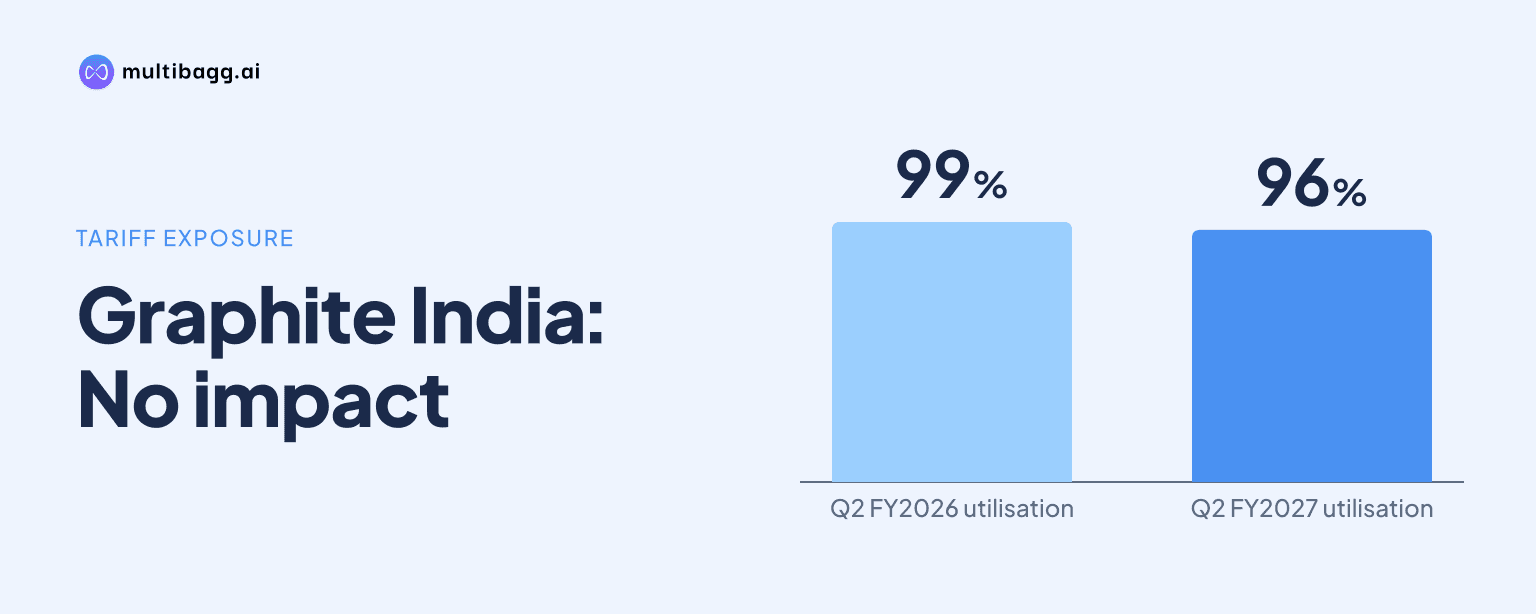
- Capacity utilisation was 96% in Q2 FY2027, compared with 99% in Q2 FY2026.
- Consolidated net cash stood at Rs 3,827 crore at the end of September 2026 after gross debt of Rs 274 crore.
powered by IRIS
Graphite India Limited says preliminary United States tariffs on graphite electrodes will not materially affect it because its export revenue is geographically diversified, according to its November 3, 2026 presentation. The assessment accompanied second-quarter financial year 2027 (Q2 FY2027) consolidated net sales of Rs 826 crore, up 13.3% year-on-year.
Know Graphite India inside out
Results, valuation, peers and who's buying, in one view.
Will US graphite-electrode tariffs affect Graphite India?
Graphite India says the recently imposed preliminary United States tariffs on graphite electrodes will not have a material impact because it has a geographically diversified export revenue base. Chairman K K Bangur stated this assessment in the Q2 FY2027 presentation, which covered the quarter ended September 2026 and reported consolidated net sales of Rs 826 crore.
The presentation does not disclose the preliminary tariff rate, its effective date, the share of revenue exported to the United States, or sales by export destination. As a result, the material presents management’s assessment rather than a quantified financial exposure. The stated protection mechanism is geographic diversification of export revenue, rather than a disclosed adjustment in prices, volumes, production or product mix.
What were Graphite India’s Q2 FY2027 financial results?
Graphite India reported Q2 FY2027 consolidated net sales of Rs 826 crore, earnings before interest, tax, depreciation and amortisation (EBITDA) of Rs 189 crore, and net profit of Rs 94 crore. Sales rose 13.3% year-on-year, EBITDA increased 43.2%, and net profit rose 23.7%; management attributed sales growth to higher volumes and realisations.
Standalone net sales of Rs 806 crore were Rs 20 crore below the consolidated figure, while standalone EBITDA of Rs 197 crore and net profit of Rs 128 crore exceeded their consolidated equivalents. Consolidated net profit reflected an exceptional item of Rs 22 crore for employee restructuring costs and inventory write-down arising from the closure of German operations. The presentation reported consolidated earnings per share of Rs 4.89 and standalone earnings per share of Rs 6.56.
What changed in Graphite India’s operations during Q2 FY2027?
Graphite India’s capacity utilisation was 96% in Q2 FY2027, compared with 99% in Q2 FY2026, while consolidated sales rose 13.3% year-on-year to Rs 826 crore. Management said higher volumes and realisations drove the sales increase, meaning revenue grew despite a three-percentage-point decline in utilisation from the prior-year quarter.
Management said graphite-electrode prices improved during the quarter as demand continued to recover, although higher input costs limited margin expansion. Consolidated EBITDA nevertheless increased 43.2% year-on-year to Rs 189 crore. The presentation does not provide graphite-electrode price levels, input-cost amounts, electrode volumes, or EBITDA margin percentages.
Got a follow-up? Ask IRIS
What steel-market conditions matter for Graphite India?
Graphite India operates in a steel-linked market where crude-steel production in 70 countries fell 0.5% year-on-year to 1,367.3 million metric tonnes in the nine months ended September 2026, while Indian output rose 6.2% to 130.0 million metric tonnes. The difference matters because graphite electrodes are used in electric arc furnace steelmaking and the presentation identifies India as growing ahead of the global production trend.
In the third quarter of calendar year 2026, global crude-steel output was 436.0 million metric tonnes, down 0.3% year-on-year. China produced 225.1 million metric tonnes, down 2.4%, whereas India produced 43.1 million metric tonnes, up 3.4%; North America increased 3.7% to 28.3 million metric tonnes. For the nine-month period, North American output rose 5.2%, compared with a 9.3% decline in the Middle East.
What demand drivers and balance-sheet position does Graphite India report?
Graphite India identifies rising use of the electric arc furnace (EAF) process as a future demand driver for graphite electrodes, with EAF production representing 28.6% of global steel output. It links EAF adoption to environmental regulation and decarbonisation measures, contrasting it with the blast furnace and basic oxygen furnace process.
India’s National Steel Policy 2017 identifies a roadmap to 300 million metric tonnes of steel-production capacity by 2030, while per-capita steel consumption has crossed 100 kilograms against a 160-kilogram target by 2030. Separately, Graphite India reported consolidated net cash of Rs 3,827 crore at the end of September 2026 after gross debt of Rs 274 crore; standalone net cash was Rs 3,751 crore after gross debt of Rs 150 crore. The presentation does not specify an intended use for that net cash balance.
Conclusion
Graphite India’s stated tariff assessment rests on the geographic diversification of its export revenue, not on a disclosed tariff rate or quantified United States exposure. The assessment comes alongside rising Q2 FY2027 sales and EBITDA, although capacity utilisation declined to 96% from 99% a year earlier and management said higher input costs constrained margin expansion.
The next disclosed demand marker is the World Steel Association forecast for global steel demand to rise 1.7% to 1,752 million metric tonnes in 2027. Its forecast for India is an 8.0% increase to 186.2 million metric tonnes in 2027, after projected growth of 7.9% to 172.4 million metric tonnes in 2026; the presentation leaves the tariff rate and Graphite India’s destination-level export exposure unresolved.