










GRSE uses long-term contracts for MSME order visibility
Key highlights
- GRSE said nearly 70% of its procurement is sourced from MSMEs.
- GRSE has concluded three-to-five-year contracts for service MSMEs involved in fabrication, erection and outfitting.
- GRSE has established rate contracts to replace piecemeal orders for production MSMEs.
- GRSE expected concurrent ship construction capacity to increase from 28 to 32 ships by the end of the following month.
powered by IRIS
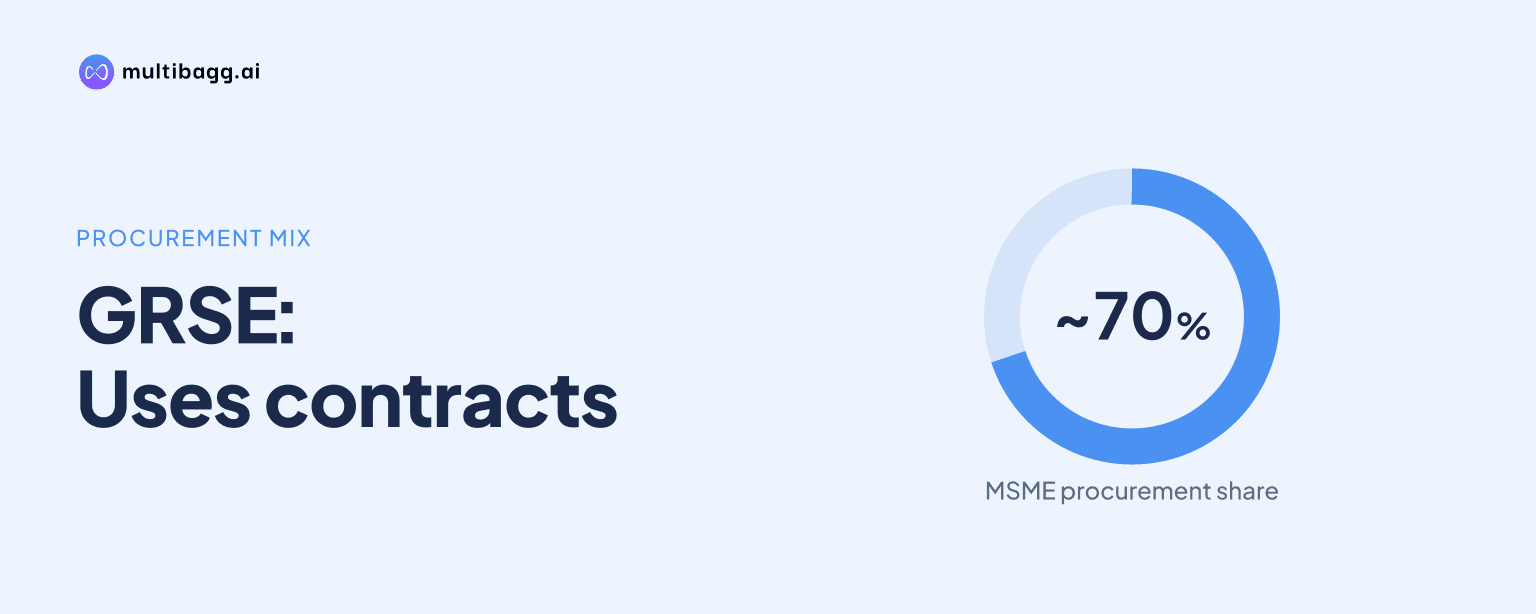
Garden Reach Shipbuilders and Engineers Limited said nearly 70% of its procurement comes from micro, small and medium enterprises (MSMEs), and it has concluded three-to-five-year contracts for service vendors while establishing rate contracts and aggregating demand for production suppliers. The measures are intended to replace piecemeal ordering with clearer longer-term visibility.
Know Garden Reach Shipbuilders & Engineers inside out
Results, valuation, peers and who's buying, in one view.
What share of GRSE procurement comes from MSMEs?
GRSE said nearly 70% of its procurement is sourced from MSMEs, placing small suppliers at the centre of its shipbuilding execution model. The supplier base includes service vendors handling block fabrication, erection and outfitting, as well as manufacturers of items such as bull bars, composite materials, doors and hatches.
GRSE described itself as a platform integrator, meaning the customer defines the equipment, systems and material specifications while the shipyard integrates them into vessels. The nearly 70% figure is a procurement-category measure and should not be treated as a measure of indigenous content in any particular ship class.
For service MSMEs, GRSE said its order book provides visibility because it has concluded long-term contracts. For production MSMEs, management identified piecemeal orders as the issue: smaller, project-specific purchase requirements can make it harder for suppliers to plan production lines, working capital and capacity additions for specialised shipbuilding components.
How is GRSE giving service MSMEs longer order visibility?
GRSE has concluded long-term contracts lasting three to five years for service MSMEs involved in block fabrication, erection and outfitting. Management said these arrangements provide clearer visibility for vendors whose work recurs across the construction cycle of naval and commercial platforms.
The contract approach is relevant to GRSE's workload of 13 projects comprising 50 platforms, although management said roughly 13 to 15 of those platforms are very small businesses. Service suppliers can receive work across multiple programmes rather than depending only on isolated assignments tied to an individual hull or construction stage.
Management did not disclose the value of the three-to-five-year contracts, the number of vendors covered, supplier-wise allocations or volumes committed through those contracts. The disclosed point was the duration and the stated purpose of giving service MSMEs greater certainty over expected work.
How will GRSE's rate contracts change production procurement?
GRSE said it has established rate contracts to aggregate requirements and move away from piecemeal orders for production MSMEs. The mechanism applies to manufacturers of customer-specified shipbuilding products, including bull bars, composite doors and hatches.
Under this approach, GRSE seeks to give suppliers longer-term demand visibility instead of issuing requirements only in smaller project-by-project tranches. Management said the company had recognised the bottleneck faced by production MSMEs and introduced rate contracts in line with directions from its ministry.
GRSE also said its ministry is steering a process to aggregate demand across four shipyards. Management expects the outcome of that consolidation to become visible in the coming months and years, but did not disclose a target value, contracted volume, implementation date or allocation method for the four-yard exercise.
The company linked longer visibility to a requirement for suppliers to respond with capacity and execution. Management said MSMEs receiving larger orders and a longer planning horizon would need to enhance capacity where necessary and deliver products on time and at the required quality.
Got a follow-up? Ask IRIS
Why does GRSE's MSME strategy matter for shipbuilding capacity?
GRSE said the supplier strategy supports its ability to take on larger orders without missing opportunities because of capacity constraints. At the time of the call, the shipyard was executing 13 projects comprising 50 platforms and was using partnerships with capable shipyards for selected construction work.
GRSE said it had capacity for concurrent construction of 28 ships and expected this to rise to 32 by the end of the following month. That total includes vessels in pre-launch and post-launch stages, including ships in dry docks, building berths, launch pads and jetties.
Reliable MSME supply matters at each stage because fabrication, erection, outfitting and equipment integration continue beyond hull construction and launch. GRSE said it has about 16 dry docks, slipways, building berths and launch pads of different sizes, alongside associated jetties, supporting its planned 32-ship concurrent capacity.
Management cited its eight-vessel share of a 16-ship anti-submarine shallow watercraft programme as an example of the partnership model. GRSE said it had delivered five of its eight vessels, expected the sixth within a week of the call, and was almost one year ahead of the contractual delivery schedule.
How does GRSE's MSME sourcing compare with indigenous content?
GRSE reported about 85% indigenous content in its last three completed warship-building projects, compared with about 40% to 45% for commercial ships built for export. These figures differ from the nearly 70% MSME procurement share because indigenous content measures local content in a finished vessel, while the procurement measure identifies the type of supplier from which GRSE buys.
For export commercial ships, GRSE said overseas customers can stipulate equipment from a particular country or vendor, limiting the shipyard's ability to substitute locally sourced systems. The 40% to 45% indigenous portion includes yard materials such as steel and outfit items obtained from the local market.
GRSE said indigenous content for commercial or non-defence platforms can reach about 60% to 65%. Management added that some first-of-class projects still require sensitive electronic equipment from abroad, explaining why local content does not necessarily reach the about 85% reported for the last three completed warship projects.
Conclusion
GRSE's disclosed supply-chain approach is designed to make a supplier base accounting for nearly 70% of procurement more predictable for shipbuilding execution. Three-to-five-year contracts provide service MSMEs with defined work visibility, while rate contracts and demand aggregation are intended to reduce fragmented ordering for producers of specialised equipment and materials.
The next development to watch is the ministry-led aggregation of demand across four shipyards, for which management expects results in the coming months and years. Execution will also depend on whether MSMEs expand capacity and meet quality and delivery requirements as GRSE moves from 28 to 32 ships under concurrent construction by the end of the following month.