










GSK India: chronic therapies outpaced acute drugs in Q2 FY27
Key highlights
- Chronic therapies grew 17% in Q2 FY27, compared with 13% for acute therapies.
- Acute therapies remained 60% of the IPM, while chronic therapies accounted for 40%.
- The IPM grew 14.7% in July-September 2026, with price at 5.0% and volume at 3.6%.
- GSK India reported Q2 FY27 revenue of Rs 1,180 crore, up 21% year on year.
powered by IRIS
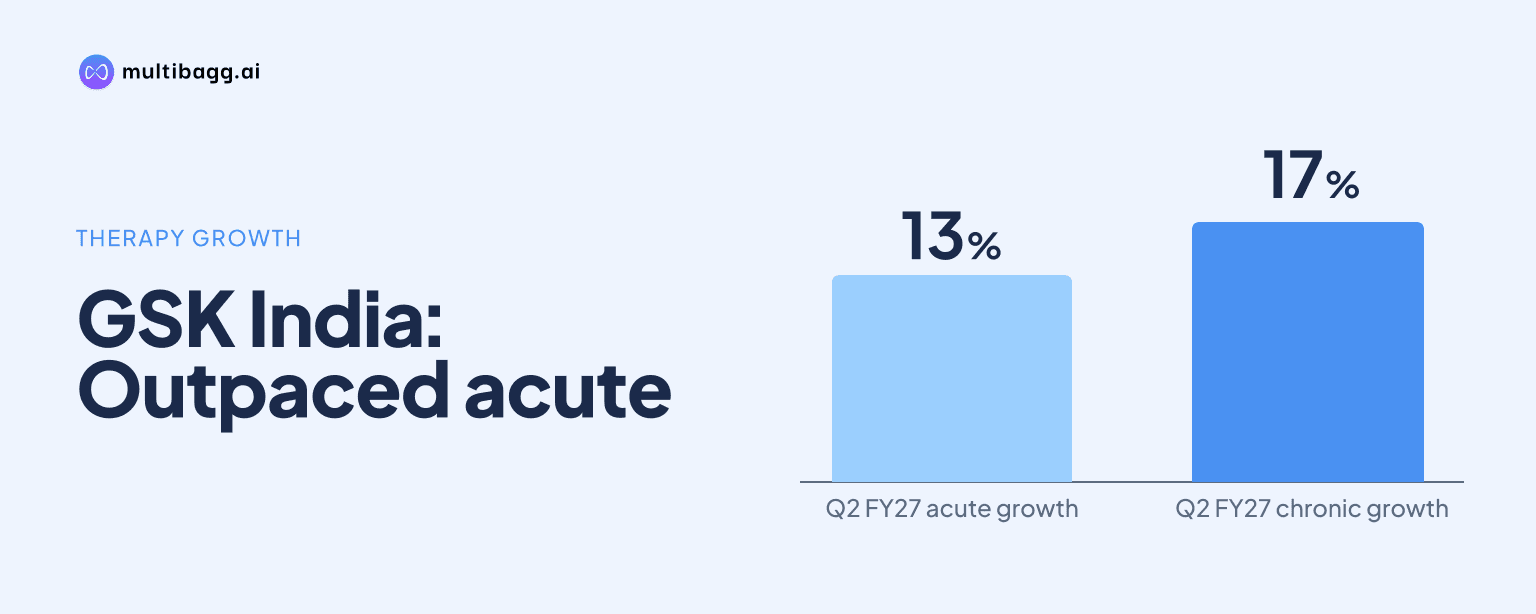
GlaxoSmithKline Pharmaceuticals Limited reported that chronic therapies in the Indian pharmaceutical market (IPM) grew 17% in the second quarter of fiscal year 2027 (Q2 FY27), four percentage points faster than acute therapies at 13%, although acute medicines remained 60% of the market. The IPM grew 14.7% in July-September 2026.
Know Glaxosmithkline Pharmaceuticals inside out
Results, valuation, peers and who's buying, in one view.
How did chronic therapies compare with acute drugs in Q2 FY27?
Chronic therapies grew faster than acute drugs in Q2 FY27, at 17% versus 13%, while acute therapies retained a 60% contribution to the IPM, compared with 40% for chronic therapies. GSK India described chronic therapies as growing better than acute therapies and increasing their industry contribution. The faster-growing chronic segment was nevertheless 20 percentage points smaller than acute therapies by market contribution during the quarter.
The comparison places both segments against IPM growth of 14.7% in July-September 2026. Chronic growth was 2.3 percentage points above the market rate, while acute growth was 1.7 percentage points below it. GSK India did not disclose prior-quarter acute and chronic contribution figures, so the presentation does not quantify the change in market mix over time.
What drove IPM growth in July-September 2026?
The IPM's 14.7% growth in July-September 2026 was largely price-led, according to GSK India, with price at 5.0% and volume at 3.6%. The presentation also showed a 6.1% metric labelled IN, without expanding the term. GSK India consequently identified price, rather than volume alone, as the principal disclosed contributor to market expansion.
The 5.0% price measure was 1.4 percentage points above the 3.6% volume measure. This provides context for the 17% chronic and 13% acute value-growth figures, but GSK India did not give separate price or volume measures for the two therapy groups. The source therefore does not establish whether chronic therapies' faster growth arose from pricing, volumes or the measure labelled IN.
Which therapy categories grew fastest in the reported market?
Vaccines were the fastest-growing listed therapy category, rising 24.8% in Q2 FY27, followed by anti-diabetic therapies at 19.3% and vitamins, minerals and nutrition at 18.5%. Cardiac therapies, the largest disclosed category by contribution at 13.3%, grew 17.5%. These data show varied growth rates across the therapy categories listed in the presentation.
Respiratory therapies grew 5.3%, while the category labelled AI grew 7.1%, making them the two slowest-growing categories listed by GSK India. Pain grew 16.5%, neuro or central nervous system therapies grew 15.2%, gynaecology grew 14.9%, derma grew 14.2%, gastro grew 10.0%, and hormones grew 9.3%. GSK India separately highlighted AI and respiratory as acute therapies with growth of 7% and 5%, respectively.
Cardiac and anti-diabetic therapies together represented 22.3% of the disclosed therapy mix, from contributions of 13.3% and 9.0%. Their 17.5% and 19.3% growth rates exceeded both the 13% acute-therapy rate and the 14.7% overall IPM rate. However, GSK India did not map every listed therapy category to either acute or chronic classifications, preventing a precise category-level explanation of the four-percentage-point gap.
Got a follow-up? Ask IRIS
How did multinational companies perform against Indian players?
Multinational companies and Indian players each grew 15% in Q2 FY27, but Indian players represented 84% of the IPM while multinational companies accounted for 16%. GSK India therefore reported the same growth rate for the two groups despite a 68-percentage-point difference in their respective market contributions. The presentation described multinational-company growth as being at par with Indian players for the quarter.
GSK India's reported representative market grew 11%, while its portfolio grew 12% and held a 25% share of that market. The presentation showed price at 3.5% and volume at 2.3% for this comparison. GSK India's general-medicines representative market grew 8%, compared with 11% for its general-medicines portfolio, which also held a 25% share.
How is GSK India linking market trends to its portfolio?
GSK India reported Q2 FY27 revenue of Rs 1,180 crore, up 21%, compared with 14.7% IPM growth in July-September 2026. Its innovation portfolio accounted for 7% of total sales, up from 3% in the previous year's comparable period. GSK India defines innovation as oncology products Jemperli and Zejula, new respiratory products Nucala and Trelegy, and the adult vaccine Shingrix.
GSK India reported earnings before interest, tax, depreciation and amortisation (EBITDA) of Rs 400 crore in Q2 FY27, up 20%, with a 34% margin that was 50 basis points lower year on year. Profit after tax (PAT), before exceptional items, was Rs 335 crore, up 33%, and the PAT margin rose 260 basis points to 29%. The company attributed the PAT-margin increase to interest income on an income-tax refund received during the quarter.
Within the representative market, GSK India's vaccine portfolio grew 22%, against 32% for its representative market, and held a 26% share. Its general-medicines portfolio grew 11%, ahead of 8% growth in its representative market. GSK India also said Shingrix sales doubled and that innovation was building momentum through oncology launches, adult vaccines and new respiratory products, but it did not disclose product-level revenue.
Conclusion
The Q2 FY27 data show chronic therapies growing faster than acute therapies, at 17% versus 13%, while acute medicines remained the larger 60% portion of the IPM. Overall IPM growth was 14.7% and was described by GSK India as largely price-led, while multinational companies and Indian players each grew 15%. GSK India's 21% revenue growth exceeded the reported IPM growth rate.
The next disclosed development is GSK India's portfolio-transformation plan, which lists Jemperli, Zejula, BLENREP, Omjjara and AREXVY as upcoming launches. Innovation represented 7% of Q2 FY27 sales, compared with 3% a year earlier, and GSK India said it was building momentum in oncology, adult vaccines and new respiratory products.