










GSK India vaccine portfolio grew 22% as Fluarix units rose 65%
Key highlights
- GSK’s represented vaccine portfolio grew 22% in Q2 FY27 and held 26% market share.
- Fluarix reported 65.3% unit growth in Q2 FY27 and gained 5.2 percentage points of unit share.
- GSK said Shingrix prescribers were 2.6 times their year-earlier level and Q2 FY27 sales doubled.
- GSK’s innovation portfolio accounted for 7% of Q2 FY27 sales, compared with 3% a year earlier.
powered by IRIS
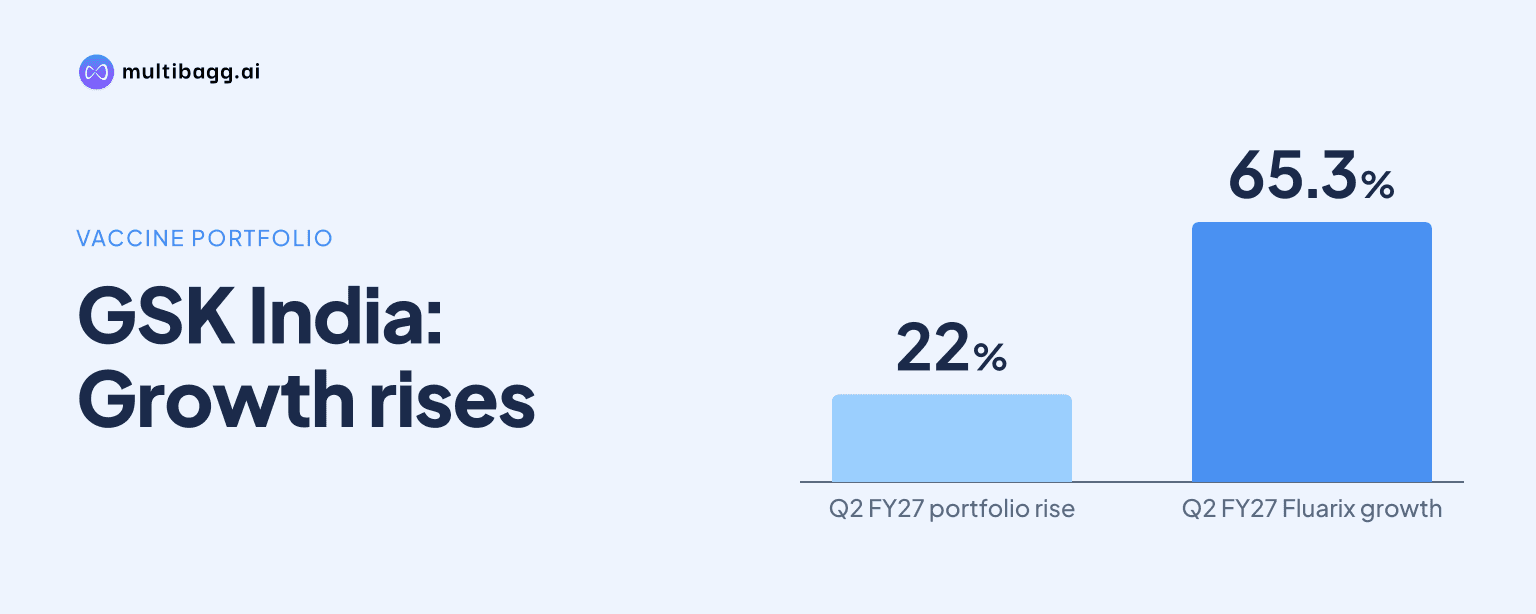
GSK India’s vaccine portfolio grew 22% in Q2 FY27, while Fluarix unit growth reached 65.3% and Shingrix’s prescriber base was 2.6 times its year-earlier level. The portfolio retained 26% share of GSK’s represented vaccine market, although that market grew 32%, compared with the portfolio’s 22%.
Know Glaxosmithkline Pharmaceuticals inside out
Results, valuation, peers and who's buying, in one view.
How did GSK’s vaccine portfolio perform in Q2 FY27?
GSK’s vaccine portfolio grew 22% in Q2 FY27, compared with 32% for its represented vaccine market, and held a 26% share of that market. The presentation attributes the portfolio’s stated growth components to 3.4% price, 12.7% volume and 16.3% new introductions, or NI. The 22% portfolio growth was above GSK’s overall represented portfolio growth of 12% and its general-medicines represented portfolio growth of 11%.
The comparison sits against Indian Pharmaceutical Market, or IPM, data for July to September 2026. Vaccines accounted for 1.5% of IPM therapy contribution and recorded 24.8% value growth, compared with 14.7% for the IPM overall. The IPM’s reported growth components were 5.0% price, 3.6% volume and 6.1% NI, while GSK reported 12.7% volume growth for its vaccine portfolio.
GSK defines the represented portfolio data as covering general-medicines and vaccine brands, excluding the GoA portfolio and discontinued brands. The 22% metric is therefore a portfolio market-performance measure, not separately reported vaccine revenue. GSK reported standalone revenue of Rs 1,180 crore in Q2 FY27, up 21%, without providing a vaccine-only sales figure.
Which established vaccines supported GSK’s vaccine position?
GSK’s established vaccines held 21.5% moving annual total, or MAT, value market share in Q2 FY27, with a unit evolution index, or EI, of 103 and a value EI of 100. GSK said the established portfolio continued to lead the overall vaccine market. The named brands showed different unit-share outcomes despite each reporting positive unit growth.
Fluarix was the fastest-growing named established vaccine, delivering 65.3% unit growth in Q2 FY27, a 22.5% unit market share and a 5.2 percentage-point unit-share gain. Its unit EI of 130 was the highest among the four disclosed brands. Boostrix reported a unit EI of 112, unit growth of 21.0% and a 3.6 percentage-point unit-share gain.
Havrix grew unit volumes by 16.3% and recorded a 33.8% unit share, with a 0.02 percentage-point increase. IH posted 21.9% unit growth and had the highest disclosed unit share at 45.5%, but its share declined by 0.7 percentage points. GSK also said paediatric vaccines retained leadership in the self-pay private paediatric market, without supplying sales or share data for that statement.
Got a follow-up? Ask IRIS
What does Shingrix’s prescriber expansion indicate?
GSK said Shingrix prescribers, described as Rxers, were 2.6 times their year-earlier level, alongside 39% year-on-year growth shown on the Q2 FY27 slide. Shingrix is a recombinant, adjuvanted herpes zoster vaccine. GSK describes its activity as establishing adult immunisation as a category, distinguishing it from the established vaccine portfolio.
GSK said it is targeting the cardiovascular-metabolic disease, or CVMD, opportunity to drive Shingrix growth in 2026. It also said Shingrix sales doubled in Q2 FY27, driven by engagement with healthcare professionals, or HCPs, and healthcare organisations, or HCOs. The presentation does not disclose the opening or closing number of prescribers, absolute Shingrix sales, or the measure underlying the 39% growth figure.
Shingrix forms part of GSK’s innovation portfolio alongside Jemperli and Zejula in oncology and Nucala and Trelegy in respiratory medicine. That innovation portfolio accounted for 7% of Q2 FY27 total sales, compared with 3% in the prior-year period. The source links the adult-vaccine effort to portfolio transformation but does not quantify Shingrix’s individual contribution to the 7% sales share.
How did vaccine momentum fit GSK’s wider Q2 FY27 results?
GSK reported Q2 FY27 standalone revenue of Rs 1,180 crore, up 21%, and earnings before interest, tax, depreciation and amortisation, or EBITDA, of Rs 400 crore, up 20%. EBITDA margin was 34%, down 50 basis points year on year. Management attributed sales growth to execution, the evolving innovation portfolio and a favourable prior-year base effect.
General medicines were also identified as a sales driver in Q2 FY27, led by Augmentin, Calpol, Neosporin and T-Bact. Calpol delivered 16.9% unit growth and a 3.0 percentage-point unit-share gain, while Augmentin grew 8.2% and gained 1.0 percentage point. Fluarix’s 65.3% unit growth was higher than both disclosed general-medicines brand growth rates, but GSK did not disclose product-level revenue contributions.
Profit after tax before exceptional items was Rs 335 crore in Q2 FY27, up 33%, and the margin increased 260 basis points to 29%. GSK said the margin change reflected interest on an income-tax refund received during the quarter. It also cited currency depreciation and higher input costs as causes of gross-margin dilution, partly offset by price increases, while selling, general and administrative expense as a share of sales fell by 1%.
Conclusion
GSK’s Q2 FY27 vaccine performance combined 22% represented-portfolio growth and a 26% represented-market share with distinct contributions from established and adult vaccines. Fluarix produced the largest disclosed unit increase at 65.3%, while Shingrix’s 2.6-times prescriber expansion and doubled sales reflect GSK’s category-building activity in adult immunisation. The vaccine portfolio nonetheless grew more slowly than the 32% represented vaccine market.
The next disclosed developments to watch are GSK’s 2026 CVMD opportunity for Shingrix and its listed upcoming launches, including Arexvy, BLENREP and Omjjara. The presentation also identifies Jemperli and Zejula among upcoming launches, despite including both products in the 7% innovation portfolio reported for Q2 FY27, leaving the timing and scope of future product expansion unresolved.