










GSK Q2 revenue rose 21% as innovation mix reached 7%
Key highlights
- GSK reported Q2 FY27 revenue of Rs 1,180 crore, up 21% year on year.
- GSK's innovation portfolio represented 7% of sales, compared with 3% in the prior-year quarter.
- GSK's Q2 FY27 profit after tax before exceptional items rose 33% to Rs 335 crore.
- GSK's Q2 FY27 EBITDA margin was 33.9%, down 50 basis points year on year.
powered by IRIS
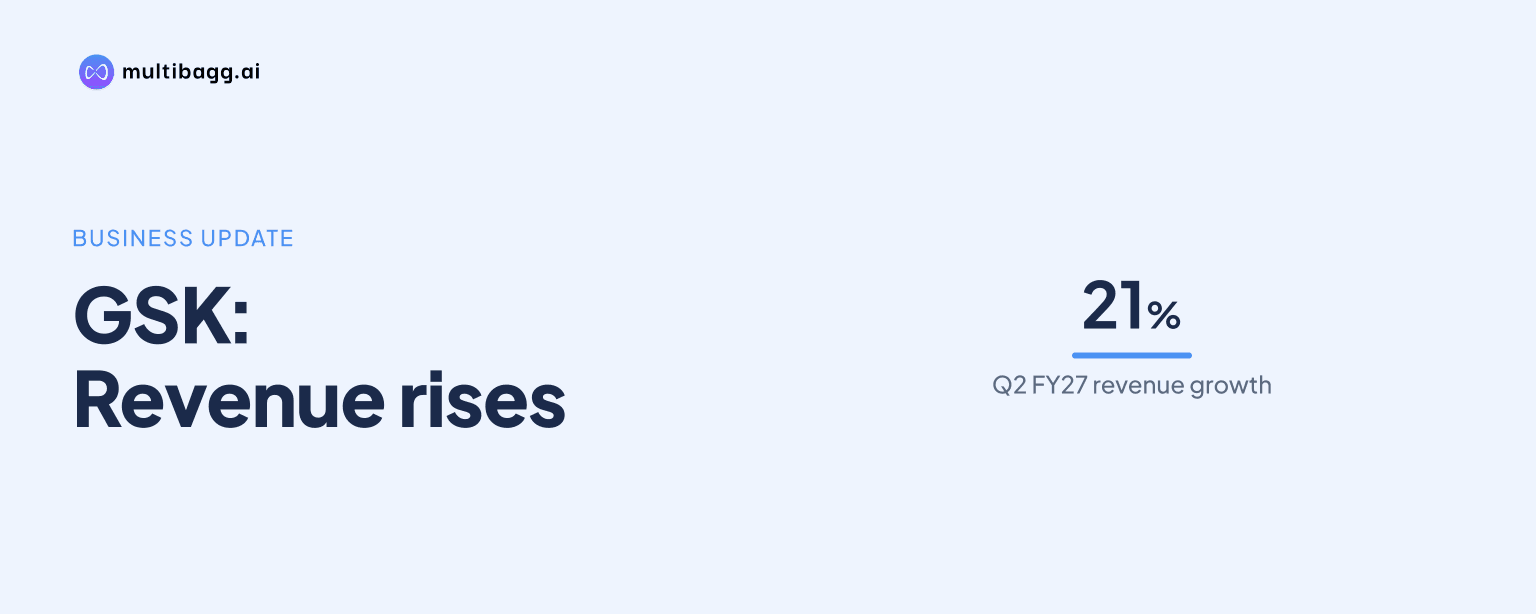
GSK India reported Q2 FY27 standalone revenue of Rs 1,180 crore, up 21% year on year, as its innovation portfolio reached 7% of sales from 3% a year earlier. GSK attributed the portfolio shift to oncology launches, new respiratory medicines and adult vaccines, while pre-exceptional profit after tax rose 33% to Rs 335 crore.
Know Glaxosmithkline Pharmaceuticals inside out
Results, valuation, peers and who's buying, in one view.
What drove GSK's 21% Q2 revenue growth?
GSK's Q2 FY27 revenue growth was driven by established brands, the expanding innovation portfolio and a favourable prior-year base, according to management. Standalone revenue was Rs 1,180 crore in Q2, while first-half revenue reached Rs 2,104 crore, up 18%. The quarterly growth rate was therefore 3 percentage points above the H1 rate.
GSK identified Augmentin, Calpol, Neosporin and T-Bact as the general-medicines brands leading growth. The company also cited continued leadership in the self-pay private paediatric-vaccine market. Shingrix sales doubled, and the adult herpes zoster vaccine recorded 2.6 times as many prescribers, representing 39% year-on-year growth in prescribers.
GSK's pre-exceptional profit after tax grew faster than revenue in Q2, at 33% against 21%, and earnings per share were Rs 19.76, up 32%. However, management said the profit-after-tax margin increase also reflected interest received on an income-tax refund during the quarter, separating part of the profit improvement from sales and operating performance.
How much of GSK sales came from innovation?
GSK's innovation portfolio accounted for 7% of Q2 FY27 sales, compared with 3% in the prior-year quarter, an increase of 4 percentage points. The company defines innovation as oncology medicines Jemperli and Zejula, new respiratory treatments Nucala and Trelegy, and the adult vaccine Shingrix.
The portfolio shift occurred alongside investment in patient and healthcare-professional engagement. GSK said more than 4,000 severe-asthma patients had benefitted from Nucala. For oncology, it reported more than 7.9 million face-to-face and digital touchpoints, over 365,000 unique healthcare professionals reached, and more than 3,300 healthcare-professional or healthcare-organisation engagement events.
GSK's presentation lists Jemperli, Zejula, BLENREP, Omjjara and AREXVY as upcoming launches. It does not disclose launch dates, regulatory status, expected sales or individual product revenue for those medicines and vaccines. The list therefore indicates management's disclosed portfolio plan but does not quantify future innovation-mix growth.
Why did GSK's EBITDA margin fall in Q2 FY27?
GSK's Q2 FY27 EBITDA margin declined 50 basis points year on year to 33.9%, rounded to 34% in the financial highlights, because currency depreciation and higher input costs diluted gross margin. EBITDA increased 20% to Rs 400 crore, but price increases only partly offset the reported gross-margin pressure. A basis point is one-hundredth of a percentage point.
Management said selling, general and administrative expenses as a percentage of sales fell by 1 percentage point through cost efficiencies. That reduction partly countered the gross-margin effect in Q2. In H1 FY27, EBITDA was Rs 693 crore, up 18%, and the margin was 33%, 10 basis points higher year on year, producing a different six-month outcome from the quarterly decline.
GSK's profit-after-tax margin before exceptional items rose 260 basis points year on year to 29% in Q2, compared with the 50-basis-point EBITDA-margin decline. Management attributed the step-up to interest on the income-tax refund. In H1, pre-exceptional profit after tax was Rs 588 crore, up 29%, and the corresponding margin rose 230 basis points to 28%.
Got a follow-up? Ask IRIS
How did GSK perform against its represented market?
GSK's represented market grew 11% in Q2 FY27, while its portfolio grew 12% and held a 25% share, according to the company's IQVIA September 2026 dataset. Its general-medicines portfolio grew 11% against 8% for its represented market. Its vaccine portfolio grew 22%, below 32% for its represented market, while retaining a 26% share.
The Indian pharmaceutical market grew 14.7% in July-September 2026, with 5.0% attributed to price, 3.6% to volume and 6.1% to new introductions. Chronic therapies grew 17%, ahead of 13% for acute therapies, though acute therapies remained the larger component at 60% of the market compared with 40% for chronic therapies. These industry figures cover a broader measure than GSK's represented market.
GSK's established vaccines retained a 21.5% value market share on a moving annual total basis. Fluarix reported 65.3% unit growth in Q2 FY27, while Calpol recorded 16.9% unit growth and a 34.0% unit share. Augmentin grew 8.2% in units with an 18.9% unit share, whereas Eltroxin's unit growth was negative 2.2%.
How has GSK's profitability changed over recent quarters?
GSK's EBITDA margin improved to 33.9% in Q2 FY27 from 31.7% in Q1 FY27, but remained below 34.4% in Q2 FY26. The sequential increase was 2.2 percentage points, while the year-on-year movement was a 50-basis-point decline. This reconciles the rounded 34% Q2 FY27 margin in the financial highlights with the 33.9% shown in the quarterly margin series.
The presentation's market-share series for key promoted brands ended at 27.8% in Q1 FY27, after 28.0% in Q4 FY26. GSK did not provide a comparable Q2 FY27 figure in that chart. The measure covers promoted brands including Augmentin, Calpol, Ceftum, T-Bact, CCM, Cobadex CZS, Eltroxin, Tenovate, Neosporin and Supacef.
Conclusion
GSK combined 21% Q2 FY27 revenue growth with a more-than-doubling of innovation's sales contribution to 7% from 3%. Established general medicines and paediatric vaccines remained material contributors, while oncology, respiratory and adult-vaccine products formed a larger part of sales. Profit after tax before exceptional items rose 33% to Rs 335 crore, despite gross-margin pressure from currency depreciation and input costs.
The next disclosed developments are the planned launches of BLENREP, Omjjara and AREXVY, alongside Jemperli and Zejula in the upcoming-launch list. GSK has not disclosed timing or financial targets for these products, so subsequent updates on launch execution, innovation mix and whether price increases and cost efficiencies offset gross-margin pressure will be relevant.