










GSP expects Q4 margin recovery after Q2 EBITDA fell 21%
Key highlights
- GSP Q2 FY27 revenue rose 19.5% to Rs 558 crore, but EBITDA fell 21% to Rs 73.6 crore.
- Q2 FY27 EBITDA margin was 13.2%, while H1 FY27 EBITDA margin was 12.3%.
- Management attributed about 50% of margin pressure to higher raw-material costs.
- GSP expects Q3 FY27 to remain subdued and Q4 FY27 margins to improve over Q3.
powered by IRIS
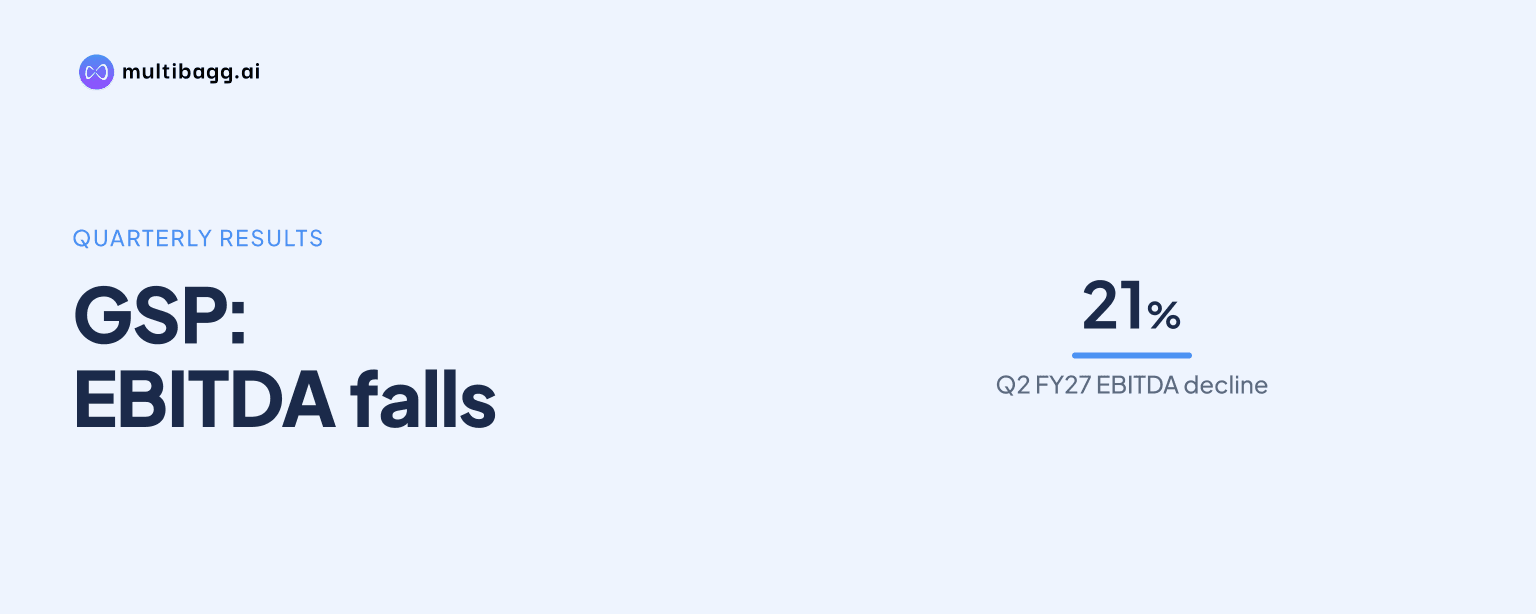
In Q2 FY27, GSP Crop Science Limited said it expects margins to recover towards normal levels in Q4 after EBITDA fell 21% to Rs 73.6 crore. Revenue rose 19.5% to Rs 558 crore, but management attributed lower profitability to higher raw-material, power and fuel costs, supply issues and a lower contribution from higher-margin products.
Know GSP Crop Science inside out
Results, valuation, peers and who's buying, in one view.
Why did GSP's Q2 profitability decline despite revenue growth?
GSP's Q2 FY27 profitability declined because cost increases and product mix outweighed higher revenue. Revenue from operations increased 19.5% year on year to Rs 558 crore, with growth led mainly by domestic business-to-business, or B2B, sales. Management said growth was largely realization-led, reflecting higher raw-material prices passed through in selling prices, while volumes increased in some products.
Earnings before interest, tax, depreciation and amortisation (EBITDA) fell 21% to Rs 73.6 crore in Q2 FY27 from Rs 93.2 crore a year earlier, taking the EBITDA margin to 13.2%. Profit after tax (PAT) fell to Rs 44.6 crore from Rs 58.5 crore. Management said gross margin declined as raw-material procurement costs increased, while power, fuel and annual manpower-cost escalation added to operating expenses.
Management apportioned about 50% of the margin pressure to raw-material costs. It attributed a further 20% to 30% to supply-chain-related costs or issues, with the remaining roughly 20% linked to other factors including lower sales of higher-margin products. This indicates that increased revenue did not convert proportionately into profit during the September quarter.
The first half showed a similar pattern. H1 FY27 revenue rose almost 12% to Rs 944 crore, but EBITDA declined to Rs 116 crore from Rs 135 crore and the EBITDA margin stood at 12.3%. PAT was Rs 71 crore. Management also said higher other income in H1 included gains from fixed-asset sales and foreign-exchange gains.
When does GSP expect margins to recover?
GSP expects Q3 FY27 to remain subdued and forecasts a recovery towards normal margin levels in Q4 FY27. Management said another quarter could face pressure, but it expects prices and overall realizations to improve in Q4 with the upcoming season forecast and the pre-placement period.
GSP also said EBITDA margin should improve sequentially in coming quarters, supported by products planned for the Rabi season and the Q4 pre-placement cycle. Management explicitly confirmed that it expects Q4 margins to be better than Q3. That outlook is management guidance rather than a reported result and depends on realizations, raw-material prices and seasonal demand.
The immediate demand backdrop remains uneven. Management said the domestic market was relatively satisfactory until July, but dry August and September conditions shifted companies and distributors towards liquidating existing inventories. Demand was subdued across B2B and business-to-consumer, or B2C, channels as market participants focused on reducing stocks.
Weather remains central to the Q3 and Q4 outlook. Management cited cumulative rainfall of about 87% of the long-period average and said conditions were particularly difficult in parts of Maharashtra, Karnataka, Andhra and Telangana. Farmers may delay sowing, and management observed crop changes of about 5% to 10% in affected regions towards shorter-duration or lower-water crops.
Got a follow-up? Ask IRIS
What products and operational measures could support GSP's margins?
GSP plans to support growth and margins through patented formulations, anchor brands and backward integration. Management said it launched a patented insecticide for the Rabi period and expects it to be positioned for current agro-climatic conditions. GSP is principally Kharif-focused, but said the new product and wider geographic penetration should help it perform better than last year during Rabi.
GSP's differentiated-formulation strategy combines existing and newer chemistries to address multiple farmer needs with one product. Management used chlorantraniliprole, an insecticide active ingredient, as an example of a chemistry for which GSP developed patented combinations after the underlying product went off patent. It said such combinations can reduce spray frequency or improve crop coverage.
Backward integration is another stated mechanism for reducing cost exposure. About 40% to 45% of GSP's raw-material requirement is imported from China, according to management. GSP has established a backward-integration plant, and its research and development, or R&D, team is developing opportunities to make active ingredients and technical products internally.
R&D investment currently amounts to about 2.5% of revenue, and management said it plans to increase this from next year as product development and backward-integration plans advance. Its three priorities over the next two to three years are expanding the domestic patented portfolio in B2B and B2C, generating returns from Brazil registration investments, and strengthening R&D-led backward integration of key technical products.
How do domestic demand and exports affect GSP's outlook?
GSP's Q2 growth was mainly domestic rather than export-led, and domestic B2B sales were the largest growth driver. That channel mix mattered because management said B2B growth came with substantial raw-material cost pressure, lowering gross profit margin and limiting the conversion of revenue growth into bottom-line growth.
Exports account for almost 20% of GSP's total business, and management targets a 25% contribution over the next three years. Latin America and Southeast Asia are the key export-growth markets. However, management said logistics, particularly vessel availability and longer transit times to Brazil, has constrained Indian suppliers, while Brazil has also faced weather-related issues.
GSP has operated a Brazilian subsidiary for three years, has built registrations and opened a small administration office for B2B activity. Management said it may take another one to two years to establish a platform to scale in Brazil and other Latin American countries, with Brazil serving as a base.
The export strategy is tied to patented products and intellectual-property protection. Management said international patent processes can take five to seven years and that it has pursued registrations for patented products for about three years. GSP plans to take formulations established in India into markets such as Brazil after securing registrations.
Conclusion
GSP's Q2 FY27 result shows that 19.5% revenue growth was insufficient to offset a Rs 19.6 crore year-on-year EBITDA decline, as raw materials accounted for about half of margin pressure and power, fuel, supply-chain issues and product mix added further costs. H1 FY27 EBITDA of Rs 116 crore, versus Rs 135 crore a year earlier, shows that the pressure extended beyond one quarter.
The next results will test management's expectation that Q3 remains subdued but Q4 margins improve. Investors should watch raw-material procurement costs, Rabi demand for the newly launched patented insecticide, pre-placement realizations, the 40% to 45% imported-material exposure and progress in Brazil, where management expects a scalable platform to take another one to two years.