










Hindustan Aeronautics Limited shares fall despite Q2 profit rise
Key highlights
- HAL's Q2 FY27 consolidated profit rose 16% year on year to ₹1,935.64 crore.
- HAL's Q2 FY27 revenue from operations increased 14.8% to ₹7,613.25 crore.
- HAL's EBITDA margin declined 70 basis points year on year to 22.8% in Q2 FY27.
- HAL shares fell as much as 4.2% after the results, despite being up 8.8% for the year at cited market levels.
powered by IRIS
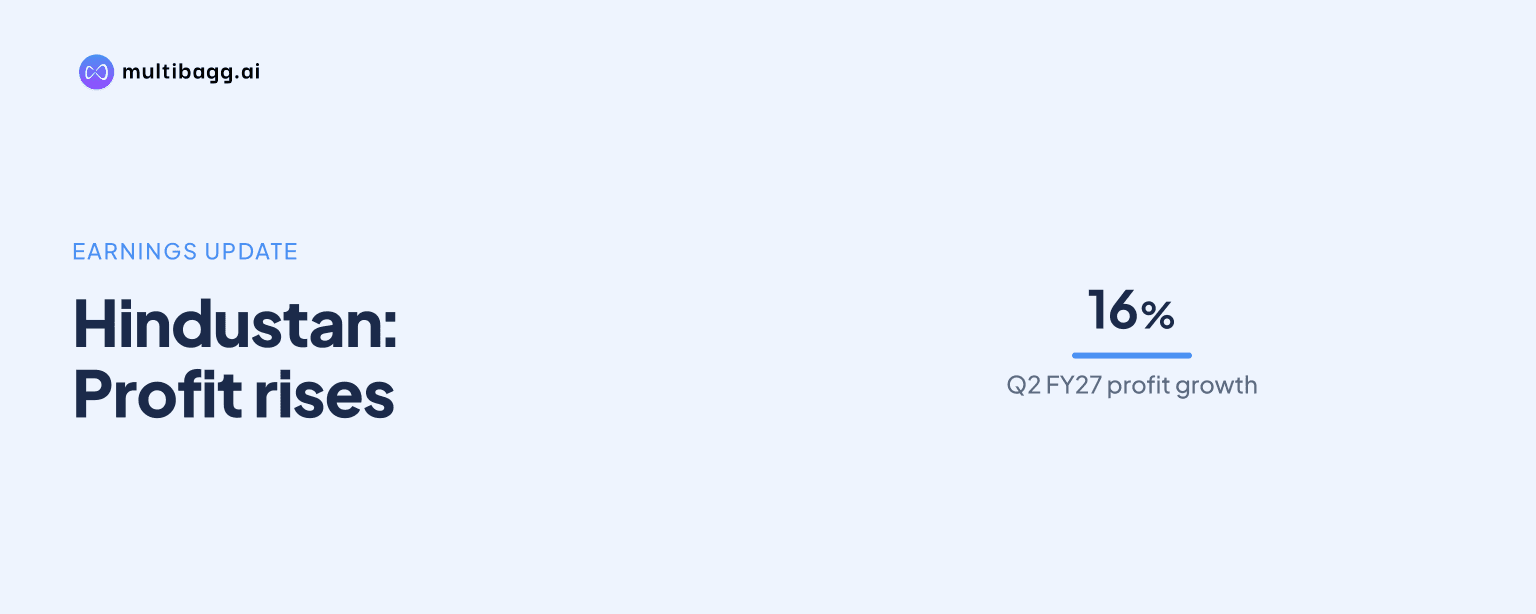
Hindustan Aeronautics Limited shares fell as much as 4.2% on November 12 despite Q2 FY27 consolidated profit rising 16% year on year to ₹1,935.64 crore, as investors weighed revenue growth against weaker-than-expected operating profitability and the timing of Tejas Mk1A deliveries.
Why did HAL shares fall after higher Q2 profit?
HAL shares fell because the market focused on operating performance and execution risks rather than the headline increase in profit and revenue. The stock declined as much as 4.2% to an intraday low of ₹4,736.60 on the NSE on November 12, even as the company reported results for the quarter ended September 30. It was down 2.1% on the following session cited in the market reports, before trading choppily on Friday.
The reaction reflected a gap between top-line growth and the operating metrics analysts were tracking. Revenue and profit were broadly supportive, but EBITDA was below the CNBC-TV18 poll estimate. Social-media discussion around the results similarly centred on whether HAL can convert its order book and higher inventory into aircraft deliveries, especially for the LCA Tejas Mk1A programme.
What did HAL report in Q2 FY27?
HAL reported 14.8% year-on-year revenue growth and a 16% increase in consolidated profit for Q2 FY27. Revenue from operations rose to ₹7,613.25 crore from ₹6,628.61 crore in the year-ago quarter, while consolidated profit after tax increased to ₹1,935.64 crore from ₹1,669.05 crore.
Operating performance was comparatively softer. EBITDA rose 11.6% year on year to about ₹1,738 crore, below the ₹1,855 crore poll estimate, while EBITDA margin declined 70 basis points to 22.8%. Gross margin fell 300 basis points year on year to 53%, a development HSBC linked potentially to an unfavourable product mix.
For the first half of FY27, HAL reported revenue growth of 15%, ahead of its full-year revenue growth guidance of 10.5% to 12%. Its first-half EBITDA margin was 24.9%, which was within the 23% to 26% analyst expectation range cited for the full year. Management's stated FY27 targets include revenue growth of 10% to 12% and an EBITDA margin of 30% to 31%.
Why are brokerages divided on HAL stock?
Brokerages are divided because revenue momentum and the order book support the medium-term outlook, while delivery execution remains the key near-term uncertainty. Nuvama retained a Hold rating and raised its target price to ₹5,250 from ₹5,040, saying near-term upside depends on LCA Tejas deliveries. Its revised target implied more than 8% upside from the referenced previous closing price.
Goldman Sachs retained a Buy rating with a ₹5,870 target, implying 21% upside, while Citi maintained Buy with a ₹6,175 target, implying 27% upside. Goldman Sachs said Q2 EBITDA missed estimates even as revenue and earnings per share were in line, and identified smoother F-404 engine supply from GE Aerospace as a key catalyst. Citi cited the Tejas Mk1A delivery ramp and better execution readiness as medium-term supports.
Other views were also constructive but conditional. HSBC retained Buy with a ₹6,350 target, Nomura maintained Buy with a ₹6,314 target, and CLSA retained Outperform with a ₹5,625 target. These targets are brokerage assessments rather than assured future share prices, and they show that the central disagreement is not over HAL's order pipeline but over the pace at which it can execute.
Got a follow-up? Ask IRIS
What does the Tejas Mk1A delivery schedule mean for HAL?
The Tejas Mk1A delivery schedule matters because brokerages see it as the main trigger for HAL's next phase of growth and for a potential change in market sentiment. Nuvama specifically tied near-term upside to deliveries, while HSBC expects deliveries to begin by the end of FY27. CLSA also identified the start of deliveries in the second half of FY27 as a potential catalyst.
Engine availability is closely linked to that timeline. Goldman Sachs said the dispatch of seven F-404 engines removed a major uncertainty and that smoother supply from GE Aerospace could support the programme. Jefferies said Tejas Mk1A represents 43% of HAL's order book, underlining why investors are paying close attention to the delivery ramp.
Inventory data has added another dimension to the debate. HSBC said inventory increased around 28% in the first half of FY27, potentially reflecting a build-up of LCA Mk1A airframes ahead of delivery. Citi cited a 39% year-on-year increase in inventory as a sign of rising execution preparedness. Higher inventory may support future dispatches, but the market response indicates that investors want evidence of completed deliveries.
How has HAL stock performed against the wider market?
HAL stock has outperformed the Nifty 50 so far this year despite the post-results volatility. At the market levels cited after the results, the stock was up 8.8% for the year, compared with a 4% fall in the Nifty 50. That relative performance helps explain why investors are scrutinising margins and execution closely after the quarterly release.
Friday trading illustrated the uncertainty. HAL shares moved between roughly ₹4,884 and ₹4,775.5, while one report said the stock fell as much as 1.4% to ₹4,772.3 on the BSE amid wider market weakness. Another market update placed the share price at ₹4,848.60, up 0.11%. The varied intraday moves showed that the results did not produce a clear one-way reaction.
Conclusion
HAL's Q2 FY27 numbers showed solid revenue and profit growth, but the share-price reaction placed greater weight on lower operating margins and the practical challenge of executing its large order pipeline. The difference between Nuvama's Hold view and the Buy or Outperform calls from several global brokerages reflects competing assessments of how quickly delivery readiness will become reported revenue and cash generation.
The next points to watch are the start and pace of LCA Tejas Mk1A deliveries, the continuity of F-404 engine supplies from GE Aerospace, and progress against FY27 guidance of 10% to 12% revenue growth and a 30% to 31% EBITDA margin. Investors will also watch whether elevated inventory converts into dispatches, as brokerages regard execution rather than order-book availability as the unresolved issue.