








Happy Square secured ₹52 crore H1 orders and extensions
MAX Plan at ₹4,999/yr

Find your next multibaggerBe a Pro Investor
Research stocks and track your picks on the go. Download the app.
Key highlights
- Happy Square secured about ₹52 crore of new orders and contract extensions in H1 FY27.
- Management identified defence and ISRO assignments among major government work orders in H1 FY27.
- Happy Square reported about ₹60 crore revenue, ₹3.2 crore EBITDA and ₹1.6 crore net profit in H1 FY27.
- VeeraAI was making 4,000 calls daily, with management targeting 40,000 daily calls by December 2026.
powered by IRIS
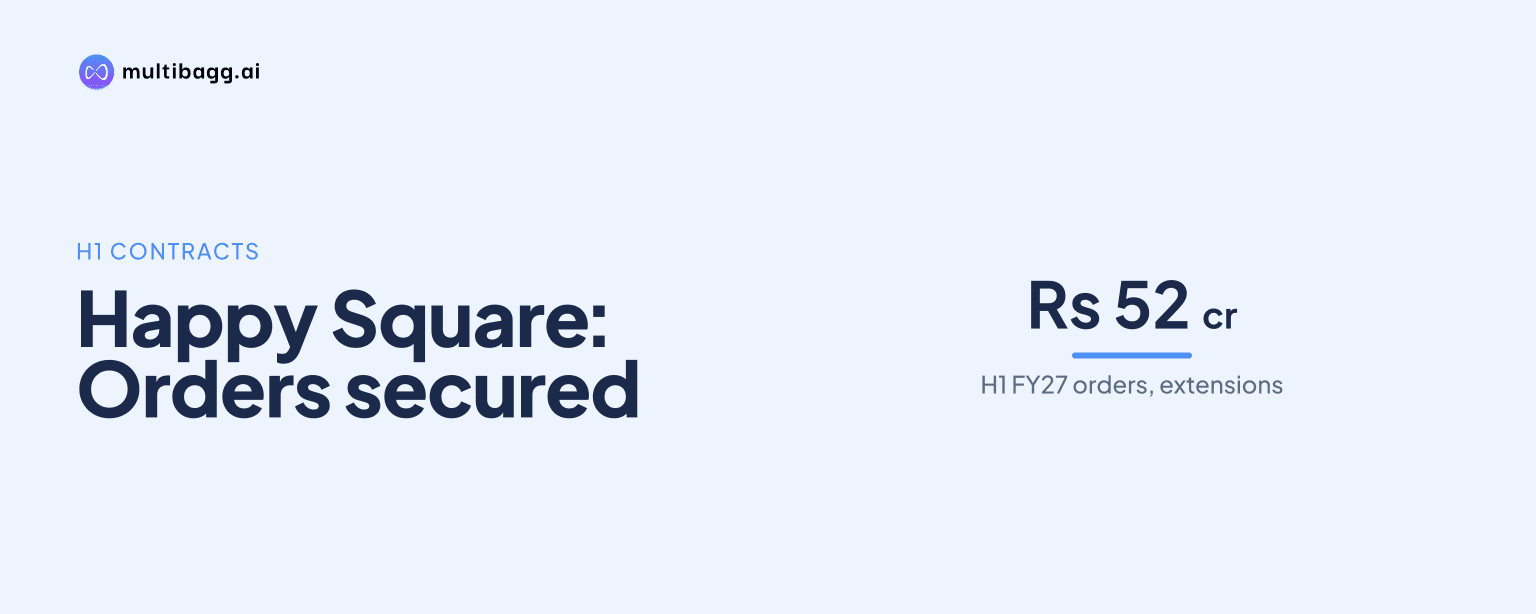
Happy Square Outsourcing Services Limited secured about ₹52 crore of new orders and contract extensions in H1 FY27, and management said defence and ISRO assignments were among major government mandates. The inflow, reported on the November 25, 2026 earnings call, accompanied about ₹60 crore of revenue from operations for the half year ended September 30, 2026.
Know Happy Square Outsourcing Services inside out
Results, valuation, peers and who's buying, in one view.
What did Happy Square win in H1 FY27?
Happy Square won about ₹52 crore of new orders and contract extensions during H1 FY27, which covered April through September 2026. Management said the inflow was driven by new tender wins as well as extensions with existing clients. It did not disclose individual contract values, award dates, tenure or the period over which the ₹52 crore of orders will be executed.
The ₹52 crore represents orders and extensions, rather than revenue recognised in the same six-month period. Happy Square reported about ₹60 crore in revenue from operations, earnings before interest, tax, depreciation and amortisation (EBITDA) of about ₹3.2 crore, and net profit of about ₹1.6 crore in H1 FY27. Management reported an EBITDA margin of about 5.3% and a net profit margin of about 2.7%.
The disclosed order inflow was close to Happy Square’s ₹60 crore H1 FY27 revenue base, but the call did not establish a direct conversion timetable between the two measures. Revenue recognition will depend on workforce deployment and delivery under each staffing, recruitment, payroll-processing or statutory-compliance mandate. Management said timely execution of new orders and extensions is its first stated priority.
Which government mandates supported Happy Square’s orders?
Happy Square’s major government work orders in H1 FY27 included defence and ISRO work, according to Chief Operating Officer Shailesh Rajpal. He said the company had built capability in the defence segment and had created a defence-category pipeline. Management did not disclose how much of the ₹52 crore total came from defence, ISRO or any other government assignment.
Rajpal also named HCL, Hindustan Copper Limited and MPPDCL in discussing work orders, alongside government and private-sector business. These organisations were cited in response to a question about the drivers of about ₹60 crore of H1 FY27 revenue, not as a contract-value breakdown. Accordingly, the transcript does not permit calculation of revenue or order inflow by government, public-sector or private-sector client.
Happy Square said it serves more than 200 clients across private, government and public-sector institutions through an asset-light model. Its operations cover more than 20 states, supporting multi-state workforce assignments. The company did not provide a state-wise split of its H1 FY27 ₹60 crore revenue or identify the locations where its defence and ISRO assignments are being delivered.
How important are contract extensions to Happy Square?
Contract extensions are material to Happy Square’s order activity because management said about 80% of clients have remained with the company for three to four years. The ₹52 crore H1 FY27 figure combined extensions and new orders, rather than separating their values. Happy Square did not disclose a renewal rate by contract value, client count or revenue.
Management cited Reliance as a large continuing client, without quantifying revenue from that account. Rajpal linked retention to hiring capability, the National Apprenticeship Program business, and an application through which clients can view attendance, productivity and performance. The company said it currently provides the app-based functions and online training to clients free of charge, while management said it could charge for them in future.
Happy Square also said it has more than 1 million registered candidates and around 5,000 live openings at a time on its in-house platform. Management said more than 1,000 candidates, and sometimes more than 2,000 candidates, apply for jobs daily and create résumés. Those data points describe the talent pool available to fulfil staffing mandates, although the call did not quantify their effect on client extensions.
Got a follow-up? Ask IRIS
How will Happy Square execute its new orders?
Happy Square plans to use its in-house VeeraAI automated agent to increase hiring capacity for new orders and extensions. Management said VeeraAI was making 4,000 calls a day as of the November 25, 2026 call and targeted 40,000 daily calls by December 2026. It said expanded use of that capacity was expected from January 2027, which remains a management target rather than a reported result.
Rajpal said VeeraAI can call candidates, assess their interest in a position and compensation, follow up on interviews, and help close an opening. He compared its 4,000 calls a day with a previous human-process capacity of roughly 500 to 2,000 calls daily. Management also said the company has a team of more than 250 people, with around 180 to 200 involved in front-line hiring.
Management’s stated objective is to meet a client requirement for 500 people rather than only partly filling it. It also expects lower human intervention after investment in VeeraAI to improve profitability in coming quarters. Happy Square did not disclose the amount invested in VeeraAI, expected cost savings, a margin target or the date by which it will assess the impact.
What could drive Happy Square’s H2 FY27 order inflows?
Happy Square said it intends to build on its order pipeline, especially among government and public-sector clients, in H2 FY27. Management described the pipeline as healthy but did not provide its value, number of tenders, bid-success rate or a schedule for converting bids into orders. The stated focus therefore indicates commercial priorities rather than a quantified H2 FY27 order forecast.
Alongside government opportunities, Happy Square said it had onboarded private-sector clients during the preceding six months, including Veera, AYUB Technology, Innovative and Ola Electrical. Rajpal said the company was targeting electric-vehicle clients, including two-wheeler and four-wheeler businesses, because of expected hiring needs in that segment. The call did not disclose orders, revenue or headcount associated with those named clients.
An analyst also cited receivables of ₹53 crore in H1 FY27, compared with ₹8 crore in FY23, while citing revenue of ₹126 crore versus ₹53 crore over that comparison. Management replied that its standard payment terms are generally 30 days and said it is focusing more on collect-and-pay arrangements. It did not provide debtor days, collection-day trends or a target for lowering receivables.
Conclusion
Happy Square’s about ₹52 crore of H1 FY27 new orders and extensions shows that tender wins and recurring client mandates both contributed to its workforce-solutions activity. Management specifically identified defence and ISRO among major government mandates, while H1 FY27 revenue was about ₹60 crore and EBITDA was about ₹3.2 crore.
The next disclosed milestones are management’s target to reach 40,000 VeeraAI calls a day by December 2026 and use that capacity from January 2027. Investors can also watch whether the government and public-sector pipeline converts into quantified orders, whether the ₹52 crore inflow is executed on time, and whether collect-and-pay arrangements affect the receivables issue raised during the call.

