








WOL3D launches Formlabs as resin capacity reaches 100%
MAX Plan at ₹4,999/yr

Find your next multibaggerBe a Pro Investor
Research stocks and track your picks on the go. Download the app.
Key highlights
- WOL3D is launching Formlabs resin printers at about Rs 1.5 lakh, versus an earlier minimum price of about Rs 6 lakh.
- WOL3D said its resin-printing production is operating at 100% capacity.
- WOL3D’s printing farm has about 10 to 20 resin printers and about 200 FDM printers.
- Management estimated India’s annual resin-printer market at about 600 to 1,000 units.
powered by IRIS
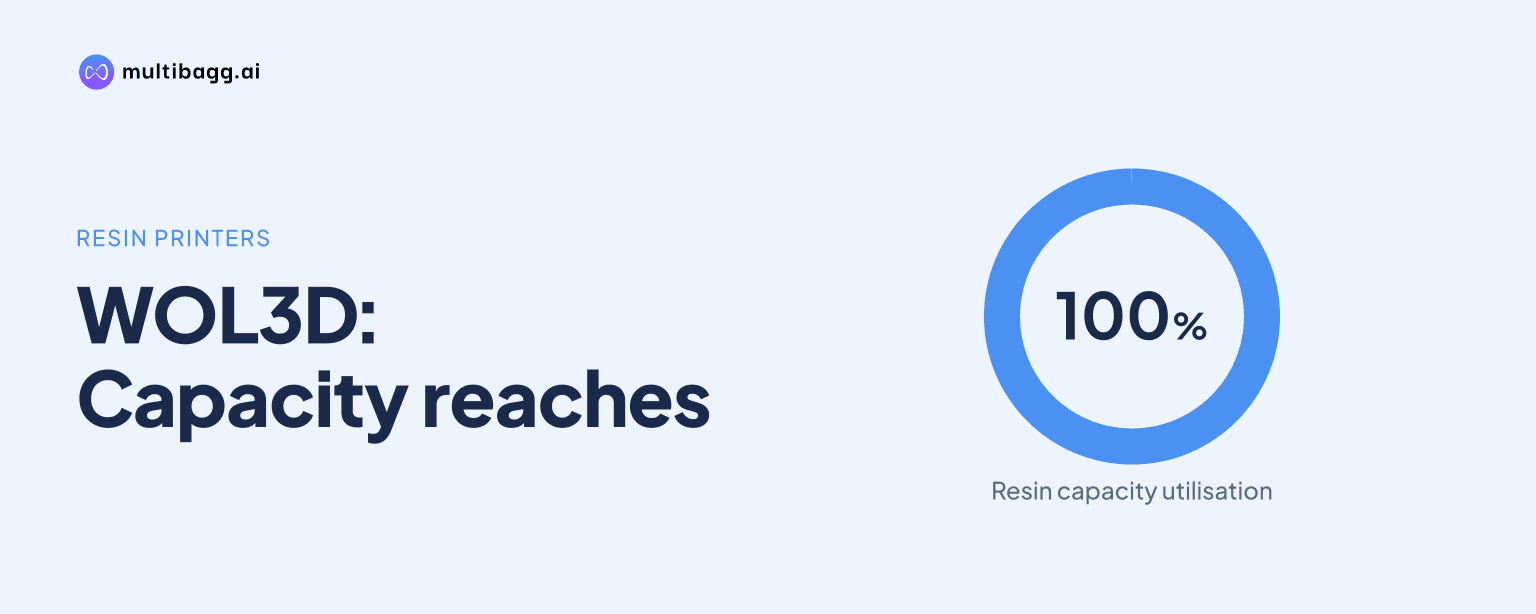
WOL3D India Limited is launching Formlabs resin printers at about Rs 1.5 lakh, compared with an earlier minimum resin-printer price of about Rs 6 lakh, while management said its resin-printing production is 100% utilised. WOL3D is positioning the lower-priced specialised machines for retail and business-to-business applications.
Know WOL 3D India inside out
Results, valuation, peers and who's buying, in one view.
What is WOL3D launching in resin printing?
WOL3D is launching the Formlabs brand in India with a prosumer-level resin printer priced at about Rs 1.5 lakh. Management described Formlabs as one of the leading stereolithography, or SLA, brands globally and said the product fills a gap between basic resin printers and higher-priced professional equipment. WOL3D uses the term prosumer for professional consumers seeking to upgrade their technology.
WOL3D had already been selling resin printers from Elegoo in India, but management said users were seeking better equipment that could use the same resin. The company said no prosumer-level option had previously been available in that range. Formlabs is therefore intended as an upgrade option rather than a replacement for WOL3D’s existing entry-level resin products.
The cited Rs 1.5 lakh price is about one-quarter of the earlier minimum price of about Rs 6 lakh cited by management. The difference is about Rs 4.5 lakh. This comparison reflects management’s description of the prior market entry point, not a sales forecast or a disclosed volume target for Formlabs.
Why is WOL3D targeting resin printing?
WOL3D sees resin printing as a specialised category for both retail and business-to-business, or B2B, users, including jewellery, dental work, miniature model making, smaller figurines and concept models. Management said the technology is more technical than other 3D-printing formats, creating an opportunity for the company to add value through its product offering and support.
Management estimated that India sells about 600 to 1,000 resin printers in a full year and described the segment as small. It said the Formlabs product can be used at home as well as commercially and is cheaper than the earlier minimum price point. The transcript does not disclose WOL3D’s resin-printer sales, Formlabs inventory, market share or target share of the estimated annual market.
WOL3D also cited wider advances in 3D printing, saying printer speeds have risen from an earlier 80 millimetres per second to 400 to 500 millimetres per second. That represents roughly five to six times the earlier speed. Management also referred to a progression from single-colour printing to four-colour and 16-colour output, though these comments concerned the wider technology market rather than Formlabs specifically.
Management said product quality matters alongside speed as users increasingly make end products using 3D printers. It referred separately to a printer that WOL3D expects to launch in December, using four filaments to produce cyan, magenta, yellow and key, or CMYK, shades. That proposed launch is distinct from the Formlabs resin-printer introduction.
Got a follow-up? Ask IRIS
Is WOL3D’s resin capacity fully utilised?
Yes, WOL3D said its resin-printing production is always 100% full, meaning its current resin capacity is fully utilised. The company operates a 3D-printing farm with about 200 fused deposition modelling, or FDM, printers and about 10 to 20 resin printers. FDM printing builds objects by depositing material layer by layer.
Resin machines represent a smaller part of the farm than the approximately 200 FDM printers, but management said WOL3D plans to increase the resin-printing category. The company did not disclose the number of additional resin printers planned, capital expenditure, or an expansion timetable. The 100% utilisation statement applies to resin production rather than to every printer in the broader farm.
WOL3D also said resin consumables have good margins, without quantifying the margin or their contribution to revenue. The reported full utilisation provides evidence of demand for its resin-printing service, but the call did not disclose the revenue generated by that capacity or the financial effect of adding more resin machines.
Will WOL3D manufacture resin in India?
No immediate domestic resin-manufacturing plan was disclosed because management said demand has not reached the capacity level needed to justify manufacturing. WOL3D currently uses original equipment manufacturing, or OEM, arrangements for its 3D resins. Management said it would consider production in India if it finds appropriate manufacturing partners.
Management linked this approach to its broader view that local 3D-printer manufacturing becomes viable only when Indian consumption is much larger. It contrasted potential sales of 20,000 printers in six months with overseas manufacturers producing more than 20,000 printers daily. That comparison concerned 3D printers generally, not resin consumables specifically.
If domestic production develops, management said it could involve an international brand and an Indian partner manufacturing together, with technical know-how held by the overseas company. WOL3D did not specify a resin-sales threshold, investment amount or date for a manufacturing decision. The disclosed arrangement remains OEM sourcing.
What other 3D-printing demand channels is WOL3D building?
WOL3D is testing retail demand for 3D-printed products near Mumbai’s Mahalaxmi Temple and Siddhivinayak Temple. Management said it is discussing product displays with stores in those areas. The plan is to create a case study in Mumbai before replicating the approach across India.
In modern trade, WOL3D said Crossword and D-Mart have placed repeat orders. Management described the category as being in a validation phase and said the D-Mart relationship has also helped the company enter more general-trade locations. The call did not provide order values, store counts or a timetable for completing this validation.
WOL3D also offers packages priced at Rs 2 lakh and Rs 3 lakh for people starting 3D-printing businesses. Management said college students, engineering graduates and people leaving corporate jobs are among buyers using printers commercially. These packages concern WOL3D’s wider entrepreneur market and are not the stated price of the Formlabs resin printer.
Conclusion
WOL3D’s Formlabs launch combines a stated price of about Rs 1.5 lakh with a resin-printing operation that management says is 100% utilised. The company’s expansion case rests on specialised applications including jewellery and dental work, an estimated Indian market of 600 to 1,000 resin printers annually, and sales of resin consumables alongside printers and printing services.
The next points to watch are whether WOL3D increases its current fleet of about 10 to 20 resin printers, whether Formlabs broadens adoption in the cited annual market, and whether management identifies a suitable Indian manufacturing partner. Management also plans to test retail displays near Mahalaxmi Temple and Siddhivinayak Temple before considering a wider rollout across India.

