








WOL3D sold 5,000 Lalbaugcha Raja miniatures in 11-day test
MAX Plan at ₹4,999/yr

Find your next multibaggerBe a Pro Investor
Research stocks and track your picks on the go. Download the app.
Key highlights
- WOL3D corrected Lalbaugcha Raja 2026 miniature sales to about 5,000 pieces over 11 days.
- The campaign used 10 LED street displays with a 30-second brand rollout every 3 minutes.
- WOL3D reported H1 FY27 revenue from operations of Rs 90.70 crore, up 118% year on year.
- Brahma prototyping revenue was approximately Rs 1 crore in H1 FY27, up 133% year on year.
powered by IRIS
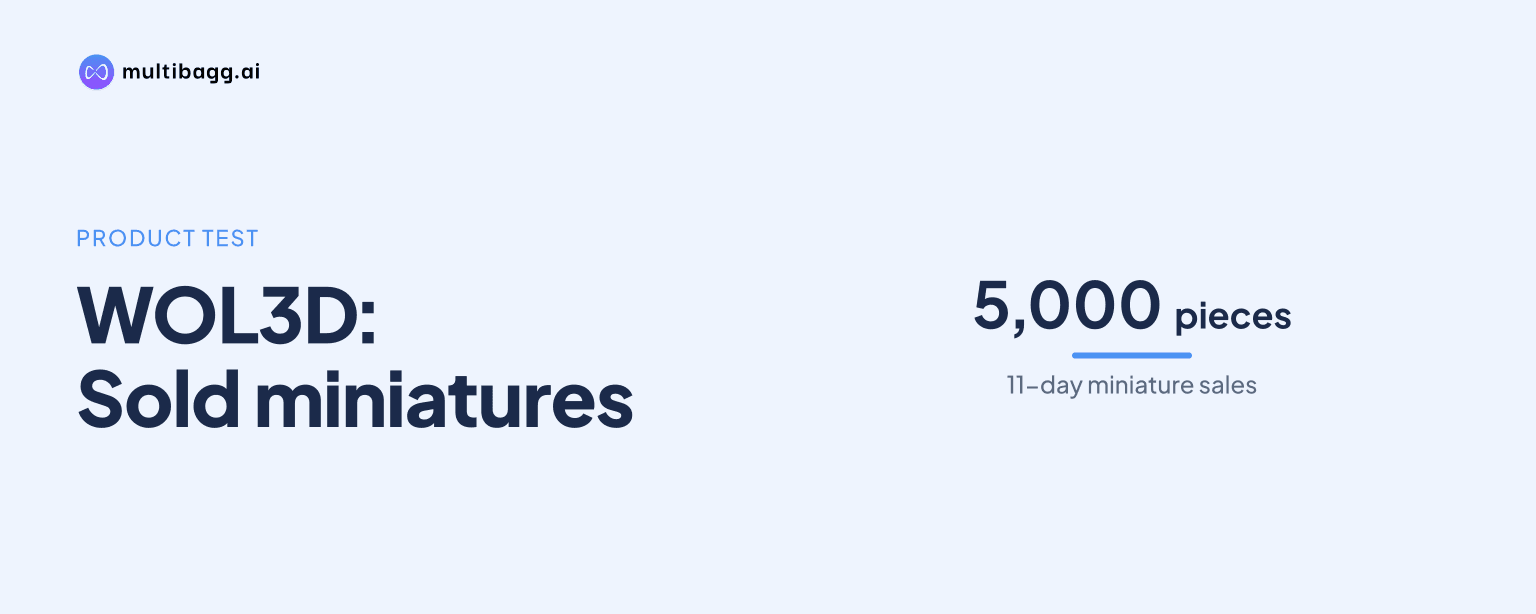
WOL3D India Limited sold about 5,000 3D-printed Lalbaugcha Raja miniatures during an 11-day 2026 festival campaign, marking its first test of the temple-idol market. Management said the corrected sales figure showed visitor interest in a standardised, coloured product and has prompted discussions with other temples about event setups and miniature supply.
Know WOL 3D India inside out
Results, valuation, peers and who's buying, in one view.
How many Lalbaugcha Raja miniatures did WOL3D sell?
WOL3D sold about 5,000 Lalbaugcha Raja miniatures during the 11-day 2026 celebration, according to corrections attached to the earnings-call transcript. The opening remarks initially said more than 8,000 3D-printed Bappa souvenirs were sold, while a later management response cited about 9,000 pieces. Both statements were specifically corrected to about 5,000 pieces.
The campaign was run under the theme “Aaye Ho Toh Bappa Ki Yaad Lekar Jao” and used WOL3D's Brahma 3D Printing Farm to manufacture the souvenirs. Management did not disclose campaign revenue, unit pricing, production cost or profit. The available result is therefore a volume measure for WOL3D's initial commercial test rather than a disclosed contribution to H1 FY27 financial results.
What was WOL3D testing in the temple-idol market?
WOL3D was testing whether 3D printing could support a branded and repeatable deity-idol offering in a market management described as largely unorganised. The company introduced the initiative under its Divine+ collection and said conventional idols are generally moulded or imported from China. Its stated objective is to provide consistent models, appearance and finish through stores across India.
Management said the Lalbaugcha Raja miniature replicated the main idol and was offered in two-colour and three-colour versions. It said 3D printing enabled intricate design and colour variation relative to standard moulded products. WOL3D did not disclose comparative manufacturing times, defect rates, repeat purchases, competing prices or the size of the addressable idol market.
WOL3D managed the miniature campaign through its own team after entering an official tie-up with the Lalbaugcha Raja mandal. The company also deployed 10 LED street displays on the main road for all 11 days, with a 30-second brand rollout every three minutes. The campaign therefore combined production, on-site sales and brand visibility in one festival-based operating test.
Why does the idol test matter to WOL3D's existing business?
The idol test matters because it uses WOL3D's Brahma prototyping operation, one of the businesses management is seeking to expand alongside distribution and filament manufacturing. In H1 FY27, prototyping revenue grew 133% year on year to approximately Rs 1 crore. Management also said Brahma creates interest among customers considering smaller printing-farm installations of 10, 20 or 30 printers.
WOL3D reported revenue from operations of Rs 90.70 crore for H1 FY27, up 118% year on year, while earnings before interest, tax, depreciation and amortisation, or EBITDA, rose 75% to Rs 8.10 crore. Profit after tax increased 69% to Rs 6.50 crore. The miniature campaign is small against the disclosed revenue base, but it tests a new application for Brahma's printing capacity.
Hardware remained WOL3D's largest disclosed business line, with revenue rising about 120% to Rs 78 crore in H1 FY27, compared with Rs 10.40 crore for consumables and about Rs 1 crore for prototyping. Management later described distribution as about 70% of revenue, consumables as about 13% to 14%, and Brahma prototyping as about 2%, showing that the idol initiative began from a comparatively small segment.
Got a follow-up? Ask IRIS
What could WOL3D do after the Lalbaugcha Raja campaign?
WOL3D said people from various temples approached it after the campaign to ask about working together, setting up at temple events and supplying 3D-printed deity miniatures. Management said it was already discussing another Lalbaugcha Raja campaign for the following year and assessing how the response could be extended. No temple agreements, launch dates, sales targets or capital requirement for Divine+ were disclosed.
The production platform is also being expanded. WOL3D commissioned its third filament manufacturing machine in July 2026, increasing capacity from 266 tonnes to 400 tonnes. Management said utilisation was about 80% to 85% and outlined a plan for six machines by FY27-end, which it said could raise annual capacity to about 800 to 900 tonnes.
Management estimated capital expenditure of approximately Rs 2 crore to add three filament machines, excluding the associated working-capital requirement. It said the Bhiwandi facility was designed to accommodate about 10 filament manufacturing lines, reducing the need for further real-estate investment if more machinery is added. The company did not connect this filament expansion directly to Divine+ production.
Retail expansion may provide a route for product discovery, although WOL3D did not say Divine+ products would be sold through its Experience Centers. WOL3D opened Pune's first experiential 3D-printing retail store at Kopa Mall with Creality and said it had 11 to 12 Experience Centers. Management said it was discussing additional flagship stores with suppliers, with international partners sharing working capital and rent for jointly opened locations.
Conclusion
The corrected result is that WOL3D sold about 5,000, rather than 8,000 or 9,000, Lalbaugcha Raja miniatures during its 11-day 2026 campaign. The test gives the company a customer-volume measure for its Divine+ concept and demonstrates a potential application for Brahma beyond conventional prototyping, but the call provided no revenue, margin or repeat-demand data for the idol venture.
The next developments to watch are management's discussions for a renewed Lalbaugcha Raja campaign and possible arrangements with other temples, neither of which had a disclosed timetable or target. Separately, WOL3D plans to reach six filament machines by FY27-end, while management said supplier rebates of 1% to 3%, generally received in January and February after targets are achieved, could support second-half margins.

