










WOL3D uses Brahma farm to sell 5,000-plus Bappa souvenirs
Key highlights
- WOL3D sold more than 5,000 3D-printed Bappa souvenirs during the 11-day Lalbaugcha Raja 2026 celebration.
- WOL3D listed Brahma as a 3D printer farm with more than 200 printers in 2025.
- WOL3D increased annual filament capacity from 266 tonnes to 400 tonnes in July 2026.
- WOL3D had 11 Experience Centres operating across India in 2025.
powered by IRIS
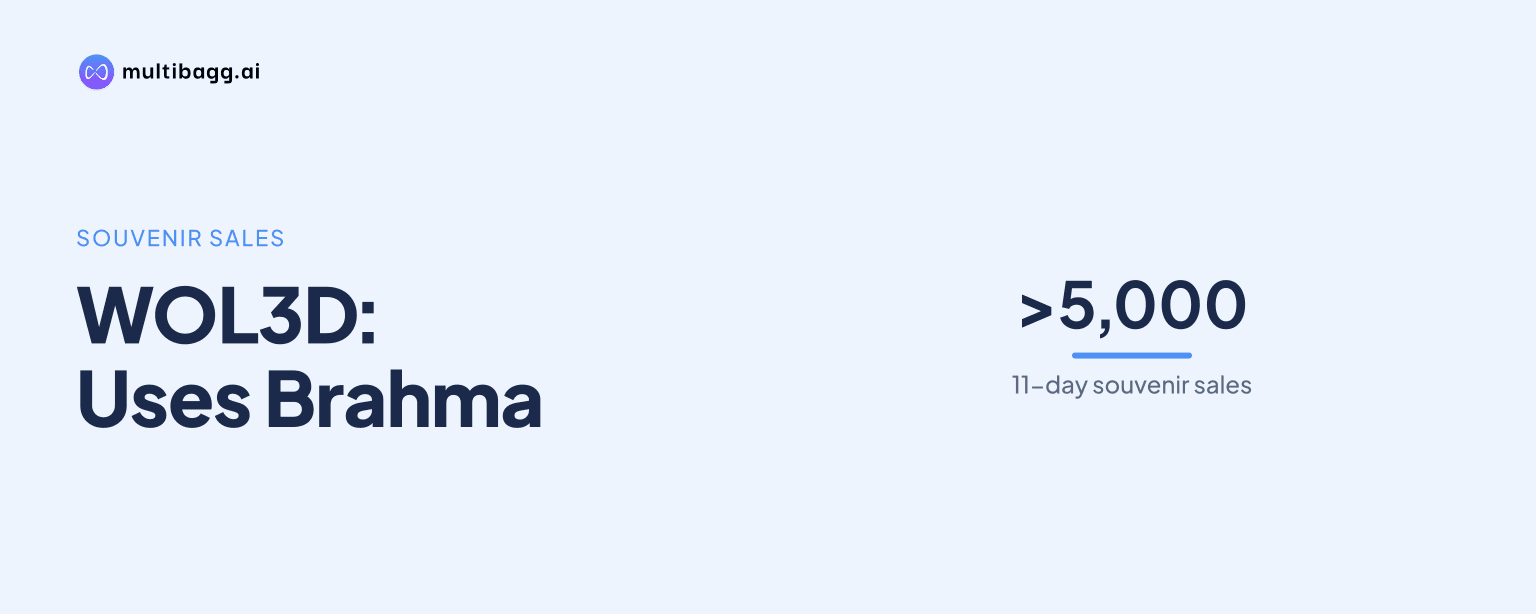
WOL3D India Limited sold more than 5,000 3D-printed Bappa souvenirs in 11 days during the Lalbaugcha Raja 2026 celebration, using round-the-clock manufacturing at its Brahma 3D Printing Farm. The campaign is the clearest disclosed evidence that WOL3D’s 200-plus-printer farm is being used for finished consumer products through its Divine+ deity-idol collection.
Know WOL 3D India inside out
Results, valuation, peers and who's buying, in one view.
How did WOL3D use Brahma for the Lalbaugcha Raja campaign?
WOL3D used Brahma to manufacture 3D-printed Bappa souvenirs 24 hours a day for its Lalbaugcha Raja 2026 campaign, “Aaye Ho Toh Bappa Ki Yaad Lekar Jao.” The campaign sold more than 5,000 souvenirs during the 11-day celebration. It is the presentation’s disclosed example of a high-volume, consumer-facing product application for the printing farm.
The campaign sits within Divine+, WOL3D’s deity-idol collection, and its stated move into deity idols and temple collaborations. It differs from a conventional printer or filament sale because WOL3D supplied a finished souvenir tied to a specific religious event. The presentation does not disclose campaign revenue, souvenir pricing, product dimensions or the number of units manufactured beyond the more-than-5,000 sold.
Brahma had more than 200 printers when WOL3D listed the facility among its 2025 business milestones. Multiple printers can produce items simultaneously, while 24-hour operations supported production through the 11-day Lalbaugcha Raja period. WOL3D does not state how many printers were assigned to the campaign, their utilisation rate or whether Brahma operated at full capacity.
What does Brahma add to WOL3D’s customised-product strategy?
Brahma gives WOL3D a production base of more than 200 printers for finished and customised products, alongside its printer and consumables businesses. WOL3D listed the farm in 2025 with Vinglits, described as India’s first 3D-printed toy brand. Divine+ in 2026 therefore extends the same manufacturing model from toys into deity-idol souvenirs.
WOL3D describes additive manufacturing, also called 3D printing, as building objects layer by layer. The company says the process offers design freedom, shape optimisation, reduced time to market and lower capital expenditure. It identifies manufacturing, education, engineering, architecture, interior design, fashion design, product design, healthcare and concrete as application sectors.
WOL3D has also participated in gifting exhibitions for four years to address adoption of 3D printing for customised products. The company positions gifting as a high-growth application segment, while the Lalbaugcha Raja campaign provides a disclosed event-linked product example. No sales figures are given for gifting exhibitions, Vinglits or Divine+, leaving the 5,000-plus Bappa souvenir sales as the only disclosed consumer-product unit measure.
Got a follow-up? Ask IRIS
How does Divine+ compare with WOL3D’s retail expansion?
Divine+ is a finished-product initiative made at Brahma, while WOL3D’s Pune retail format focuses on access to 3D-printing equipment and related products. In 2026, WOL3D and Creality opened Pune’s first experiential 3D-printing retail store at Kopa Mall in Koregaon Park. The store offers live demonstrations, product trials and expert guidance.
The Pune outlet carries 3D printers, filaments, scanners and laser engravers for students, creators, hobbyists, businesses and technology enthusiasts. By comparison, Divine+ delivered ready-made Bappa souvenirs, with more than 5,000 sold in 11 days. The retail store is designed to encourage technology adoption, whereas the Lalbaugcha Raja campaign demonstrates production of an end product.
WOL3D calls the Pune outlet the first milestone in its experiential retail expansion strategy and says it plans to expand the format across India. The presentation provides neither a future-store count nor a timetable. WOL3D had 11 Experience Centres operating across India in 2025 and says it conducts monthly student workshops across all Experience Centres.
Can WOL3D support further printer-farm production with filament capacity?
WOL3D increased annual filament manufacturing capacity from 266 tonnes to 400 tonnes after commissioning its third filament manufacturing machine in July 2026. The 134-tonne increase is intended to meet growing demand, improve production flexibility and provide headroom for scaling the consumables business, according to the company.
Filament is relevant to a printer-farm model because it is the feedstock used by many 3D printers. WOL3D identifies polylactic acid, thermoplastic polyurethane, acrylonitrile butadiene styrene and resins among 3D-printing materials. The company does not identify the material used for the 5,000-plus Bappa souvenirs or state whether Brahma obtains all of its materials from the expanded plant.
The increase from 266 tonnes to 400 tonnes is a disclosed operating-capacity change, but equivalent output measures are absent for Brahma. WOL3D does not disclose annual farm output, monthly idol or toy capacity, or printer utilisation. As a result, the presentation supports an assessment of one completed 11-day campaign, not a quantified forecast of Divine+ production or sales.
Conclusion
WOL3D’s sale of more than 5,000 Bappa souvenirs over 11 days shows Brahma being used as a production asset for finished consumer products rather than only as a 200-plus-printer installation. The 2025 Vinglits launch, four years of gifting-exhibition participation and the 2026 Divine+ campaign point to several customised-product applications built around layer-by-layer manufacturing.
The next disclosed development to watch is WOL3D’s planned expansion of its experiential retail format across India and the use of its 400-tonne annual filament capacity commissioned in July 2026. The presentation leaves unresolved whether Divine+ will add temple collaborations, whether festival demand will recur beyond the 11-day Lalbaugcha Raja campaign and how much of Brahma’s capacity these new applications will use.