










India reaches E20, while E22–E30 rollout remains unmandated
Key highlights
- India averaged 20.0% ethanol blending in petrol in ESY 2025-26, versus 19.2% in 24-25.
- Ethanol blending increased from 8.1% in 20-21 to 20.0% in 25-26*.
- BIS has notified E22–E30 fuel specifications, but no higher blending target or rollout timeline is confirmed.
- SONA reported an approximately 66% year-on-year decline in distillery sales in H1 FY27.
powered by IRIS
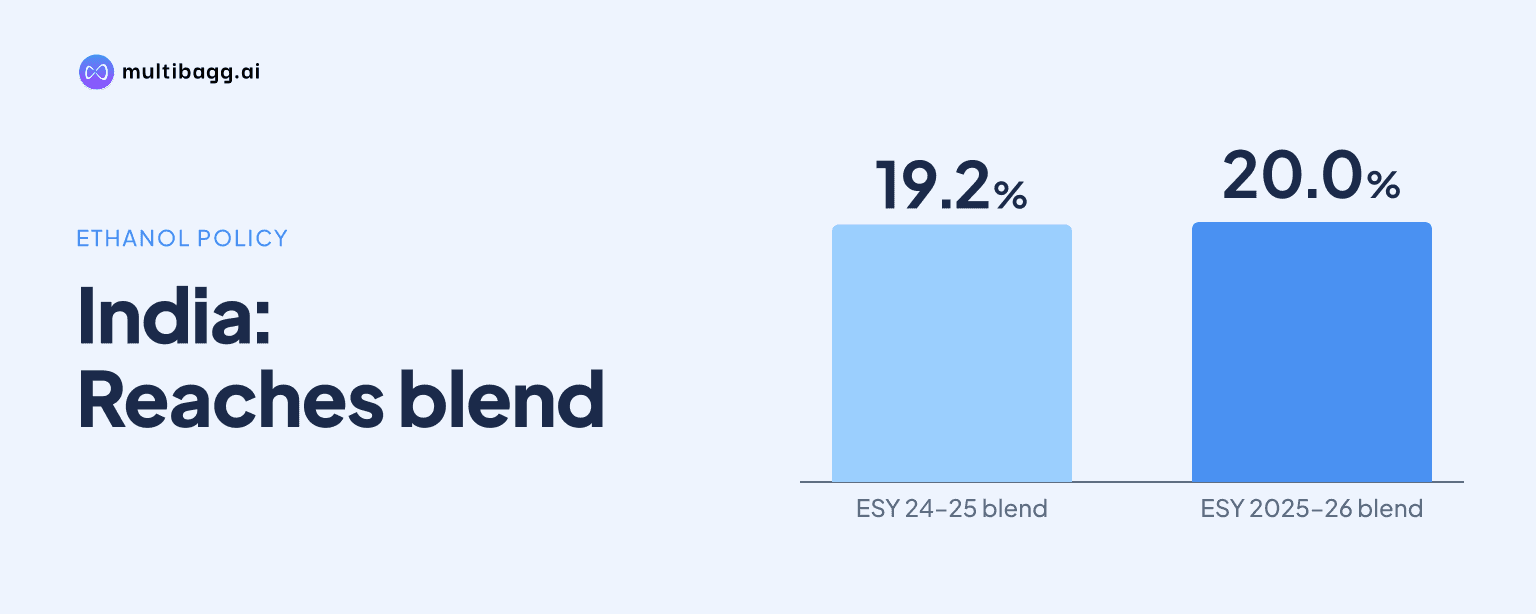
India reached 20.0% average ethanol blending in petrol in ESY 2025-26, but no higher blending target or rollout timeline has been confirmed for E22–E30. The presentation says BIS has notified E22–E30 fuel standards as specifications only, meaning adoption depends on future policy and vehicle compatibility.
Know Sona Machinery inside out
Results, valuation, peers and who's buying, in one view.
Has India reached E20 ethanol blending?
Yes. India recorded actual ethanol blending in petrol of 20.0% in ESY 2025-26, after reaching 19.2% in 24-25. The presentation defines ESY 2025-26 as November 2025 to June 2026, so the cited average applies to that stated period rather than a full financial year.
The E20 Blending Programme is a confirmed demand driver because nationwide E20 adoption provides a structural base for ethanol. The presentation also identifies crude-import substitution, feedstock diversification through maize and rice, and decarbonisation as drivers, but does not say that any blend above 20.0% has been made compulsory.
What do India’s E22–E30 standards establish?
India’s E22–E30 standards establish fuel specifications, not a required nationwide blending level or implementation schedule. BIS, identified in the presentation as Indian Standards, has notified the specifications, while the presentation explicitly says no higher blending target or rollout timeline is confirmed.
The presentation places E22–E30 in its potential long-term category, saying adoption depends on future policy and vehicle compatibility. It similarly identifies E85 for compatible flex-fuel engines, hybrid vehicles and sustainable aviation fuel pathways as potential opportunities rather than confirmed demand programmes.
That distinction has affected SONA’s ethanol-facing business. Management said ethanol-segment activity was subdued in H1 FY27 because policy uncertainty and limited clarity on the industry’s capacity-expansion roadmap led customers to put several proposed projects on hold, contributing to an approximately 66% decline in sales to distilleries from the corresponding prior-year period.
How quickly has India’s ethanol blending increased?
India’s petrol ethanol blending increased by 11.9 percentage points, from 8.1% in 20-21 to 20.0% in 25-26*. The increase was 4.6 percentage points between 23-24 and 24-25, followed by a smaller 0.8-point increase in ESY 2025-26.
The progression establishes E20 as the current policy-backed demand base described in the presentation. However, the source provides no volume target, procurement commitment or mandated blending percentage above 20.0%, leaving the size and timing of a subsequent capacity cycle unresolved.
The presentation also cites a projected compound annual growth rate, or CAGR, of 13.95% for the India ethanol market from 2026 to 2034E*. That market forecast is separate from a blending obligation: the same page says adoption of E22–E30 still requires future policy direction and vehicle compatibility.
Got a follow-up? Ask IRIS
What does no higher-blend mandate mean for ethanol capacity plans?
The absence of an E22–E30 mandate means capacity decisions beyond the E20 base remain dependent on policy timing and customer decisions. SONA said customers adopted a cautious approach in H1 FY27 and put proposed projects on hold, with distillery sales declining by approximately 66% from the corresponding period a year earlier.
Management said it remains positive about the sector’s longer-term prospects. It cited recognition of E100 as a fuel for certified flex-fuel vehicles and restrictions on sugarcane-based ethanol as regulatory developments that could encourage investment in alternative and hybrid ethanol capacity, creating potential opportunities for grain-based ethanol-processing machinery.
SONA has added electrical automation solutions, which management says account for about 20% of ethanol-project order value. The company describes this backward integration as a way to reduce costs and improve execution efficiency, but it does not resolve the disclosed uncertainty over when higher-blend policy could translate into customer capital expenditure.
How is SONA responding to uncertain ethanol investment?
SONA is pursuing cost rationalisation and diversification while targeting FY27 sales of Rs 90 crore. Management said fixed expenses fell by approximately 30% in H1 FY27 versus H1 FY26, plans further manpower rationalisation, and expects the full financial impact of these measures from Q4 FY27.
The company is also broadening its machinery offering. Rice-sector customer sales grew approximately 30% in H1 FY27 from the corresponding prior-year period, although management said total rice-segment sales remained below expectations as some key customers deferred investment decisions. SONA is expanding from 10 tonnes per hour, or TPH, capacity to complete solutions for 16 TPH rice mills.
Management’s FY27 objective is annual operating break-even alongside the Rs 90 crore sales target. It said lower business volumes reduced capacity utilisation and fixed-overhead absorption, producing an earnings before interest, taxes, depreciation and amortisation, or EBITDA, loss during the period; higher raw-material prices also added pressure.
Conclusion
India’s policy framework now separates an achieved E20 demand base from a possible but unconfirmed next phase of higher blends. The rise from 8.1% blending in 20-21 to 20.0% in ESY 2025-26 demonstrates the expansion of the existing programme, while notified E22–E30 specifications provide technical parameters without establishing compulsory incremental demand.
The next issue to watch is whether policy sets a higher-blend target and a vehicle-compatibility pathway, both of which the presentation identifies as necessary for E22–E30 adoption. For SONA, management’s Rs 90 crore FY27 sales target, annual operating break-even objective and expected Q4 FY27 benefit from cost actions are the disclosed operating milestones while distillery investment remains cautious.