










WOL3D launches Pune store for national retail format rollout
Key highlights
- WOL3D launched an experiential 3D printing retail store with Creality at Kopa Mall, Koregaon Park, Pune.
- WOL3D’s existing physical network includes 11 experience centres, five franchises and one manufacturing unit.
- WOL3D increased filament manufacturing capacity by 134 tonnes, from 266 tonnes in FY26 to 400 tonnes in H1FY27.
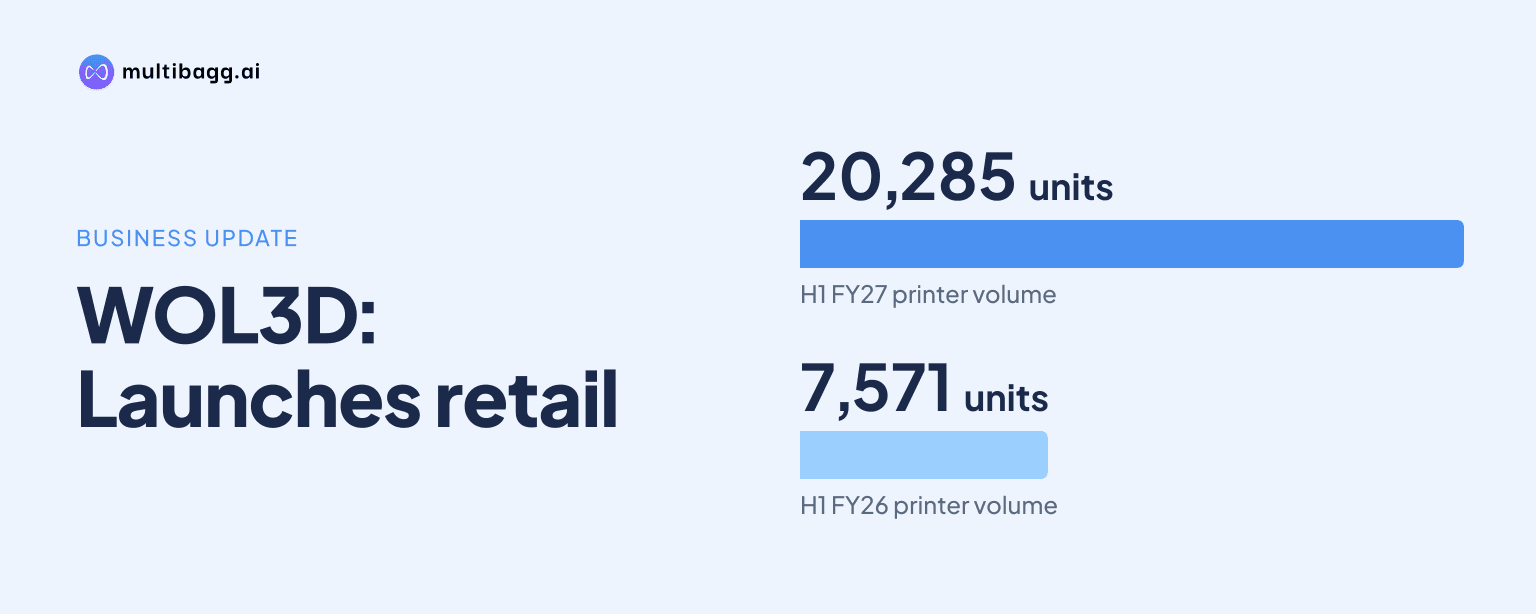
- WOL3D reported printer volume of 20,285 units in HIFY27, compared with 7,571 units in HIFY26.
powered by IRIS
WOL3D India Ltd. launched Pune’s first experiential 3D printing retail store with Creality at Kopa Mall, Koregaon Park, as the first step in a format it plans to scale across India. The rollout builds on an existing physical network of 11 branch-office-cum-experience centres and five franchises.
Know WOL 3D India inside out
Results, valuation, peers and who's buying, in one view.
What has WOL3D launched in Pune?
WOL3D has launched an experiential 3D printing retail store in collaboration with Creality at Kopa Mall in Koregaon Park, Pune. The company describes the outlet as Pune’s first experiential 3D printing retail store and identifies it as the starting point of its retail-expansion strategy. Its stated objective is to widen 3D printing adoption while strengthening its consumer-facing presence.
The presentation does not disclose the store’s opening date, floor area, investment, staffing, revenue target or sales terms with Creality. It also does not state whether the Pune store will operate as a company-owned outlet or under another ownership structure. What it does disclose is the intended direction: WOL3D plans to replicate the retail format across India.
The Pune initiative sits alongside WOL3D’s wider brand-building programme for 3D printers, filaments, scanners and other products. The company says it is using in-store displays, freebies and promotions, as well as Indiamart, Justdial, Google Ads, Facebook, Instagram and YouTube, to educate customers and handle queries through digital infrastructure. Its promotional material also advertised a six-day Mega Anniversary Dhamaka sale from October 12 to October 17, 2026.
How extensive is WOL3D’s current retail and distribution network?
WOL3D’s disclosed offline network comprises one manufacturing unit, 11 branch-office-cum-experience centres and five franchises. Its listed locations are Ahmedabad, Rajkot, Bhiwandi, Mumbai, Pune, Nagercoil, Delhi, Indore, Hyderabad, Vijayawada, Bangalore, Chennai, Coimbatore, Kolkata and Guwahati, giving the company an operating presence across 15 named cities.
The new Pune store therefore adds a dedicated retail-format initiative to a network that already includes experience centres and franchises. WOL3D also sells hardware and consumables through Flipkart, Amazon, Reliance Digital, Blinkit, IndiaMART, FirstCry, Snapdeal, Moglix and Crossword. This distinguishes the planned experiential retail rollout from its existing mix of physical locations and third-party sales platforms.
WOL3D says it plans both to establish new experience centres and expand existing ones across India, with an objective of having a presence in every state. Each centre is expected to span about 1,000 to 1,500 square feet and is intended to help customers align requirements with the company’s product offerings. The company also recently expanded its warehousing and manufacturing space in Bhiwandi, Maharashtra, although it provides no area or capital-spending figure for that expansion.
Got a follow-up? Ask IRIS
Which products and customer uses will WOL3D’s retail format support?
WOL3D’s hardware range includes 3D printers, 3D pens, 3D scanners and laser engravers. It is an authorised distributor for brands including Creality 3D, Flashforge, Bambu Lab, Phrozen, Elegoo, UltiMaker and Tvasta. WOL3D states that it holds a 60% to 70% market share in India, although the presentation does not define the measure, period or source for that estimate.
The product range also includes filaments and resins manufactured or offered through WOL3D’s Bhiwandi operations. Its resin range includes high-transparency, wax-like, dental, engineering, glow-in-the-dark, castable and water-washable products. In prototyping services, gifting models for pharmaceutical and other customers represent 30% of the disclosed work mix, ahead of new-product-development prototypes at 20%, while aerospace and defence and healthcare each account for 12%.
The retail strategy is also linked to newer consumer offerings. WOL3D is broadening its consumer ecosystem through Vinglits, described as India’s first 3D-printed toy brand, and Divine4, described as India’s first 3D-printed deity idol collection. Both are supported by the Brahma 3D Printer Farm, which has more than 200 printers operating 24 hours a day for batch manufacturing, on-demand customisation and prototyping without a minimum order requirement.
What operating capacity supports WOL3D’s planned rollout?
WOL3D reported printer volume of 20,285 units in HIFY27, compared with 7,571 units in HIFY26, and presents the increase as 168%. The reported HIFY27 volume was also above the 19,609 units shown for FY26, although the presentation uses different reporting periods and does not explain the HIFY labels.
Filament manufacturing capacity increased from 266 tonnes in FY26 to 400 tonnes in H1FY27 after WOL3D commissioned a third filament manufacturing machine. That is an addition of 134 tonnes, which WOL3D says reduces dependence on third-party suppliers and provides capacity headroom for its consumables business. Capacity is a measure of potential output rather than a disclosure of actual production or sales.
Beyond physical capacity, WOL3D says it is pursuing workflow digitisation, customer relationship management (CRM) integration and sales-force automation to improve execution and scalability. It also cites talent acquisition, leadership development and organisational capability as priorities. These initiatives form part of its growth plan, but the presentation gives no budgets, completion dates or quantified cost savings.
Conclusion
WOL3D’s Pune launch moves its consumer strategy toward a dedicated experiential retail format, supported by 11 experience centres, five franchises and multiple online channels. The plan combines hardware distribution, 400 tonnes of filament capacity, consumer products including Vinglits and Divine4, and the Brahma Farm’s more than 200 printers.
The next point to watch is execution of WOL3D’s stated plan to establish and expand experience centres across India, with a presence sought in every state and a typical centre size of 1,000 to 1,500 square feet. The presentation leaves the rollout timetable, number of future stores, ownership model, capital requirement and financial contribution from the Pune format unresolved.