








WOL3D targets 60:40 mix as higher-margin units expand
MAX Plan at ₹4,999/yr

Find your next multibaggerBe a Pro Investor
Research stocks and track your picks on the go. Download the app.
Key highlights
- WOL3D said distribution contributes 70% of revenue, while consumables contribute about 13%-14% and Brahma prototyping about 2%.
- WOL3D plans to lift filament capacity from 400 tonnes to about 800-900 tonnes by FY27-end.
- Management said current 400-tonne filament capacity is operating at about 80%-85% utilisation.
- WOL3D estimates about Rs 2 crore of machinery capital expenditure to add three filament machines.
powered by IRIS
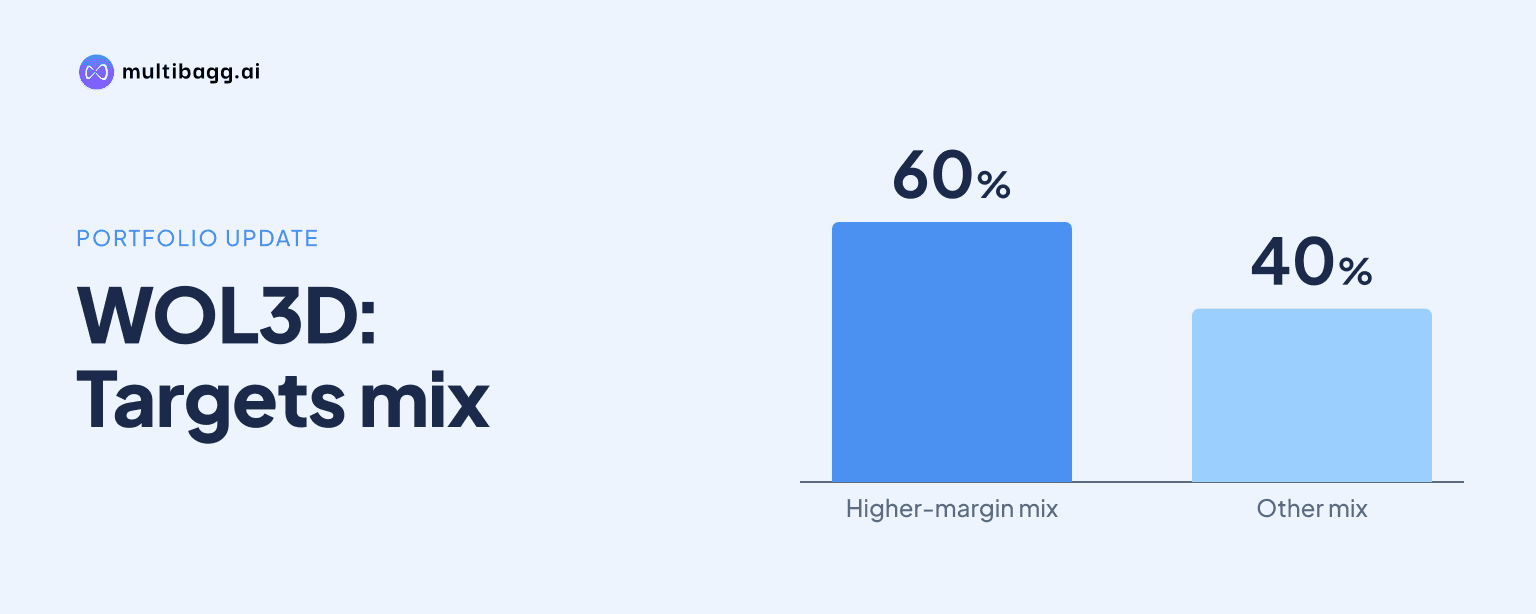
WOL3D India Limited is targeting a 60:40 revenue mix between distribution and its filament and Brahma prototyping businesses, compared with distribution’s current 70% contribution. Management’s plan depends on raising filament capacity from 400 tonnes to about 800-900 tonnes by FY27-end and expanding businesses it said have 40%-50% margins.
Know WOL 3D India inside out
Results, valuation, peers and who's buying, in one view.
How is WOL3D changing its revenue mix?
WOL3D is seeking to grow filament and Brahma faster than distribution while retaining growth in printer distribution. Management said distribution currently accounts for 70% of revenue, consumables account for about 13%-14%, and Brahma prototyping contributes about 2%. Distribution includes trading in 3D printers and the associated service and spare-parts ecosystem.
The target is a 60:40 balance, rather than a 50:50 split, between distribution and the other businesses. Management said a 50:50 mix would be difficult because distribution has a higher value per transaction, whereas filament and Brahma transactions have lower individual values. It said distribution is not declining and continues to grow alongside the internally developed operations.
WOL3D said consumables generated about Rs 11 crore of revenue and had grown by about 100%, while prototyping had grown 133%. Management identified those growth rates as the route to a different revenue composition, rather than any reduction in printer distribution. The disclosed segment percentages do not fully reconcile to 100%, because management also referred to other products and activities.
Why are filament and Brahma important to WOL3D?
Filament and Brahma are important because management said the two businesses generate margins of 40%-50% and can contribute more to net profit than distribution. It described filament as intellectual property developed by WOL3D, supported by suppliers, a trained manufacturing team and its distribution network across India. Management expects additional raw-material manufacturing to raise margins by year-end.
WOL3D has raised filament capacity from 144 tonnes previously to 400 tonnes through its third machine. Management said the present 400-tonne capacity is operating at about 80%-85% utilisation, but daily demand exceeds daily production. It said that mismatch has created delivery delays for raw materials and supports the need for further capacity additions.
Brahma is WOL3D’s printing-farm and prototyping operation, which management said had delivered good results over the previous six months. The company also sees a link between Brahma and hardware sales: customers exposed to printing farms may build smaller facilities with 10, 20 or 30 printers. Such farms could generate printer sales and recurring filament demand.
What filament expansion is WOL3D planning?
WOL3D plans to operate six filament machines by FY27-end, which management said could increase annual capacity to about 800-900 tonnes from 400 tonnes. The company estimated machinery capital expenditure of about Rs 2 crore for the additional three machines. Management separately noted that working-capital needs will rise because more raw material must be held for higher production.
The Bhiwandi facility was built to accommodate about 10 filament-manufacturing lines, according to management. That means expansion beyond the current three lines mainly requires machinery investment rather than new real-estate expenditure. WOL3D did not disclose either a timetable for reaching 10 lines or a capital budget beyond the approximately Rs 2 crore cited for three additional machines.
Management linked the expansion to the rising installed base of 3D printers in India, which it expects to increase monthly and daily filament consumption. WOL3D did not provide a forecast for filament prices, unit volumes or utilisation once the 800-900-tonne capacity level is reached. The disclosed 80%-85% utilisation therefore remains the available indicator of existing demand.
Got a follow-up? Ask IRIS
How will retail partnerships support WOL3D’s plan?
WOL3D is using experience centres and jointly supported flagship stores to widen consumer access to 3D printers. Management said it had about 11-12 experience centres and had opened an experience centre in Pune. It plans to focus on leading malls in metro cities, where it expects higher walk-in traffic and better visibility for 3D-printing products.
Management cited Kopa Mall as an example of direct retail demand, saying customers had bought printers priced at Rs 30,000, Rs 40,000 and Rs 50,000. WOL3D also said it is discussing flagship-store opportunities with international brands including Creality, Bambu Lab, Elegoo and Snapmaker. Under this model, the supplier and WOL3D share investment, working capital and rental costs.
WOL3D said it expects some results from mall-store discussions within the next six months, but did not disclose a numerical outlet target for FY28. It has also hired national sales head Pradeep Gangurde, who has more than 17 years of experience, to develop offline and online sales. A marketing head is overseeing brand presentation and more than 20 exhibitions across India.
Can Brahma develop a printed-products business?
WOL3D is testing 3D-printed miniature products through Brahma in addition to its prototyping work. At the Lalbaugcha Raja event, the transcript initially stated sales of about 9,000 pieces over 11 days, but a footnote corrected the figure to about 5,000 pieces. The corrected 5,000-piece figure is the disclosed result for the campaign.
Management said the campaign was intended to test demand for consistent, branded 3D-printed religious miniatures. It said the event included 10 LED street displays that ran a 30-second WOL3D promotion every three minutes for 11 days. Management is discussing a campaign for the following year and said other temples have approached the company about potential arrangements.
WOL3D also identified branded miniatures, bobbleheads and souvenirs as possible future applications for its printing-farm capacity. Management said such activity would require greater capacity, working capital and marketing investment. It referred to international brands such as Disney offering 3D-printed products in the US and Europe, while stating that WOL3D currently has capacity constraints in serving similar demand.
Conclusion
WOL3D’s 60:40 target is a plan to alter the composition of growth rather than replace distribution, which still contributes 70% of revenue. Filament capacity of 400 tonnes, current utilisation of about 80%-85%, consumables revenue of about Rs 11 crore and the reported 133% prototyping growth form the operating basis for management’s push into filament and Brahma.
The next disclosed milestones are the six-machine filament plan, which could take capacity to about 800-900 tonnes by FY27-end, and expected progress from mall-store discussions within six months. Execution will depend on whether WOL3D can maintain demand as capacity rises, fund the associated working capital and convert Brahma’s product trials into repeatable sales.

